
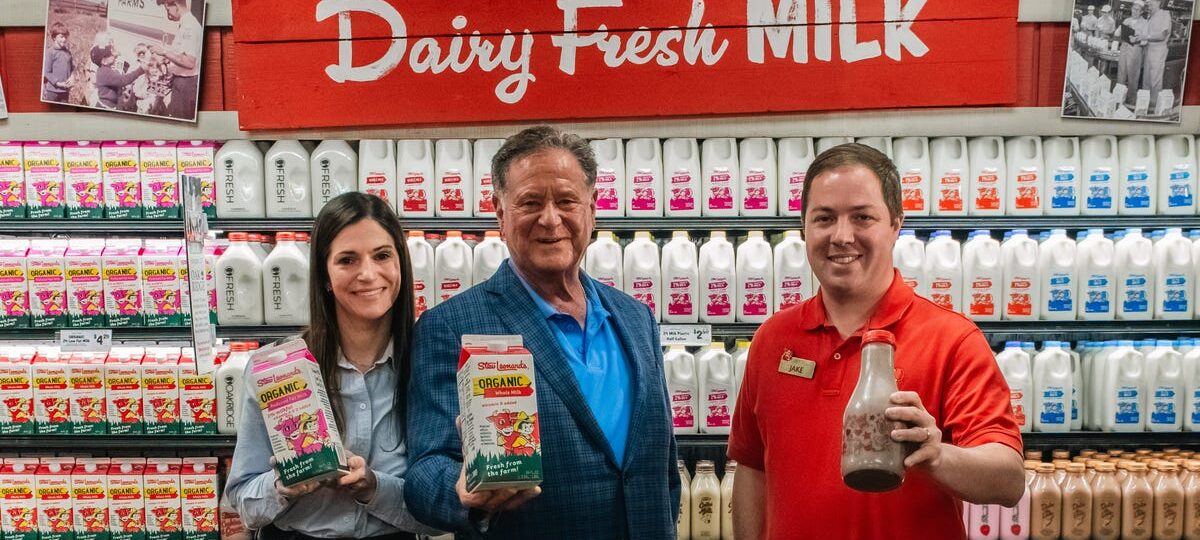
Stew Leonard Jr. is greeted like a celebrity as he makes his way through his family’s business.
Known as Connecticut’s “Disneyland of grocery stores,” Leonard’s locations come complete with animatronics, petting zoos, and costumed mascots.
Every few feet, a customer does a double-take and rushes over.
Mostly, they want to say hello or ask for a selfie.
A few have constructive criticism to share.
Over by the Stew Leonard’s Farm Fresh Five, a band of singing milk cartons, a mom with two young kids approaches him.
She has an idea to make the restrooms more family-friendly, showing a picture of a rest stop bathroom with child-sized toilets and superior design.
Stew Jr. tells her to forward the picture to his team.
Stew Jr. has been president of the small-but-mighty grocery empire since 1982, for 44 of the company’s 57 years.
He moves with the ease of a graduating senior walking their high school halls: He knows where everyone and everything is, and they know him.
But Stew Jr. won’t be the face of Stew’s for much longer.
Walking with Stew Jr., but going mostly unrecognized, are his successors.
His daughter, Blake Leonard, 41, will step in as president, and his nephew, Jake Tavello, 38, will take over as CEO.
Blake is more likely to hop into photos with her father, while Jake — outfitted in a store uniform — more quietly hovers behind the lens.
Stew Jr. has been the heart and soul of Stew Leonard’s for decades — not only its president and CEO, but the literal continuation of its namesake and the person loyal customers know and trust.
Blake and Jake will not only be taking over a quirky, beloved chain.
They’re hoping to become a case study in how family businesses can remain successful — and stay in the family — as they’re passed down through generations.
It’s a challenge familiar to millions of Americans.
More than half of US business owners are over the age of 55, at a time when America is about to undergo a Silver Tsunami — a once-in-a-generation transfer of wealth.
For family businesses, it’s even more fraught, since the third generation is seen as the inflection point for a family business, with one famed research paper finding that 30% of firms make it to the second generation, 13% make it to the third, and just 3% to the fourth.
For Stew Leonard’s, the transition is a delicate process, and the family has planned a meticulous handover spanning four years. “I have devoted my life to this.
I grew up here, literally, as a little kid,” Stew Jr. said. “I would be devastated if the next generation didn’t carry the torch.” Stew Leonard’s is a Connecticut institution.
A decade ago, this very publication proclaimed it the best grocery store in America, and its lore has only grown since.
It’s become a go-to destination for TikTokers.
In 2024, it was featured on “The Bachelorette,” when contestant Jeremy Simon tried to woo Jenn Tran, the titular bachelorette, by bringing her to the store during their visit to his hometown. “I think there were probably a few people who thought it was kind of weird, like, ‘Why would he take you to a grocery store?” Simon tells me when I reach him by phone.
But fans responded that “this looks like the coolest grocery store ever — and they love the date,” he says.
Today, the chain has eight locations in Connecticut, New York, and New Jersey, and employs over 2,500 people.
All stores are built around the same design concept, first dreamed up by Stew Leonard Sr.: a single, one-way aisle (think: Ikea) with the star of the show, the dairy section, arriving halfway through.
Disneyland was an inspiration when Stew Leonard Sr. founded the company, and there are still numerous references to be found.
Workers dress up as Clover the Cow and Stewie the Duck (When I visited the flagship location in Norwalk, the store advertised character meet-and-greets with its own characters, as well as Paw Patrol and Disney favorites.) A life-size rendering of Stew Sr. in a dairy truck waves at shoppers as they enter the store, much like the iconic statue of Walt Disney and Mickey Mouse that greets visitors to the Magic Kingdom.
But while Disney started as a family-run company under Walt and his brother Roy, it went public early in its history, and leadership moved beyond the family after the second generation.
Stew Leonard’s, which is privately owned and employs six third-generation family members — including three recent third-generation promotions — hopes to remain in the family’s hands.
The first time Stew Leonard’s was passed down, back in 1982, Stew Jr. wasn’t given much of a choice.
He remembers his father taking him out to the store’s famed rock, etched with the company’s ideals: “Rule 1: the customer is always right!
Rule 2: If the customer is ever wrong, read rule 1.” There, Stew Sr. had informed him that he was being named president of the family business.
Never mind that Stew Jr., who was 27 and fresh out of business school at UCLA, had gone to California to get away.
He was still considering a pivot to something like Microsoft or Apple.
His father had decided on a different path. “Oh, by the way, congratulations,” is how Stew Sr. framed the promotion that would rewrite the path of his son’s life. “I was like, ‘Whoa, what?
Wow, thanks,” Stew Jr. tells me. “It wasn’t like, ‘Sit down, let’s talk about your new compensation package.
Or, here’s your new duties that you’re supposed to do.'” Still, Stew Jr. took up the mantle and never looked back.
He further professionalized the company’s “chaotic and unorganized” culture and created the governance structure that undergirds the coming transition, mandating that Leonard family members aren’t allowed to work for the company for at least two years after graduating from college.
Then, in 1991, Stew Sr. was arrested and later imprisoned for tax fraud in 1993.
Stew Jr. told Westchester Magazine in 2015 he remembered when he received the call that IRS agents had arrived at the Norwalk location, “it was like when JFK was shot, you remember exactly what you were doing.” With his father in prison, Stew Jr. was thrust into the role of CEO.
Despite the upheaval, he’s opened six new locations, including some in (gasp) New Jersey.
It’s hard to tell exactly how much the grocery empire has raked in — Stew Leonard’s isn’t a publicly traded company — but the Hartford Business Journal reported that revenue was $116 million in 1991.
Per the store’s PR, revenue now sits around $550 million.
And, when it came time for him to retire, Stew Jr. was determined to do better.
Alejandro Cárdenas Villa, a family-enterprise attorney and the author of “Legacy Traps: Why Family Businesses Fail And How To Protect Yours,” said that family businesses have five specific make-or-break risks to account for.
They need to be able to constructively address conflict, establish governance structures and objective performance measures, ensure that family members are not dependent on the business, and that those who are actually involved are trained to understand the business.
At least some of those considerations seem to be top of mind in Stew Jr.’s slow stepping away. “It’s probably the hardest thing to have your kids work for you because on one hand you want to act like a dad to them, but on the other hand, you have to be a boss,” Stew Jr. said.
He says you never want to force your kid or family back into the family business.
Ideally, you want to present it as somewhere exciting for them to land.
His other difficulty: letting go. “I just really want to never go away,” he says, “I don’t think I’ll go away, but I have to let the leash out.” Blake, the oldest of Stew Jr.’s four daughters — Stew Leonard III, her brother, drowned as a small child — was never told outright that the stores would be her future.
Life as a kid was shaped by visits to the store and the stories her father would bring home from work.
Playdates with friends would include dressing up in cow or duck costumes.
During sleepovers on the floor above the store, Blake and her friends would be awoken at 4:30 in the morning by the dulcet tunes of Cindy Celery and Larry Lettuce, animatronics perched over the produce section.
At the age of five, Blake was put to work putting sprinkles on ice cream cones.
If the business had been less tactile, Blake isn’t sure she’d be as passionate.
But the grocery stores were a special, physical place.
That didn’t mean Stew’s felt pre-ordained.
As she got older, Blake’s interest turned to wine.
After college, she spent a decade working her way up in the wine industry, becoming a certified sommelier and working in New York City and California.
As her career progressed, she didn’t know whether she would end up back at the family business.
And starting at the bottom built confidence; in her first wine role, she wheeled deliveries to clients, waking up at 4 a.m. to dust off bottles and coordinate deliveries.
Nobody there knew what Stew Leonard’s was.
Blake lived in Napa, working for a winery, and went to New York City to sell wine and do a yearlong program at the Culinary Institute of America.
Toward the end of her time in wine, she knew she wanted to head back home. “I saw if I came back here, I wasn’t going to leave,” Blake says. “And so for me, there was just that moment where I was like, ‘Okay, I would love to — and I think I’m ready.'” Tavello first came to the store in utero when his mom was pregnant, and spent pretty much every summer working there as a teen.
After college, he spent two years working at a rival chain, Wegman’s, which is also one of the largest and most successful family-owned supermarket chains in the US. (The Leonard family considers the Wegmans’ friends, or, at the very least, comrades in keeping the family grocery business alive and robust.) He returned to Stew’s in 2015 to run the Danbury store.
Tavello described it as an exercise in trust: He felt like he was walking on eggshells at first, managing workers who had been there for upward of 30 years (he was in his 20s at the time). “Over time, they got to see that on my drive home, I wasn’t calling Stew, and they could trust me,” Tavello says.
Throughout our time in the store, Tavello is the consummate polite salesperson — pointing out trendier items like pickle-everything and the butter-covered soft serve.
His favorite section of the store was the fresh mozzarella.
Part of the new generation’s challenge will be maintaining and updating some of the brand’s campiness — something that looms large for both the parents bringing their kids in for entertainment, and for the nostalgic TikTok generation. “When I bring my kids through Stew’s, the same exact things that I loved over 30 years ago when I was a kid are the things my kids today are loving,” Blake says.
She adds, “I think that we’ll keep evolving, but we really want to keep the heart and soul and what you get so excited about with Stew Leonard’s the same.” Tavello says that he was inspired by a visit to Sesame Place with his children, who eagerly watched a character parade featuring Elmo.
Now, Stew’s has its own character parade.
Still, working for your dad or uncle isn’t all chocolate milk and apple cider doughnut holes.
Blake Leonard’s first performance review with her dad didn’t go great.
He made some fair points, but was more blunt than he needed to be. “He walked in, and I could just tell that he was tired,” Blake said. “Because I’m his daughter, he could probably lower his kind of barriers, not be as whatever he wanted to be to me that day.” It was the type of experience that you may want to call your dad to complain about — if they weren’t the one giving you the tough talk in the first place.
After taking some time to process it, Blake thanked him for the honest feedback, though she said his points could have been delivered differently.
Stew Jr. says he was a “little tough” on her, but that his goal was to improve on the way his own dad had handled such moments. “I had him stop doing it because he would give me all 10s,” Stew Jr. says.
He had to say: “Dad, it’s not helpful.” It goes both ways.
He’s asked Blake and Jake to review him… he’s still waiting for their feedback.
Blake says this second transition is being handled much more intentionally than the first.
If her grandfather’s generation figured it out as they went, with her father at the helm, many more guardrails have been put in place. “I don’t love to call them that, but it gave us a little bit of a framework for our future,” Blake says.
Part of that planning is splitting Stew Jr.’s job in two.
The family says that the divided role is playing to each of the dual heirs’ respective strengths: Blake is more outgoing, while Jake is more operationally minded.
I asked Blake if she thought stopping for pictures and receiving the adoring public would fall to her after Stew Jr. phases out.
It’s part of the tricky balancing act that the Leonard family has to toe.
It’s not just a familial succession — it’s an experiment in incorporating a community, and almost cultlike following, into what’s usually litigated in boardrooms and family roundtables.
Jennifer Strom, an advisor at the Family Business Consulting Group who works with the Leonards, says the company is better positioned than most to weather the transition.
Stew Leonard’s culture is “pretty much incomparable” to that of any other family Strom has worked with, she says.
Their next generation is engaged, the brand is strong, and their bench is deep.
Even if they don’t agree on everything, they’re willing to come to the table.
Blake says that the whole Leonard clan gets together at least once a year to discuss the business.
As third-generation-ers — or G3, in the business-school parlance — Blake and Jake’s journeys reflect an inflection point for Stew’s.
By the time a family business reaches its third generation, it has to balance both its original goal of building a successful business and a more intentional approach toward the larger legacy that’s accumulated over time.
It’s the leap from haphazardly announcing to your kid that they’re going to take over to creating an internal governance system that can balance complex family dynamics. “We are very intentional about not ignoring the family dynamics and actually calling them out,” Strom says of the conversations she has with clients. “So any past resentments that exist, we get out on the table and say, ‘Okay, despite that, what do we agree to?
And what do we want to set up for the future?'” That’s part of the especially sticky nature of crafting a family succession plan.
It’s one thing to fire a low performer; it’s another when that person is related to you.
Strom says she’s seen chairs knocked down, pens thrown, screaming, and declarations that family members will never speak to one another again.
Emotions aren’t inherently bad — Strom is also trained as a therapist — they show when families are getting to the issues they really do need to work out at the table.
And there are moments when families are fighting so much, and not happy, or feel stuck, that Strom will sit down with them and ask if they really want to keep the business going.
Sitting across from Stew Jr. in his office — Blake and Jake eventually joining us around the table — I was struck by how engaged he still is in the business.
For one, he’s done his homework on me and even quotes from a few of my previous articles.
I notice a printout on his desk with my headshot and a few paragraphs summarizing my work.
It’s the kind of reception I expect from a Fortune 500 CEO.
Stew Jr. is also deep in the weeds about the day-to-day business, and at one point ticks off how different products were faring on TikTok.
When I ask him if he personally uses the app, he points me to his heirs apparent and a PR person.
Both Blake and Jake have an online presence, so this is perhaps an area where the younger generation might have a leg up.
Stew Jr. has a few more years left at the helm, and he clearly takes pride in knowing and greeting everyone we encounter while working on the floor.
He often stops to share workers’ life stories with me.
He talked about how the company has brought in a slew of immigrants (some of whom we met throughout our stroll) and has given those workers training, pay, and strong benefits.
It’s, as Stew Jr. says, “really, the American dream” — hard workers starting on the ground floor and working their way up.
The American dream, social media dominance, and a family legacy: All of that is a lofty edict to place upon the shoulders of Blake and Jake, who are preparing to balance the stewardship of a beloved brand with making their own marks.
After our tour wraps up, Stew Jr. has to run to a CNN news hit to discuss how tariffs are affecting tomato prices.
On the way out of his office, Blake and Jake start meandering ahead, making their way back to the sales floor.
As I walk out with Stew Jr., our photographer stops and asks to take a picture of him under his office’s sign, which proclaims “Stew Leonard Jr. – President.” “I guess that’s an old sign, isn’t it?” Stew Jr. says.
Discover more from NAIRAVOICE.COM.NG
Subscribe to get the latest posts sent to your email.