

It’s a major week, which means it’s time for our latest Q&A deep dive into the weirdest corner we can find within range of the host venue. A few examples from the recent past:
• The Oakmont Turnpike• The controversial political parade at Portrush• Tree Island at TPC Sawgrass• The odd history of Masters pairings• That time Walter Hagen lost (then found) the PGA Championship trophy
Our destination this week is the northeast rich people paradise of The Hamptons, and the story begins with me taking on a tedious, obsessive, but also irresistible task: Documenting every single course on Long Island. With the help of Phil Carlucci from GolfOnLongIsland.com, I made this map, which contains all 144 of them, including pitch & putts, par-3 courses, nine-holers, the handful of courses in Brooklyn and Queens (technically Long Island) and more. In our initial sweep, though, we actually found 143, and it was almost split down the middle—72 public, 71 private.
As it turned out, we’d missed one. I found it in one of my Google searches, and there was a good reason it slipped our nets the first time. It’s one of the most obscure tracks in the entire United States.
So now we ask: What is Cow Neck Golf? Let’s do this, Q&A style.
Q: Before we get going, can I ask you first about this word “neck”? You hear it all the time in Long Island. What is it?
A: That’s a very astute geographical observation, disembodied questioner. A “neck” is basically just a peninsula—a piece of land jutting out into the water. It’s a little confusing, because sometimes a neck can be an isthmus (a thin strip of land connecting two larger bodies), and that almost makes more sense because you can picture it as a “neck” between a projecting headland or cape and the main body, but at some point in English we just started using it to mean any headland.
Q: They should probably call it a head.
A: I’ll write a note to Long Island letting them know your opinion.
Q: Thank you. So what’s Cow Neck? Where exactly is this place?
A: In fact, it’s extremely close to Shinnecock Hills, host of this year’s U.S. Open, meaning it’s right in the thick of what is probably the best mega-dense stretch of golf courses in America. In one very small plot of land between the Great Peconic Bay and the Atlantic Ocean in the Hamptons, you’ve got Southampton Golf Club, Shinnecock Hills, Sebonack Golf Club and the National Golf Links of America. The “worst” of these, Southampton, is ranked by Golf Digest as the No. 34 course in New York State. The rest are top 100 courses in the entire country, with National Golf Links rated No. 7 and Shinnecock No. 4. And if you took a walk one day where you touched all four clubhouses, that walk would be about 2½ miles.
Q: That’s pretty wild.
A: It’s very wild. And if you stand on the 17th green of the northernmost of these courses, National Golf Links, you can look across the water and just about see another course about a mile off in the distance.
Q: That’s Cow Neck?
A: That’s Cow Neck. (So named, by the way, because of the dairy farms that used to be on the land.)
Q: What makes this place so intriguing?
A: Here’s a taste: It’s a privately owned and privately constructed, extremely nice nine-hole course with a full staff and a head professional, but with zero membership, and where you can only play if you know somebody. It’s a course where only a handful of people know who designed it, where the routing is a mystery, where it might host one group in a day, and where millions have been spent to make a course that’s more exclusive than the most exclusive place you’ve ever heard of. For a very long time, I didn’t even know exactly what it was called.
In a shorter sentence, it’s basically a private golf playground.
More From Golf Digest  Course set-up U.S. Open 2026: A worst-case weather scenario is brewing at Shinnecock Hills. Here’s how the USGA is already addressing it
  Courses Why Shinnecock Hills has resisted change—and remains golf’s most preserved masterpiece
  Golf Digest Logo U.S. Open 2026: What’s a ‘good’ shot at Shinnecock? These 5 show the difference between our editors and the PGA Tour average
Q: OK, where should we start? Maybe with that owner?
A: Yes, the owner is the key to unlocking this whole thing. He’s Louis Bacon, the Wall Street icon who runs the investment firm Moore Capital Management. He’s 69, his net worth is in the billions and the assets his company manages are more in the range of $10 billion. However, he’s also a renowned conservationist, and he’s known for setting up easements everywhere from the Bahamas to the Rocky Mountains to the forests of his home state, North Carolina, and a lot of other places besides. Those actions are protective in nature, saving the land he buys (and later donates) from development.
Q: Which is what happened at Cow Neck?
A: That’s right. He bought the 540 acres of land in 1998 for $25 million, and the list of people he outbid includes a fairly well-known New Yorker with an interest in real estate who wanted to turn the land into a championship golf course. Any guesses?
Q: That sounds suspiciously like our president.
A: Bingo. And part of the reason Bacon won the bid against Donald Trump and a few others is that the seller knew from his reputation that Bacon would protect the land from development, which was important to her in a world where all of Long Island, and the Hamptons in particular, are being developed to the hilt, and a lot of nature is being lost. Cow Neck is a particularly diverse plot of land ecologically. As The Southampton Press noted, it contains “tidal and freshwater wetlands, woodlands, agricultural and equestrian lands, uplands and meadows.” It’s a fair estimate that Bacon could have built around 80 homes on the land, each of them valued in the millions, and made a killing while razing the land. Instead, he donated the land to the Peconic Land Trust, which was their biggest gift ever, and per the New York Times, they were “ecstatic.” That’s why it’s called Cow Neck Preserve, and why if you research it online, the golf course is also called Cow Neck Preserve. Which seems to be not exactly correct, but we’ll get to that later.
Q: Before we move on, is there a suitably wacky Hamptons story about the woman who sold it to him?
A: I’m glad you asked. Yes. It was sold by an heiress named Countess Wiltraud von Salm-Hoogstraeten, which I promise you is not made up. She’s in her late 80s now and lives in a haunted jazz-age hunting lodge with a name. And that name is “The Port of Missing Men.”
Q: I pray we come back to her.
A: We will!
Q: But where does golf come into this?
A: Yes, we’ve gone many words without golf, haven’t we? As it turns out, the course that Bacon would build, eventually, is not the first time golf has been associated with Cow Neck. In the early 1920s, around 100 men pooled their resources to buy land on Cow Neck with the idea of building a course there. They even had Seth Raynor draw up a sketch of the course, the clubhouse, etc., and he was going to be a vice president.

This was the origin of Southampton Golf Course, or at least the false start of it, and if you read about it now in old newspaper accounts, the reason they wanted to build it is that only very rich people could get onto Shinnecock and National Golf Links. Southampton was going to be the people’s course, which is especially funny today if you know how high the club’s average initiation fee runs.
Q: Did it work out?
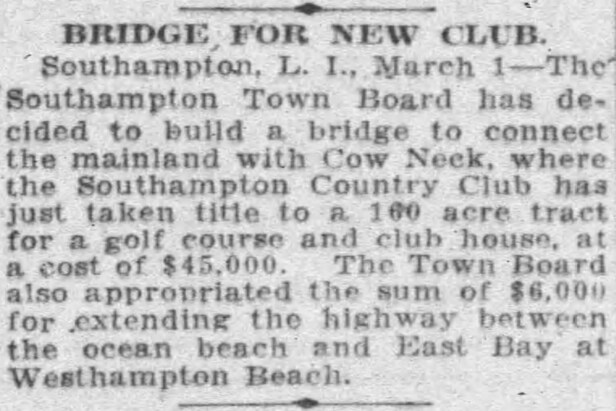
A: It did not, because a man named Henry Huttleston Rogers Jr. happened. Rogers’ father, by then deceased, was a classic turn-of-the-century oil baron, who was such a pain in John Rockefeller’s neck that Rockefeller decided he’d be a better partner than rival, and brought him in to Standard Oil, where Rogers became a leader and made lots of money. He died in 1909, and his son, a colonel in the New York militia who saw action in France in WW1, was heir to his estates. One of the main distinguishing features of H.H. Rogers Jr. is that he really hated when people came anywhere near his private property, to the point that he once abandoned a summer house mid-build in Long Island because a trolley line came too close. Instead, he came to Cow Neck, where he had a game reserve that he didn’t want the new golfers crowding. He fought them tooth and nail, including in the courts, with the biggest fight over a bridge and a road that would connect the property to the mainland. In early 1923, the word was that the bridge would be built:

Q: That all sounds good!
A: Ah, but by August, it was known that the “Southampton elect oppose golf course,” and I particularly like the subtitle of this anonymously authored piece: “Plain people planning club for own amusement.”

You and I both know you can’t have the plain people planning amusement, and though that article concluded by saying that “a public golf course for Southampton is assured,” it also introduced the fiery specter of Rogers:

Court battles raged for almost two years, and by 1925 the newcomers had abandoned the course entirely. They sold to Rogers himself for the same price they bought it at, and were given a tract of land farther to the south, near Shinnecock, by a man named C.H. Sabin, where they built the Southampton course that exists today.

Q: So Cow Neck was protected from golf, and the plain people! What happened then?
A: Rogers Jr. had a daughter, Millicent Rogers, who married an Austrian count named Ludwig von Salm-Hoogstraeten—the first of many husbands and lovers for Millicent, who was quite the socialite. The two of them had a son named Peter, and Peter married the woman who became Countess Wiltraud von Salm-Hoogstraeten, who, before embarking a quiet late life at the haunted jazz-age hunting lodge called “The Port of Missing Men,” sold the land to Bacon and invited golf back onto Cow Neck.
Q: My goodness.
A: I know.
Q: And when did this golf actually come back?
A: 2015. That’s when Bacon began building the ultra-private nine-hole course that now sits, barely used, one mile from the greatest golf stretch in America.
Q: But wait, wasn’t the land protected from development in the easement?
A: Not quite all of it. As part of the gift in 2000, Bacon got a few things in return. First was tax breaks—The Southampton Press estimates around $200,000 a year. Second was the right to build a few houses. Third was the right to set aside 142 acres (which later became 113) as an “equestrian, farm and game management zone.” And within that zone, he was allowed to build a few things, including a polo field, a “stick and ball field,” all kinds of equestrian facilities, anddddd … yes, as many as nine golf holes.
Q: That crafty dog!
A: And that’s what happened in 2015. Which, as far as I could tell, was where the trail of information online stopped. An article about the building process, with the faint whiff of controversy about the pesticides he’d have to use, and then more or less a decade of silence. Everything else is just what we could glean from Google Earth and Google Maps, where we could see a layout with five fairways, 10 greens (one of which had to be a practice green), some water, 23 bunkers and a lot of trees, including this one in the middle of a fairway.
Q: And I guess that’s where this story ends? Or is there a dramatic twist?
A: My friend …
[pauses to build anticipation]
We found someone who played the course.
Q: WHAT?
A: And this source gave us quite a bit, starting with the scorecard:

Look at that! It’s 2,700 yards, with the first two holes skirting the edge of a polo field (passing the practice green as you play No. 1), a little zig-zag action on the three ensuing par 4s—including one, No. 4, with that tree in the fairway—then a short par-3, a long hole along the water—incidentally, the best place for a civilian to see this course, provided you own a boat and can access the Great Peconic Bay—then a long par 4 back to the clubhouse and a closing par 3.
Also worth noting: At least on the scorecard, they call it “Cow Neck Golf,” not “Cow Neck Preserve.”
Q: It’s a shame this source didn’t take pictures.
A: Oh, but they did! Here are a couple choice ones. First, looking down at No. 3 green, with a front bunker and water distantly visible in the back:

Now No. 5, with another front bunker, and again looking out at the water, where in the distance you can see the clubhouse for National Golf Links and, behind it, Sebonack.


Here’s No. 6, the short par 3, which includes a lovely chapel in the colonial revival style:


And here’s No. 7, our source’s favorite hole, stretching along the water, with an old windmill tower rising above the landscape:

And two more, No. 8 and the par-3 ninth, to finish:


Oh, also, here’s a sweet little footbridge you encounter on your way back:
Q: What else did the source tell you about playing there?
A: You get an invite based on knowing someone affiliated with the club. On the day in question, you’ll drive on North Sea Road past Conscience Point Marina (you may be asked to carpool, a sign of how “lowkey” they want to keep proceedings), and you’ll turn off on the small dirt road (Rd. A) you see here:
Beyond that is a security gate, and then Rd. A takes you by the north side of a big body of water called Scallop Pond, and then to a series of red-roofed buildings housing various fitness amenities, outdoor pickleball courts, and the polo field. From when you turn off the main road, it’s more than a mile to the course.
Once you arrive, you may see the pro there, and you may see some of the staff, but you won’t see any caddies—there aren’t any. Nor will you see a golf-specific clubhouse. What you will see are carts waiting for you (complete with bluetooth speakers), and coolers with any kind of drink you want, alcoholic or otherwise.
It’s almost a guarantee that your group will be alone on the course, and probably the only group out that day, and with the carts you’ll play quickly enough to loop it twice.
Q: Yes. YES. Alright, well how is the course?
A: The word is that Bacon enjoys golf, but is not quite a golf obsessive, so with this course and its facilities, he wasn’t out to duplicate the treasures a mile away. Even the conditioning, said the source, while good, doesn’t match the high standards of its neighbors.
Nevertheless, the source described some of the holes, including 7, as “visually mind-blowing.” And the land itself, the source said, was incredible in its beauty—one of the most spectacular properties in the Hamptons.
Q: There are some lingering questions here. Do a few Cow Neck mysteries persist, or have you unraveled it all?
A: Sadly, mysteries persist. The biggest one is, “who designed the course?” That’s guarded like a state secret, and in the process of trying to figure it out, I had a back-and-forth with one of Bacon’s (very nice) representatives. I asked him for the designer’s identity, and lobbed out a few other ambitious questions—how many people play in an average summer, how many staff work at the course (and doing what), how much it cost to build, what sort of use the chapel gets, and how often Bacon himself plays. Sadly, the answer to all those questions came back a day later: “No comment.”
Q: You know what? Maybe that’s better. Maybe we need some enigmatic golf courses maintained by uber-private rich people in 2026, keeping a little intrigue in this age of endless information and attention-seeking behavior?
A: Yeah, sure, OK. But I still want to know who designed it, and it will eat at me for the rest of my days. Maybe we can do it by process of elimination. Thanks to the internet, we can at least rule out Tom Doak. How many others can there be?
Discover more from NAIRAVOICE.COM.NG
Subscribe to get the latest posts sent to your email.