

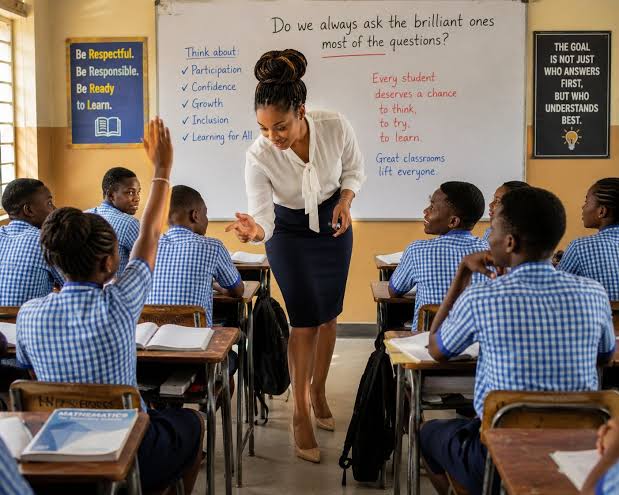
The teacher sets the tone
Encouragement is particularly important. Students do not need constant praise for every action, but they benefit from feedback that recognises genuine effort and improvement. A learner who performs poorly in Mathematics, for example, may need to hear what they are doing correctly as well as what they need to improve.
Constructive feedback gives students a path forward. Insults simply communicate disappointment without explaining how improvement can happen.
In addition, teachers can create a stronger learning culture by allowing students to contribute to discussions. Education should not become a one-way process where teachers speak and students simply copy. While direct instruction remains important, learners also benefit from explaining ideas, asking questions and connecting lessons to their own experiences.
This approach can be especially valuable in large classrooms. A teacher may not be able to have an extended individual conversation with every student during every lesson. However, group discussions, peer learning and carefully structured participation can allow more learners to become actively involved.
Technology may also support classroom culture when used appropriately. Digital tools can create opportunities for collaboration and access to information. However, technology cannot replace human relationships. A classroom with expensive devices but poor communication may still struggle to engage students.
The most valuable learning environment is therefore not necessarily the one with the smallest number of students or the most impressive equipment. It is the one where available resources are supported by trust, fairness and purposeful teaching.
For policymakers, this should not become an excuse to ignore overcrowded classrooms. Governments and school authorities still have a responsibility to improve infrastructure, recruit qualified teachers and reduce excessive class sizes. Research and educational experience have repeatedly shown that overcrowding can make effective teaching more difficult.
However, improving numbers alone will not solve every problem.
A school may reduce a class from 60 students to 30, but if students remain afraid to speak, if bullying continues and if teachers rely on humiliation, learning may still suffer. Physical conditions and classroom culture must therefore work together.
The strongest schools recognise that educational quality is both physical and human. Students need suitable classrooms, adequate learning materials and manageable teacher workloads. At the same time, they need teachers who create an environment where curiosity is encouraged and mistakes become part of growth.
Ultimately, students may forget the exact size of the classroom where they learnt a particular subject. However, they are more likely to remember how that classroom made them feel.
They may remember the teacher who encouraged them to speak when they lacked confidence. They may remember classmates who made them feel included or the moment they realised that making a mistake did not mean they were incapable of learning.
These experiences can shape attitudes towards education long after students leave school.
Conclusion
Classroom size matters, particularly in countries where overcrowding remains a major challenge. Yet the number of desks in a room cannot, by itself, determine whether meaningful learning happens. Culture gives the classroom its character.
When students feel respected, safe and included, they are more likely to engage with learning. When teachers create fairness, encourage participation and respond constructively to mistakes, the classroom becomes more than a physical space. It becomes a community where learning has room to grow.
For Nigeria’s education system, the long-term goal should be to improve both conditions at the same time: classrooms should become less overcrowded, better equipped and more conducive to learning, while teachers should also be supported to build positive relationships with students.
After all, a smaller classroom may make teaching easier, but a positive classroom culture can make learning meaningful.
Discover more from NAIRAVOICE.COM.NG
Subscribe to get the latest posts sent to your email.