The US Army is developing new warfighting software to change the way it fights a large-scale, high-speed, high-tech war.
A major exercise recently held in the California desert showed both why the service is moving so quickly and what challenges will need to be overcome to have it work as planned in combat.
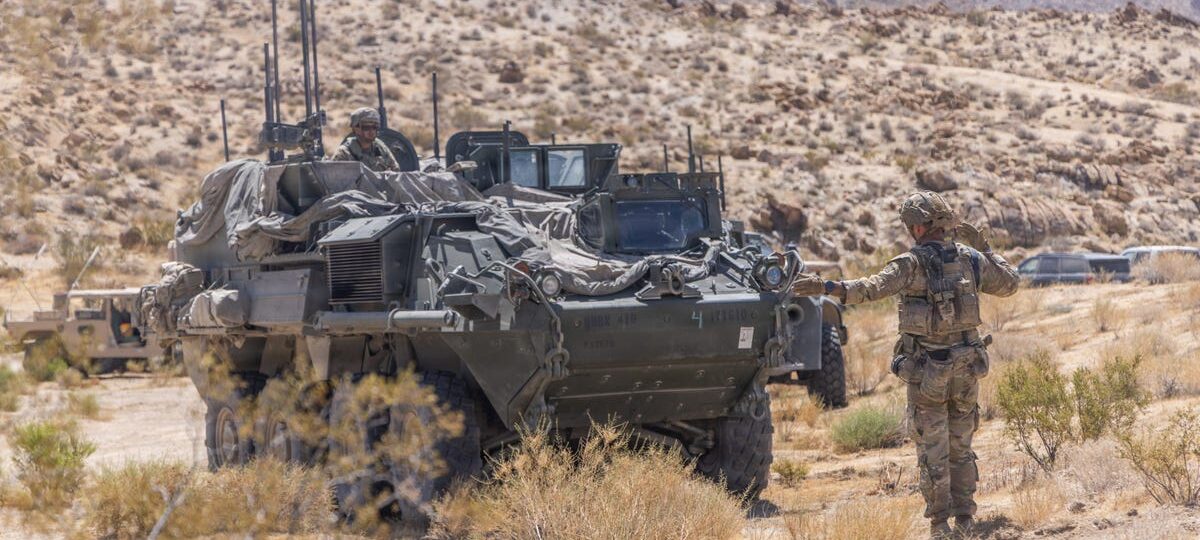
Out at Fort Irwin in California, the service tested its Next Generation Command and Control, or NGC2, as part of its Project Capstone Convergence exercise.
The system is complex and ambitious, marking a total overhaul of how the Army plans and fights.
During the exercise, soldiers used NGC2 to locate friendly forces on a digital map, communicate via laptops, tablets, and MPU5 radios, collect data to inform battlefield moves, manage airspace, and make weapon and maneuver decisions.
But some technologies that Business Insider saw weren’t yet connected to NGC2, and soldiers reported connection issues that sometimes made elements of the system unusable.
The occasional shortcomings that emerged during the experimentation at Irwin cut to the central challenge facing the NGC2 project and speak to the work ahead.
The Army wants to connect nearly everything on the battlefield into a single networked system, but that vision depends on its weapons, drones, and communications effectively working together under tough conditions like electronic warfare that are designed specifically to disrupt them. “We still got challenges to work through,” Joe Welch, an Army senior civilian executive overseeing NGC2’s development, told Business Insider, “but I mean, I’ve done this kind of work in the Army for most of my career, and I’ve never seen anything move nearly as fast as what we’ve delivered over the past nine to 10 months.” Army leadership bet big on NGC2 last year when it began prototyping the new system with the 4th Infantry Division at Fort Carson, Colorado, as well as a smaller version led by different vendors at the 25th Infantry Division at Schofield Barracks in Hawaii.
The 4th ID’s NGC2 effort has been led by a team of companies, including Anduril.
Army leadership describes NGC2 as a substantial replacement for its old, siloed systems, with data at the forefront of the change.
A data layer stores information and shares it with the applications inside the system.
These applications cover a range of warfighting functions.
Some apps communicate intelligence on enemy positions and weapons.
Other applications manage the supplies, ammunition, and logistics needed to sustain soldiers and coordinate fires on enemy targets.
The transportation layer keeps data secure and moves it where it needs to go.
Artificial intelligence capabilities are also involved in processing data and reviewing battle plans.
Several big questions drove the experimentation with NGC2 at the California exercise. “How do we use our apps to command and control more efficiently?
How do we use those apps to make decisions so that we can close the kill chain faster?” Brig.
Daniel Hibner, head of the Army Joint Modernization Command, said.
The Army also examined how NGC2 would perform at a larger scale than the earlier Ivy Mass exercise, under jamming and dispersal, and without close vendor support.
Vendors weren’t allowed in the key experimentation area, instead troubleshooting issues inside tents at Fort Irwin.
Over days of simulated combat, some areas of NGC2 proved valuable for soldiers.
Mobile command posts allowed decision-making on the go and supported more dispersed, virtual communications. “We’ve had more apps that help us for things like mission planning.
We are now much more efficient and can mission plan a lot faster, distributed,” Lt.
Shawn Scott, a unit commander within the 4th ID, said.
Soldiers can gather more data to inform what assets to use and how to use them.
If a mission changes, soldiers can quickly adapt to new orders and movements.
Others saw similar benefits. “Currently, it is helpful with being able to quickly talk to people,” Capt.
Dominic Sparkling, a unit commander within the 4th ID, said.
He said NGC2 helps him communicate with his soldiers, make decisions, and give commanders a clearer picture of what’s happening on the battlefield.
However, soldiers also acknowledged that NGC2 is still in a prototyping phase, with bugs and integration gaps still being worked out.
While some drones, like Anduril’s GhostX, were plugged into NGC2, others that the Army was testing, including the Bolt-Munition and Rogue 1, weren’t.
The Army attributed the lack of connection for some drones present to the time needed for vendors to meet its interoperability requirements.
Those include broadcasting a drone’s location through NGC2 and satisfying specific cybersecurity standards.
Some drones at the exercise also aren’t yet official Army programs. “By and large, the majority of vendors say, ‘I can meet that requirement, and therefore, I will do the required software development to meet the requirement and test it.’ And so it’s actually not been a large friction point; it’s time.
Some vendors take a little bit longer to get there than others,” Lt.
Ruben Rangel, deputy chief of staff, Command and Control Support Element, 4th ID, said.
The Army plans to require that all drones meet those expectations, turning vendors away if they cannot.
The eventual goal is to have every asset it has — whether soldiers, weapons, or uncrewed systems — appear as one of the blue dots in NGC2.
Having all that data available in one place could be a major step forward for mission planning. “I’m not even sure we’ve fully unlocked the potential of what that can do for us,” Maj.
Patrick Ellis, commander of the 4th ID, said.
At Fort Irwin, the Army’s ability to see that complete battlefield picture was limited by what was connected — and whether soldiers could maintain a connection for networked systems.
NGC2 is designed to work across various means of connection, whether that’s radio, 5G, or satellite, so that if one goes down, a soldier can still retrieve information via another method.
Previously, multiple connections might not have been available, or soldiers would run into dead zones they’d have to skirt to reconnect.
Soldiers said that the additional options made communications more resilient, including under simulated jamming. “We have multiple different types of communications that allow us that, if one is jammed, we still have others to make the signal out,” Scott said.
But some soldiers also said they’d experienced bad or lost connections that prevented them from using NGC2, static that made it hard to hear and talk, with soldiers “kind of stepping on each other,” Sparkling said, and errors loading maps or populating locations.
Part of the exercise featured a simulated urban assault involving Strykers, uncrewed aerial vehicles, and dismounted soldiers clearing buildings in raids on enemy positions.
In one of the back alleys of the urban area, a platoon sergeant opened his End User Device, a chest-mounted Samsung phone loaded with NGC2, and attempted to zoom in on the map to see where friendly forces were in the city. “Right now, I’m off WiFi, so it’s not working properly,” the sergeant said.
He could see his location and the relative positions of his objective, but the map would’ve ideally been more detailed and exact. “Without WiFi, it’s dead in the water,” he said.
In that particular moment, a system intended to give soldiers a clearer battlefield picture couldn’t do so when the necessary connection was unavailable.
The same platoon sergeant repeatedly made calls for an ammunition resupply over the MPU5 radio, but also noted connection issues.
Industry partners said these problems were being assessed throughout the exercise.
They said the disruptions could have been due to other planned effects as part of the training, including a cyber vulnerability assessment and electronic warfare elements.
NGC2 has marked a major change in how the Army develops and tests its programs.
In iterative exercises of the Ivy Sting series and the culminating Ivy Mass, the 4th ID has continually expanded the system’s capabilities, tested it against electronic warfare and denied connections, and made changes quickly.
The service is asking for close to $4 billion for NGC2’s continued development in this year’s budget request, up from around $3 billion last year.
That investment raises the stakes for the next phase of development.
Following the conclusion of the exercise, the Army plans to assess feedback on NGC2, including whether it made targeting enemies and closing the kill chain faster, how survivable it was in harsh conditions, how much its performance was affected by jamming, and whether it helped reduce the cognitive load on soldiers.
The new system’s ability to work with international allies and partners is also an area of interest. “The beautiful thing about that is you’re not just looking for good news,” Hibner said.
The Army is hopeful that scaling NGC2 to other divisions will be quicker and easier because of lessons learned from its iterative development, testing, and soldier experiences using the system.
Discover more from NAIRAVOICE.COM.NG
Subscribe to get the latest posts sent to your email.