The 20th century forged fantasy into its modern shapes. Drawing on fairy tales and myths, a handful of influential writers laid the foundations for one of the most popular genres. Even today, pretty much all fantasy novels are either borrowing from or deliberately subverting the fantasy conventions established between the 1930s and ’60s.
With that in mind, this list attempts to rank some of the finest and most important fantasy books of the previous century, from the grandeur of Lord of the Rings to the philosophical density of The Golden Compass. Each of the titles below gave us characters and places that readers are still returning to, cementing their place as the pillars upon which modern fantasy rises.
10
‘A Game of Thrones’ (1996)
<<img src="https://static0.colliderimages.com/wordpress/wp-content/uploads/2026/07/a-game-of-thrones-1996-book-cover.jpg?q=70&fit=crop&w=825&dpr=1" />
Image via Bantam Spectra</figure>
“We should start back.” GRRM broke with a lot of genre conventions with A Song of Ice and Fire. From the first installment, he plunged readers into a brutal world of politics and scheming, amoral characters, and real stakes, with even the most beloved protagonists at risk of being killed off at any moment. This recipe resonated, vaulting A Game of Thrones onto the bestseller lists and eventually spawning a global phenomenon that continues to hold a solid grip on pop culture.
The first book contains all the series’ most entertaining elements in microcosm: action, skulduggery, clashing nobles, old grudges, punchy writing, a layered world, a sprawling cast of compelling characters, and a looming supernatural threat. The history and backstory feel weighty, too; we really get the sense that the characters and kingdoms had lives long before we meet them. All in all, it’s a solid foundation for everything that came after.
9
‘Harry Potter and the Philosopher’s Stone’ (1997)
<<img src="https://static0.colliderimages.com/wordpress/wp-content/uploads/2026/08/harry-potter-and-the-philosopher-s-stone-1997-book-cover.jpg?q=49&fit=crop&w=825&dpr=2" />
Image via Bloomsbury</figure>
“Mr and Mrs Dursley, of number four, Privet Drive, were proud to say that they were perfectly normal, thank you very much.” While Game of Thrones was a sensation, it hardly compares to the pop culture juggernaut of Harry Potter. Not since Beatlemania had something inspired so much devotion in young fans. The series’ appeal is very much on display even in the first book, which is fun and whimsical, cramming so much plot into just over 200 pages.
In it, Harry escapes the drudgery of the Dursleys’ house and into the wizarding world, a place of goblin-run banks, enchanted sweets, flying broomsticks, cheeky ghosts, and, most importantly, Hogwarts School of Witchcraft and Wizardry, a warm home not just for the boy wizard himself but the reader, too. Ron and Hermione round out a wonderfully mismatched trio, while the mystery surrounding the Philosopher’s Stone gives their first school year a taut, gripping narrative structure.
8
‘Watership Down’ (1972)
<<img src="https://static0.colliderimages.com/wordpress/wp-content/uploads/2026/09/watership-down-book0.jpg?q=70&fit=crop&w=825&dpr=1" />
Image via Puffin Books</figure>
“The primroses were over.” Rabbits searching for somewhere safe to live shouldn’t feel like the basis for an epic, yet that’s exactly what Watership Down is. The story kicks into gear when the anxious Fiver experiences a vision of destruction coming to the Sandleford warren. His brother Hazel believes him, and a small group of rabbits abandons their home shortly before humans obliterate it. What follows is simultaneously an animal adventure, survival story, political drama, and miniature heroic saga.
Indeed, Watership Down gets surprisingly poignant and tragic, at times even brutal or frightening, like with the references to the feared Shining Wire. Even more impressively, author Richard Adams makes sure that the rabbits actually feel like animals, not just humans with a fuzzy exterior. Their behavior is rooted in rabbit biology, and they have their own language, social customs, mythology, and stories about the trickster hero El-ahrairah.
7
‘The Silmarillion’ (1977)
<<img src="https://static0.colliderimages.com/wordpress/wp-content/uploads/2024/08/the-silmarillion-cover0.jpg?q=70&fit=crop&w=825&dpr=1" />
Image via Harper Collins</figure>
“There was Eru, the One, who in Arda is called Ilúvatar.” It’s the most challenging of the Lord of the Rings books, but also one of the richest. Published posthumously, The Silmarillion presents the mythology and ancient history of Middle-earth, beginning with the creation of the universe and moving through the wars, betrayals, loves, and catastrophes of the First Age. At the center of it all, the rebellious Fëanor creates the Silmarils, three jewels containing the light of the Two Trees, before the dark lord Morgoth steals them.
The resulting oath taken by Fëanor and his sons drives generations of bloodshed. Around that central tragedy emerge stories powerful enough to stand on their own: Beren and Lúthien’s impossible love, Túrin Turambar’s disastrous life, the fall of Gondolin, Eärendil’s voyage, and the eventual destruction of Beleriand. The scale of all this is simply breathtaking, adding even more depth to an already dense world.
6
‘The Last Unicorn’ (1968)
<<img src="https://static0.colliderimages.com/wordpress/wp-content/uploads/2026/07/athe-last-uni-1.png?q=70&fit=crop&w=825&dpr=1" />
Image via Viking Press</figure>
“The unicorn lived in a lilac wood, and she lived all alone.” This gem follows a unicorn who learns that she may be the last of her kind. Leaving the safety of her forest, she sets out to discover what happened to the others and eventually learns of King Haggard and the terrifying Red Bull that has driven the world’s unicorns away. Along the way, the book repeatedly takes classic fantasy archetypes and gives them a treatment that’s a little more complex and melancholy than usual.
The major characters are all flawed, and their stories bear their fair share of pain and loss. For example, Molly Grue has spent years waiting for something magical to enter her life, only for the unicorn to arrive after youth has already passed her by. Even more strikingly, these characters are self-aware: they know they are trapped inside a fairy tale, and this meta element is key to the book.
5Enjoying this article? Support our work with a small crypto donation.
‘The Golden Compass’ (1995)
<<img src="https://static0.colliderimages.com/wordpress/wp-content/uploads/2026/01/cover-of-the-golden-compass-by-philip-pullman.jpg?q=49&fit=crop&w=825&dpr=2" />
Image via Alfred A. Knopf</figure>
“Lyra and her dæmon moved through the darkening Hall…” The Golden Compass (aka Northern Lights) serves up an entertaining plot alongside genuine food for thought; it’s perhaps the most philosophical children’s fantasy story ever. In an alternate version of Oxford, every human possesses an animal-shaped dæmon, armored bears rule in the North, witches fly through the skies, and a mysterious substance called Dust has become the subject of a theological and scientific struggle.
At the heart of these tangled threads is Lyra Belacqua, a compulsively curious girl whose talent for lying proves surprisingly useful. The Golden Compass surrounds her with unforgettable characters, from the formidable Mrs. Coulter and explorer Lord Asriel to aeronaut Lee Scoresby and armored bear Iorek Byrnison. Finally, the book pulls no emotional punches. There is betrayal and occasionally horror here, as well as the realization that authority figures, even parents, can be dangerous.
4
‘The Lion, the Witch and the Wardrobe’ (1950)
<<img src="https://static0.colliderimages.com/wordpress/wp-content/uploads/2026/07/cover-of-the-lion-the-witch-and-the-wardrobe-by-c-s-lewis.jpg?q=49&fit=crop&w=825&dpr=2" />
Image via HarperCollins</figure>
“Once there were four children whose names were Peter, Susan, Edmund and Lucy.” It’s one of the most enduring images in the whole genre: a character walking through a wardrobe and discovering another world. In this one, Narnia is trapped in perpetual winter under the rule of the White Witch. Lucy and her siblings Peter, Susan, and Edmund become entangled in the resistance against her, eventually joining the great lion Aslan.
Although the story that follows is relatively short (about 150 pages), C.S. Lewis fills it with ideas and creations that generations of readers have remembered: Mr. Tumnus beneath the lamppost, the Witch’s sleigh, Edmund’s Turkish Delight, Father Christmas distributing gifts, and the Stone Table. The Christian symbolism is hardly hidden, particularly in Aslan’s sacrifice and resurrection, but Narnia’s appeal extends far beyond allegory. It’s the defining work of portal fantasy.
3
‘The Hobbit’ (1937)
<<img src="https://static0.colliderimages.com/wordpress/wp-content/uploads/2026/06/the-hobbit-book.jpg?q=49&fit=crop&w=825&dpr=2" />
Image via George Allen & Unwin</figure>
“In a hole in the ground there lived a hobbit.” The Lord of the Rings is grander, but The Hobbit is unsurpassed when it comes to pure adventure. It begins with Bilbo Baggins enjoying the comforts of Bag End and having little interest in quests or journeys. Then Gandalf arrives, followed by thirteen dwarves who consume his food, sing about a lost kingdom beneath a mountain, and expect him to accompany them as their burglar.
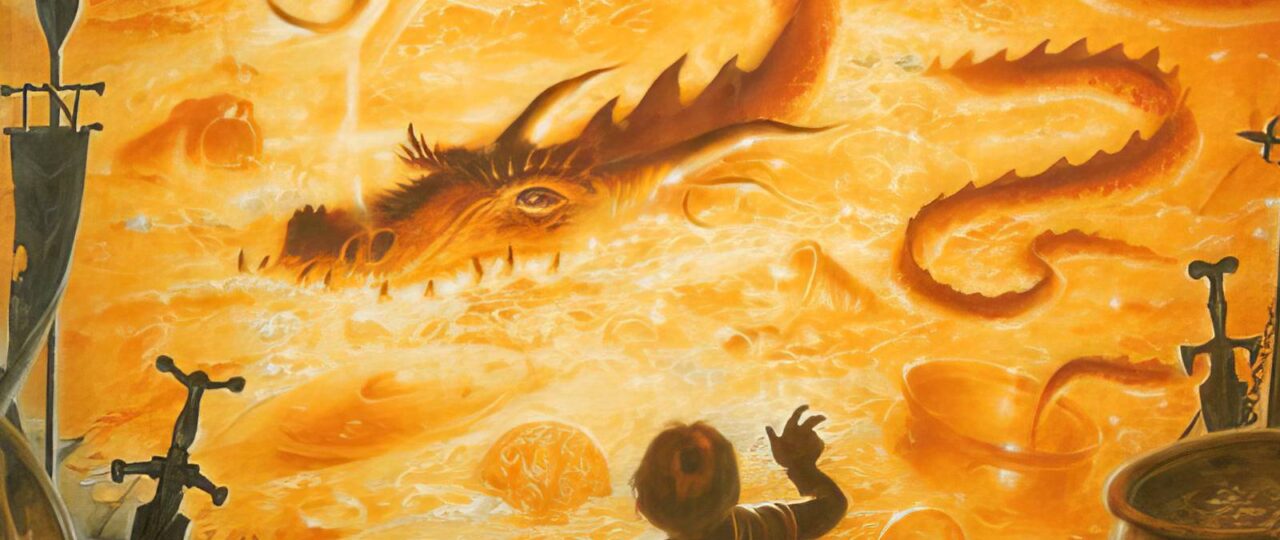
Soon, the homebody hobbit is contending with trolls, goblins, giant spiders, elves, enchanted forests, ancient ruins, riddles in the dark, and, of course, one of literature’s most famous dragons. The story is fun and economical, rarely wasting time, and Bilbo’s character arc is deeply compelling. Before our eyes, he develops into someone capable of repeatedly saving his companions. His story still feels vivid and alive almost 90 years since it was published.
2
‘A Wizard of Earthsea’ (1968)
<<img src="https://static0.colliderimages.com/wordpress/wp-content/uploads/2026/09/a-wizard-of-earthsea-ursula-k-le-guin-gollancz.jpg?q=70&fit=crop&w=825&dpr=1" />
Image via Gollancz</figure>
“Only in silence the word, only in dark the light, only in dying life: bright the hawk’s flight on the empty sky.” One of the genre’s greatest coming-of-age stories. In A Wizard of Earthsea, we meet Ged, an arrogant, immensely talented boy who slowly evolves into a wizard forced to confront the consequences of his hunger for power. While studying magic on Roke, Ged recklessly summons a shadow creature that nearly kills him and then pursues him across the archipelago.
Ged initially believes becoming powerful means accumulating greater abilities. His resulting quest teaches him that wisdom may consist of understanding when power shouldn’t be used at all. Most importantly, the shadow Ged fights cannot ultimately be defeated like an ordinary monster, meaning his mission must turn inward. Through that, the book says a lot about the parts of ourselves we would rather deny.
1
‘The Lord of the Rings’ (1954-1955)
<<img src="https://static0.colliderimages.com/wordpress/wp-content/uploads/2026/07/the-lord-of-the-rings-jrr-tolkien.jpg?q=49&fit=crop&w=825&dpr=2" />
Image via Allen & Unwin</figure>
“All that is gold does not glitter, not all those who wander are lost.” This is the axis around which the whole genre rotates. Arriving in the mid-’50s and heavily shaped by World War II, The Lord of the Rings permanently divided fantasy into before and after. Drawing on folklore staples like elves, dwarves, and magic rings, Tolkien synthesized mythology, linguistics, history, and adventure and grand moral themes into a new blueprint that charmed millions of readers, many of whom would go on to write fantasy books of their own.
The central premise is straightforward: Frodo inherits the One Ring and must carry it to the one place where it can be destroyed. Around that quest, however, we get a collection of layered, lovable characters, each with their own journey, all of them unfolding against a backdrop that feels perfectly realized. Middle-earth is no flimsy set for the plot, but practically a character in its own right.
Discover more from NAIRAVOICE.COM.NG
Subscribe to get the latest posts sent to your email.