



 Getty Images
The outbreak of the US-Israel war with Iran in February caused shock waves across the global economy.
The region plays a key role in global oil and gas supplies, and the closure of the key Strait of Hormuz shipping corridor, has driven up prices on a wide range of things from energy bills to air fares.
On 18 June, Iran and the US signed a deal aimed at bringing an end to the war, with the Strait set to reopen.
But negotiations on some of the thorniest issues – including Iran’s nuclear programme – will be deferred for 60 days, raising questions about how long this agreement will last.
Here are five ways the deal might affect your day-to-day life.
The war caused an immediate rise in motor fuel prices, as production and transport of oil in the Middle East slowed or stopped entirely.
Prices at the pump have started to drift lower in recent weeks on rising hopes for a peace deal.
But they are still far above where they were before the conflict began.
As of Thursday in the UK, petrol cost an average of 154.72p per litre, while diesel was an average 174.30p per litre, according to RAC Fuel Watch data.
Nearly four months ago, petrol was 132.05p a litre and diesel was 141.6p.
In the US, the latest data shows that average gasoline prices stood at $4.05 (£3.05) per gallon, up from $2.94 per gallon before the war started, while diesel had risen from $3.81 to $5.06 over the same period.
Simon Williams, head of policy at the RAC, said the recent fall in global oil and wholesale petrol prices “if sustained – will “in time lead to much lower prices at the pumps”.
But he said: “The big question is how fast will this happen, and whether the fall in pump prices happens as swiftly as the rise drivers had to endure through March and April did.”
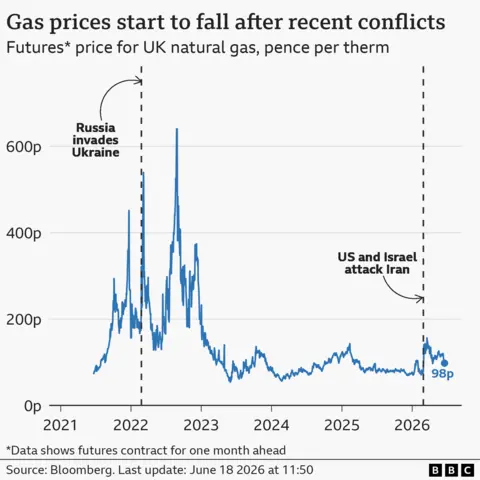
UK gas prices almost doubled at the beginning of the conflict, sparking fears of higher energy bills across the country. Gas is used directly in millions of homes for heating and hot water; it was also used to generate about 27% of our electricity last year.
The benchmark UK gas price was below 80p a therm before the Iran war began but was trading at around 157p by 19 March. Now it’s back down at 98p per therm.
However, the consultancy Cornwall Insight says it would be “overly optimistic” to assume prices will quickly return to pre-conflict levels.
Firstly, the UK energy regulator Ofgem has already set its next price cap on household energy bills for July and it can’t be changed. The average household bill is set to rise by 13% – or £221 – per year from next month. The cap covers 33 million households in England, Wales and Scotland.
The Gulf is where Europe gets around half of its jet fuel from. In the weeks following the start of the war, jet fuel prices soared from about $784 per tonne to $1,838, raising fears of shortages and higher flight prices.
Some airlines announced fare hikes, particularly for long haul flights, but there was also evidence of European airlines cutting fares to try to overcome customer “hesitancy”.
In recent weeks, jet fuel prices have fallen sharply to around $967 a tonne, but the aviation industry is not out of the woods yet, says Amaar Khan, a jet fuel specialist at Argus Media.
He says European airlines should have all the fuel they need to meet demand this summer and beyond. But he also expects jet fuel prices to remain above pre-war levels for much of this year.
Inflation, which measures the rate at which prices rise, had been falling in the UK and globally prior to the war. But the conflict has disrupted that overall downward trend, largely because of the rise in global energy prices.
In February, UK inflation fell to 3% and the Bank of England said before the current conflict it believed inflation could reach its 2% target by as soon as April.
In March, however, it climbed to 3.3% before settling at 2.8% in April and May.
Charlotte O’Leary, associate economist at the National Institute of Economic and Social Research, says there is expected to be a “sizeable” upward impact on inflation when Ofgem increases its energy price cap in July.
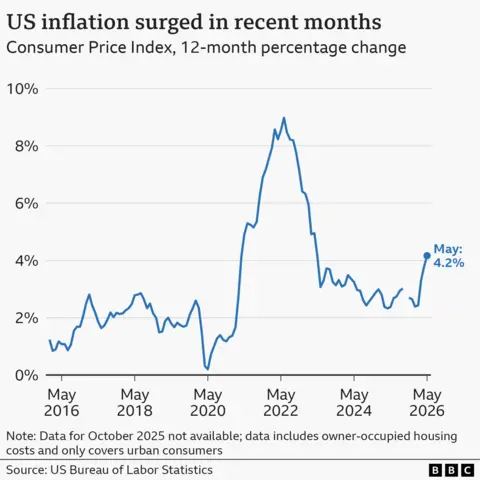
Over in the US, inflation rose from 2.4% in February to 4.2% in May, with the war seen as a major contributing factor, while in the European Union it went from 2.1% to 3.3% over the same period.
Interest rates are the primary tool used to control inflation; they also influence the cost of borrowing as well as the interest paid to savers.
But uncertainty over the impact of the Iran war on energy prices has prompted central banks around the world to keep interest rates on hold.
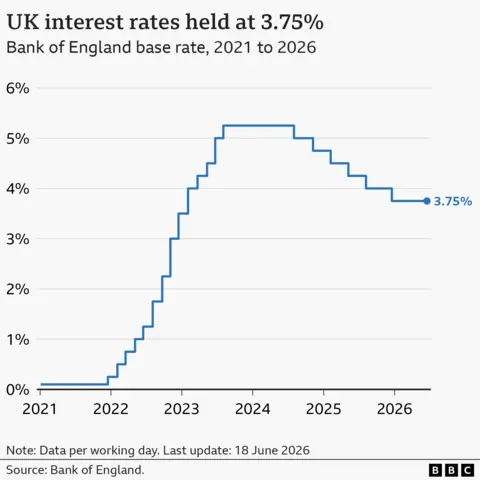
The Bank of England held rates at 3.75% for a fourth consecutive meeting this week. Its governor Andrew Bailey said that recent drops in oil prices were “encouraging” but high energy prices during the war had still left “inflationary pressure in the pipeline”.
Interest rates are widely expected to remain on hold for the rest of this year, with some analysts predicting cuts next year.
This week the US Federal Reserve also held interest rates at between 3.5% and 3.75%, citing “elevated uncertainty” owing in part to the conflict in the Middle East.
Last week, the European Central Bank opted to increase its interest rate to 2.25%, the first rise for almost three years, noting that the conflict was “generating inflation pressures”.

Get our flagship newsletter with all the headlines you need to start the day. Sign up here.
Discover more from NAIRAVOICE.COM.NG
Subscribe to get the latest posts sent to your email.