
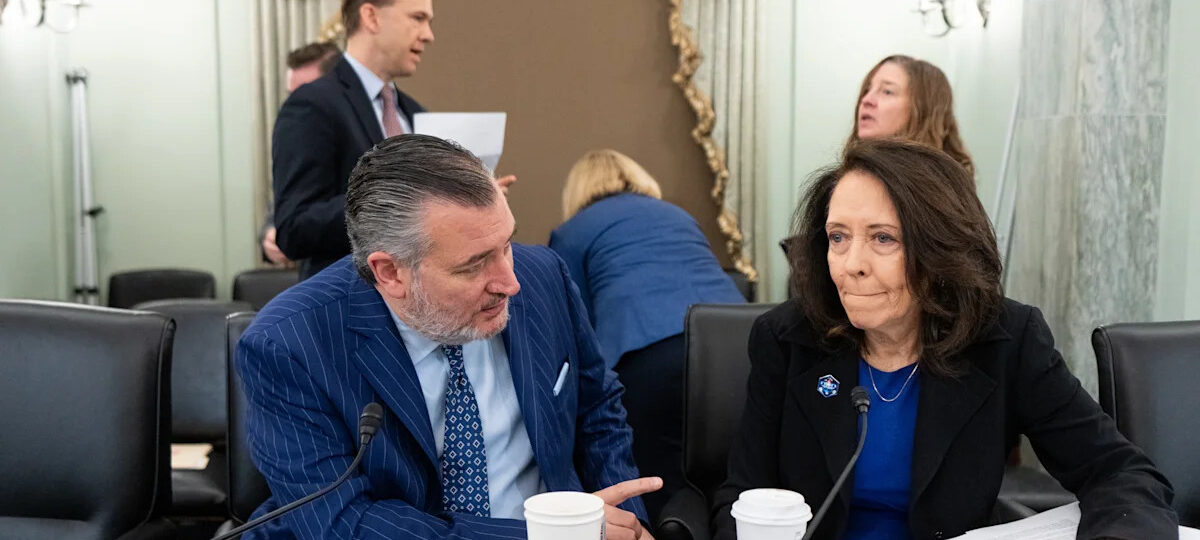
WASHINGTON, D.C. — Moments after the passage of the newest college sports legislation through the Senate Commerce Committee here Thursday, Sen. Maria Cantwell removed her proverbial gloves.
She took big swings at the big boys: the commissioners of the SEC and Big Ten.
“People have to wake up,” said Cantwell, a Washington Democrat who’s been in the Senate for 25 years. “The politics of these [conference] commissioners moving around deck chairs [with realignment] and making millions of dollars themselves and not thinking about the broad interest to solve these problems has led us to this point. It’s time to listen to some other people.”
In the wake of a 19-9 vote that advances her and Ted Cruz’s bill to the next step in the legislative process — it may soon be brought up for a full vote on the Senate floor — Cantwell unleashed a three-minute tongue-lashing directed at the two conferences that oppose the legislation: the SEC and Big Ten.
In an effort to align their schools in opposition to the Protect College Sports Act, Cantwell accused the conference commissioners of “intimidating” members by “threatening” team scheduling changes; suggested that league executives were treating university presidents and athletic directors as “puppets;” and believes that school board members who want their institutions to support the bill are now springing into action.
“Athletic directors and presidents are going to get their comeuppance from regents who are all the sudden saying, ‘What the hell are you doing sending these letters [opposing the bill]?'” Cantwell said. “The jig is going to be up on schools. You’re really letting the conference drive this discussion?”
The SEC and Big Ten are “threatening intimidation on the schedule [of games]. There is intimidation here,” she said.
The comments continue a wild public spat between U.S. senators and the wealthiest conferences in America — two leagues that adamantly oppose the legislation for an assortment of reasons.
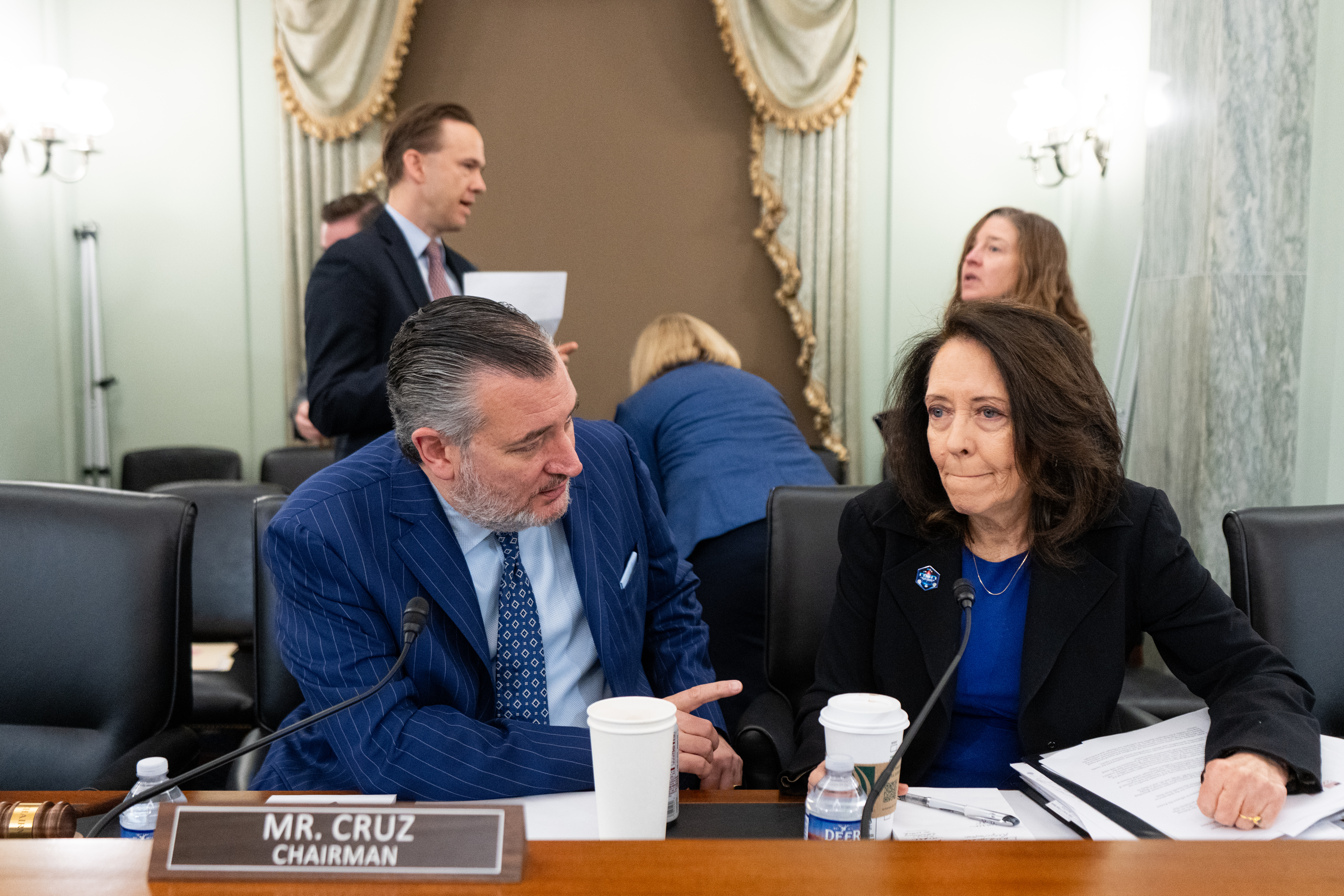 Bill Clark via Getty Images
While many within college athletics have lent their support to a bill granting the NCAA a limited antitrust provision — notably around the one-time transfer limitation and five-year eligibility standard — officials from the Big Ten and SEC have been critical of a bill that paves the way to potentially pool FBS media rights, may limit third-party NIL to athletes and, they say, still provides an avenue for outside influences to poach their schools for the creation of a super league.
In a last-minute adjustment to the legislation on Wednesday night, lawmakers changed an anti-expansion provision that specifically targeted the two conferences — it prohibited them adding new schools — to also apply to the other power leagues. The “concession,” as Cantwell called it, to possibly garner the SEC and Big Ten’s support failed, as the leagues, moments before Thursday’s vote, released a statement in opposition.
Executives at the two conferences believe that the anti-expansion provision still remains too narrow and that it should also prohibit third parties or outside firms from poaching members of a conference.
What are the chances of passage?
The disagreements rage onward over legislation that stands to regulate an industry while not holding the support of the two biggest industry stakeholders.
It is an unusual circumstance, but one that the bill’s authors believe doesn’t matter in the end. While he’d like their support, Cruz has told Yahoo Sports in the past that he believes the legislation can pass without the SEC and Big Ten’s endorsement.
Some may even view the absence of their support as a positive.
“What we did today is say we’re not going to let the most powerful and richest conferences dictate to the rest of America what’s going to happen to 500,000 athletes,” Cantwell told a standing-room-only hearing room on Thursday.
“They need our help, they asked for it and today, we are giving it,” she said.
Thursday’s vote of the 28-member committee moved the legislation a step closer to history.
Since the NCAA began lobbying for a bill to regulate the industry seven years ago, the Protect College Sports Act is just the second piece of college sports legislation to pass a committee vote, bringing it a step closer to a most significant development: A vote on the floor of the U.S. Senate.
The legislation will then need to be adopted by the House of Representatives, whose leaders — both from the SEC footprint of Louisiana (Mike Johnson and Steve Scalise) — have expressed opposition to some of the bill’s concepts. At the White House, U.S. President Donald Trump released a statement earlier this month supportive of the bill but encouraging lawmakers to find a compromise that both chambers can support.
Cantwell said that “now it’s time” to bring into the conversation those House members, many of whom saw their own college sports bill, the SCORE Act, never reach the House floor for a vote. The SCORE Act granted sweeping and more broad antitrust powers to the NCAA and included a clause preventing athletes from being deemed employees.
While acknowledging that he would vote for the SCORE Act, Cruz said, “precisely zero Senate Democrats” would. “It is a bill that has no prospect of actually being signed into law,” he added.
The Protect College Sports Act, meanwhile, has more than a chance, Cruz said.
In the Senate, Majority Leader John Thune (R-SD), a member of the Senate Commerce Committee who voted for Cruz-Cantwell’s bill, holds the authority to introduce it onto the floor. Cruz said Thune (R-SD) is “committed” and “intends” to do so and believes that will happen in July. His objective is to have the bill signed into law “before the school year” and he believes “that timeline is doable.”
“I believe this bill is going to pass,” Cruz said flatly after Thursday’s vote.
The bill passed committee by a four-vote margin (needed 15 and got 19). Cruz described it as a “big bipartisan vote” that “gives the bill real momentum” ahead of a vote on the Senate floor vote, where a 60-vote threshold is needed in a chamber with a three-person Republican advantage. On Thursday, of 28 committee members, six Democrats voted for the bill and two Republicans, Roger Wicker (Miss.) and Todd Young (Ind.), voted against it.
Eight of the 19 supportive votes came from lawmakers in a state with an SEC or Big Ten program. Seven of the nine votes against came from their footprint.
SEC/Big Ten vs. the Senate
Over the next few weeks, more drama is likely set to ensue.
Lawmakers and staff members will enter into what’s described as “vote whipping” in an attempt to rally senators to support the bill — or, for those in opposition, to dissuade them against it.
At the center of the fight are the two wealthiest conferences, each of which holds skepticism over legislation that they believe was partially developed by forces outside of college athletics. At a hearing for the bill two weeks ago, for instance, Texas Tech booster Cody Campbell and those with the private-equity backed firm Smash Sports sat, separately, within the velvet ropes often reserved only for witnesses or lawmaker guests.
Campbell and those from Smash are each separately proposing an idea to pool FBS media rights, a concept that found its way into the legislation. Though that concept is optional, executives in the SEC and Big Ten are adamantly against such a move.
Many lawmakers, even those from the 26-state SEC and Big Ten footprint, want the pooling concept to happen, though. Both Cantwell and Cruz have publicly urged the leagues to pool rights in an effort that, in theory, will generate more revenue to be distributed to women and Olympic programs — the sports, they say, are negatively impacted by the reallocation of resources to football and men’s basketball.
In fact, Eric Schmitt (R-Mo.), who helped develop the bill, offered an amendment on Thursday to “incentivize” the SEC and Big Ten to pool rights with others by granting the two conferences more governance and voting authority in any new FBS entity of consolidated rights.
The pooling of rights was at the center of discussion two weeks ago when each group of university presidents and their commissioners held a call with Cruz, Cantwell and Schmitt. The lawmakers originally did not invite commissioners Greg Sankey and Tony Petitti.
“These people had to have a meeting, the presidents, to decide whether they could get on a conference call with Sens. Cruz and I without the conference commissioners,” Cantwell said. “And [the commissioners] made them only read a statement. One university president could talk and nobody else could talk or had questions. Who’s the puppet here?”
The criticism toward the two leagues continued later Thursday on a video call held by Yankees president Randy Levine and Campbell, both of whom Trump selected to lead the presidential roundtable on college sports. Levin said the SEC and Big Ten “tried to sink the bill” but “weren’t successful.”
“We are moving forward even with their objection, but we truly do want them to be involved and engaged,” Campbell said.
Levine welcomed the conferences to return to the negotiating table to “work through all of the problems.”
Wednesday negotiations
Those problems arose on Wednesday night, hours before Thursday’s amendment session, when heated negotiations unfolded between the leagues and lawmakers unfolded.
One particular issue found center stage overnight: an anti-expansion concept that, at first written, would freeze Big Ten and SEC conference membership.
The change to apply the anti-expansion concept to the ACC and Big 12 as well did not appease, most notably, officials from the Big Ten.
Sen. Tammy Baldwin, representing the Big Ten footprint of Wisconsin, proposed an amendment, obtained by Yahoo Sports, that would have prevented an outside firm, such as a private-equity entity, from poaching conference members to form the so-called super league.
That portion of Baldwin’s proposal was not accepted. However, a Senate Commerce Committee staff member told Yahoo Sports that the bill’s language “prevents anyone from realistically forming a super league, including outside firms and entities” and said that any necessary adjustment to the language “will be made.”
However, the bill’s language “prevents anyone from realistically forming a super league, including outside firms and entities,” according to a statement from the Senate Commerce Committee to Yahoo Sports. Any necessary adjustment to the text “will be made,” the committee said.
Cantwell addressed the issue on Thursday, calling the Big Ten and SEC’s fears as “irrational.”
“They thought that somehow private equity was going to rearrange the deck chairs and make the ACC and Big 12 some sort of supremacy league,” she said.
During the talks Wednesday night between the conferences and Senate staff, another issue arose.
Section 114 of the bill takes aim at a loophole that schools are using to circumvent the school revenue-share cap. The section may limit millions of dollars in third-party NIL compensation currently going to athletes, as it prohibits dollars from “associated entities” like multimedia rights holders. The NCAA, Big Ten presidents, the National Urban League and a group of athletes themselves expressed concern over the section in letters and memos over the last few days — an issue explored in a story Wednesday on Yahoo Sports.
During negotiations Wednesday evening, Senate staff members declined to change that portion of the legislation, despite amendments from lawmakers like Wicker from SEC and Big Ten footprints.
Asked about the issue after Thursday’s vote, Cantwell suggested that the bill’s intention is to limit or eliminate compensation from entities that are closely affiliated with schools.
“Everybody wants a very legitimate process and wants everybody to adhere to it,” she said. “What everybody is anxious about is somebody else going to be able to get around it and how are they going to get around it and how are they doing that?”
In the meantime, the boxing match between the two richest conferences and some of the highest-ranking lawmakers in the country moves on to another round.
Ding!
“We are going to continue to have dialogue with these two divisions who think they control this debate,” Cantwell deadpanned.
Discover more from NAIRAVOICE.COM.NG
Subscribe to get the latest posts sent to your email.