
While the modern Formula 1 calendar is stacked with great tracks, fans know that Interlagos is unique in the way that it almost always turns the Brazilian Grand Prix into the most memorable race of any season. But what is it about the track that makes it so incredible?
Many fans will be quick to point to Interlagos’ identity as one of F1’s classic venues to explain the excitement, and that does play a part. But there are many more reasons why the Brazilian Grand Prix is suited to memorable moments like Max Verstappen‘s greatest drive and Lewis Hamilton‘s first championship. Keep reading to find out what those are.
Sebastian Vettel’s 2012 championship was won on Interlagos’ relentless layout

Interlagos is one of the oldest tracks on the Formula 1 calendar; when it was first opened in 1940, its layout stretched for almost five miles over the rolling countryside between two artificial lakes that provide water to the city of São Paulo. Now, the track is trimmed back to a much more manageable 2.677-mile length, but rather than tarnishing the magic of the original layout, the shorter track has only concentrated the action into a relentless dash that almost guarantees a show for spectators.
Part of that comes down to the age of the track. In order for a track to earn the FIA Grade 1 certification that makes it eligible to host F1, modern tracks need to be built to a minimum width and feature ample paved run-off zones. Tracks like Interlagos, which were constructed before those standards came into play, can be ‘grandfathered’ into the calendar. As a result, the track is narrower than many of its contemporaries on the F1 schedule. To make things even more treacherous, Interlagos has very little paved run-off, which means drivers who make a mistake will either hit the grass or a wall. In either case, their race is over.
And it was that narrow track that made it so impressive that Sebastian Vettel clinched the 2012 championship at the Brazilian Grand Prix.
Coming into the event, Red Bull Racing’s Vettel had a 13-point championship advantage over Ferrari’s Fernando Alonso, which made him a clear title favorite. And then, there was chaos on the very first lap.
The race started in damp conditions with all teams on slick tires, and it led to an almost immediate collision between Vettel and Bruno Senna. Vettel dropped to the rear of the field and reentered the race in 22nd position. Other major issues threatened to rule him out of the running, too: His sidepod was damaged, his radio was broken, and when he pitted for fresh tires, his Red Bull pit crew wasn’t ready for him and had to scramble through a long stop to get him back in action.
Despite everything working against him, Vettel carved his way through the field. Every overtake he made had to be as precise as possible lest he spin through the wet grass or collide with another competitor on the narrow track. The German driver called it “the toughest race” he’d contested, and fans were on the edge of their seats as Vettel nailed one pass after another.
Thankfully for Vettel, there was a little luck on his side. On lap 54 of 71, Lewis Hamilton was knocked out of the race after he was hit by Nico Hulkenberg, and it meant Vettel had one fewer car to overtake on his way to the front. And on lap 63, Michael Schumacher moved over to allow his fellow German to pass him by; Schumacher, who was retiring, saw it as a passing of the torch to his countryman. Had Hamilton and Schumacher both maintained their position, Vettel would have finished eighth and lost the 2012 World Drivers’ Championship to Alonso by a single point. Instead, Sebastian Vettel finished sixth and earned the title with a three-point margin.
Juan Pablo Montoya’s daring downhill move showed off Interlagos’ elevation
While Interlagos doesn’t boast the most extreme elevation changes over the course of a lap on the F1 calendar (that honor goes to Spa-Francorchamps), the 140 vertical feet between its highest and lowest points still makes it the third-most undulating circuit in modern Formula 1. And that elevation often plays a huge role in keeping the racing at Interlagos exciting.
The highest point on the track actually sits on the front straight; when drivers launch off the line, they’re carving downhill all the way to Turn 5, the lowest point of the circuit. All race fans know the race to the first turn is one of the most intense moments of the race; now imagine that race aided by a downhill slope.
If you watched the start of the 2001 Brazilian Grand Prix, you wouldn’t have to imagine. Early in that race, a safety car paused the action, but not before rookie driver Juan Pablo Montoya had rocketed from fourth on the grid to second, just behind reigning champion Michael Schumacher.
On the restart, Montoya stuck close to Schumacher’s rear and used the downhill momentum of Interlagos’ layout to make an aggressive overtake for the lead on the dirty inside line heading through the first corner. It was a hugely audacious move for any driver, but the fact that Montoya was a rookie challenging one of the best drivers in the world made it all the more exciting.
Montoya had the pace to keep setting faster laps, but after Jos Verstappen made contact with the rear of his car, which ended his race and handed David Coulthard the victory. But Montoya’s move on Schumacher easily remained the highlight of the 2001 Brazilian GP.
Max Verstappen’s greatest race in São Paulo’s unpredictable weather

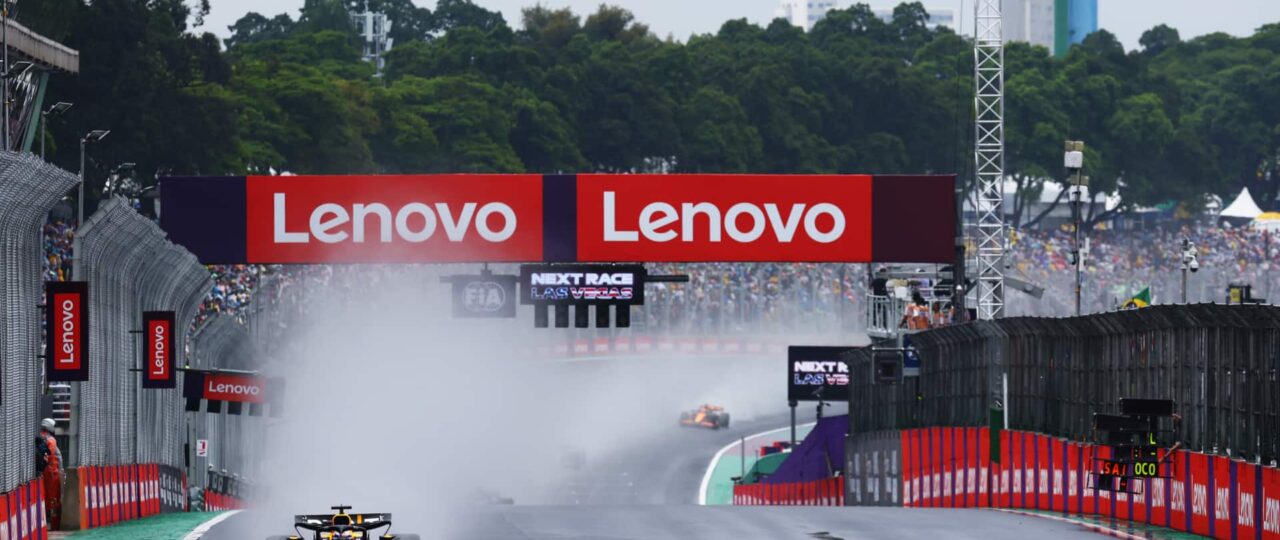
The 2024 São Paulo Grand Prix has gone down in history as one of the greatest drives of Max Verstappen’s Formula 1 career, and it all had to do with Interlagos’ unpredictable weather, a hallmark of the track.
In addition to its changes in elevation, Interlagos lies on a plateau over 2,500 feet above sea level, which means it’s often prone to collecting the storm clouds, and storms are common in November, which is the start of Brazil’s tropical wet-weather season. São Paulo, nicknamed the “Land of the Drizzle,” is therefore a hub for rapidly changing conditions.
By the time Brazil came around in 2024—round 21 that season—Verstappen’s early dominance had given way to a contentious season that saw McLaren’s Lando Norris trying to unseat the reigning champion from the top of the championship standings, and Brazil looked like it would be a critical point in the fight. The Dutch driver came into the weekend knowing he’d have a five-place grid penalty to serve after exceeding his power unit component allocation. A difficult qualifying meant he only set the 12th-fastest time, and after the penalty was applied, Verstappen lined up for the race in 17th place, with Norris on pole.
Lo and behold, the 2024 São Paulo Grand Prix was a wet race, and the drama kicked off with an aborted attempt at a formation lap. Once it actually went green, Verstappen carved his way from 17th to sixth within the first 12 laps of a race originally scheduled for 71 laps. Over the course of the next 20 laps, he moved his way up to second place.
Then, during a red flag on lap 32, Verstappen found himself sandwiched between the Alpine duo of Esteban Ocon and Pierre Gasly. All three had remained on track while the rest of the frontrunners pitted for fresh tires, which meant they were able to gain a strategic advantage by effectively performing a “free” pit stop when they swapped tires during the red flag.
When the race restarted, Verstappen cruised by Ocon and into a 19-second lead. Both Alpines followed behind to round out the podium. It was an unbelievable result that wouldn’t have been possible without Verstappen’s mastery in the rain.
Wet races always put driver talent at a premium, and Interlagos’ geographic location makes it particularly prone to those exciting wet-weather showcases.
Six World Drivers’ titles thanks to Interlagos’ championship timing

Interlagos’ characteristics and location make it naturally primed to put on a compelling race, but the Brazilian Grand Prix’s timing on the modern F1 calendar tends to ramp up the stakes.
Between 1973 and 2003, the Brazilian GP was usually one of the first three races on the F1 calendar, which was mostly a matter of necessity. Travel from Europe to South America was tough, so it made sense to start the year with the major flyaway events before returning to Europe in the summer.
But in 2004, things changed, and Brazil became the season finale, and the natural drama of the track’s characteristics made it well suited to a memorable end to the year. Since then, Brazil has either been the finale or one of the final four rounds of the calendar—and that means it often sits right in the thick of major title battles.
Between 2005 and 2012, the Brazilian Grand Prix settled the F1 championship six different times: 2005, 2006, 2007, 2008, 2009, and 2012.
Fernando Alonso took back-to-back crowns in Brazil in 2005 and 2006. Kimi Raikkonen snatched the title from leader Lewis Hamilton by a single point in 2007. Hamilton secured his 2008 title by just one point over Felipe Massa. Jenson Button led the 2009 championship coming into Brazil and was crowned champion after finishing fifth. And, as we talked about above, Sebastian Vettel secured his third championship in Brazil in 2012.
While the growth of the F1 calendar means it’s been rarer to see championships decided in Brazil, the race is nevertheless important in turning the tides of the title. In 2014, Nico Rosberg’s victory in Brazil narrowed Hamilton’s lead in the standings to just 17 points, making for a compelling finale. In 2016, the roles were reversed, and Hamilton’s victory over title leader Rosberg kept the fight alive heading to Abu Dhabi. In 2021, the contentious fight between Lewis Hamilton and Max Verstappen picked up steam in São Paulo through both a Sprint and a Grand Prix.
A stage for Brazil’s passionate racing culture
More than anything, the culture that surrounds Interlagos makes it special. Brazilian race fans are renowned for their passion, and for generations, the grandstands have turned into a sea of green and yellow to celebrate any Brazilian driver on the grid.
And that’s been true since the very beginning. In fact, a major reason that the track has earned a mythic quality is the fact that, when it joined the F1 calendar, its first three victors were from São Paulo: Emerson Fittipaldi in 1973 and 1974, and Carlos Pace in 1975. The celebrations were intense: In 1973, UPI reported that fans celebrated Fittipaldi’s win by waving their Brazilian flags and setting off fireworks. While it would be almost two decades before another Brazilian won an F1 race at Interlagos, it certainly kickstarted a deep passion for the sport.
Those later wins were just as emotional. In 1991, legendary racer Ayrton Senna finally won his home Grand Prix after eight attempts; between wet weather and a failing gearbox, Senna was so physically exhausted by the strain of the drive that he could barely stand on the podium and needed help to lift his trophy. He’d repeat the feat in 1993, and Interlagos erupted into celebrations that spilled into the streets of São Paulo in both cases. Felipe Massa would be the next Brazilian to win the race in 2006; a fan actually broke onto the track after the checkered flag to hand Massa a Brazilian flag to wave on his cool-down lap.
In the end, Interlagos is special because it brings together so many of the elements that make Formula 1 compelling. From its short lap and vintage character and elevation to its weather, title-deciding timing and passionate fans, this is a track where memorable racing is the norm, and that’s what has made it a fan favorite since it first hosted a race in 1973.
Photo of Lewis Hamilton celebrating his 2008 title sourced from Diogo Dubiella via Wikimedia Commons under the Creative Commons Attribution-Share Alike 2.0 Generic license.
Discover more from NAIRAVOICE.COM.NG
Subscribe to get the latest posts sent to your email.