As dark as it is, there’s something fascinating about watching the world fall apart—especially when the warning signs feel a little too close to home. That’s the nature of dystopian movies. They take our greatest fears about the future and turn them into unforgettable cinematic nightmares, whether that be through authoritarian governments, environmental collapse, unchecked technology, or the breakdown of society itself.
From the absence of control to worlds struggling to hold onto hope, these films offer plenty of thrills alongside some genuinely thought-provoking (or existential) ideas. Sure, it might feel a little odd given the world we’re currently living in, but just in case you’re in the mood to witness a future you wouldn’t want to live in, consider these your essential films in the dystopian genre.
10
‘Metropolis’ (1927)
<<img src="https://static0.colliderimages.com/wordpress/wp-content/uploads/2026/03/metropolis-1927-4.jpg?q=49&fit=crop&w=825&dpr=2" />
Image via Parufamet</figure>
A futuristic city is divided between wealthy elites living in luxury skyscrapers and workers condemned to toil underground to keep the power-machines running. But when Freder (Gustav Fröhlich), the privileged son of the city’s ruler, discovers the brutal conditions faced by its working class, he joins forces with Maria (Brigitte Helm), a compassionate worker advocating for change.
Nearly a century later, Metropolis remains one of the most influential sci-fi films ever made. For one, its towering architecture, striking imagery, and vision of technology serving the powerful has shaped countless dystopian stories we all know and love today. Because beneath its silent-era spectacle lies a warning about unchecked industrialization and class inequality. A true masterpiece of German Expressionism that still endures.
9
‘Gattaca’ (1997)
<<img src="https://static0.colliderimages.com/wordpress/wp-content/uploads/2022/10/Gattaca-Ethan-Hawke.jpg?q=70&fit=crop&w=825&dpr=1" />
Image via Sony Pictures Releasing</figure>
Genetic engineering has created a society where DNA determines a person’s opportunities. This becomes a problem for Vincent Freeman (Ethan Hawke), who dreams of traveling to space, as his genetic profile makes him an unlikely candidate. That is, until he takes a risk and assumes the identity of a genetically superior man, Jerome Morrow (Jude Law).
What makes Gattaca so unsettling is how plausible its dystopia feels. There are no towering robots or overtly tyrannical rulers here, just a society that disguises discrimination as scientific objectivity. Its obsession with genetic destiny raises uncomfortable questions about meritocracy, prejudice, and who gets to decide what makes someone worthy. A forgotten gem that should really be more prevalent in today’s society.
8
’12 Monkeys’ (1995)
<<img src="https://static0.colliderimages.com/wordpress/wp-content/uploads/2024/08/twelve-monkeys_rmycrh.jpg?q=70&fit=crop&w=825&dpr=1" />
Image via Universal Pictures</figure>
In a world where a deadly virus has wiped out most of humanity, prisoner James Cole (Bruce Willis) is sent back in time to gather information about the outbreak. Arriving in 90s, he struggles to distinguish reality from his own troubling memories. But his mission brings him into contact with psychiatrist Kathryn Railly (Madeleine Stowe) and institutionalized activist Jeffrey Goines (Brad Pitt), whose erratic behavior may just hold the key to preventing the catastrophe.
Rather than focusing on the mechanics of a post-apocalyptic wasteland, 12 Monkeys makes its dystopia feel like an inescapable psychological trap. Much of this is attributed to Terry Gilliam‘s fragmented storytelling that keeps viewers questioning what they can trust. Plus, its central mystery becomes more haunting as the pieces fall into place, making it a sci-fi thriller that rewards repeat viewings.
7
‘V for Vendetta’ (2005)
<<img src="https://static0.colliderimages.com/wordpress/wp-content/uploads/2024/08/v-for-vendetta-2005.jpg?q=70&fit=crop&w=825&dpr=1" />
Image via Warner Bros.</figure>
Set in a future Britain ruled by a brutal totalitarian government, young Evey Hammond (Natalie Portman) is rescued from secret police by V (Hugo Weaving), a masked revolutionary determined to bring down the regime. But as V launches a campaign of political assassinations and symbolic attacks, Evey becomes entangled in his plans and begins to question what freedom demands—and what it costs.
V for Vendetta‘s dystopia is built on familiar tools of authoritarian control: surveillance, propaganda, fear, and the persecution of anyone deemed undesirable. Its stylized imagery and Guy Fawkes mask have since become closely associated with real-world protest movements, giving the story a cultural afterlife few comic-book adaptations can claim. And while its politics can be blunt, the film remains compelling as it asks how ordinary people respond when a government turns obedience into a condition of survival.
6
’28 Days Later’ (2002)
<<img src="https://static0.colliderimages.com/wordpress/wp-content/uploads/2022/11/28-Days-Later.jpg?q=49&fit=crop&w=825&dpr=2" />
Image via Searchlight Pictures</figure>
When bicycle courier Jim (Cillian Murphy) wakes from a coma, he quickly discovers that London has been devastated by a highly contagious virus that turns its victims into violently aggressive creatures. While attempting to find safety, he joins a small group of survivors—despite learning that the infected are not the only threat in their new broken world.
Danny Boyle‘s 28 Days Later helped reinvigorate zombie cinema by making its monsters fast, furious, and frighteningly immediate. Its grainy digital cinematography gives the abandoned streets of London an unsettling realism, while its most disturbing moments come from the survivors themselves. The film understands that a collapsed society doesn’t automatically make people more united. And it’s that tension between survival and humanity that makes the dystopia all the more frightening.
- The Wachowskis’ 1999 film won four Academy Awards, including Visual Effects and Film
Editing. - Bullet time was shot with a rig of roughly 120 still cameras firing in sequence around the
actors. - Keanu Reeves trained in martial arts for about four months before a frame was shot,
recovering from neck surgery the whole time. - It opened the same year as Fight Club and eXistenZ, in a run of films about not trusting the
world in front of you.
- Mad Max: Fury Road won six Academy Awards in 2016, more than any other film that year.
- George Miller storyboarded the entire film as roughly 3,500 panels before there was a
script. - The chase was shot almost entirely practical in the Namib Desert, with real vehicles and
real stunt performers. - Anya Taylor-Joy and Chris Hemsworth carried the prequel, Furiosa: A Mad Max Saga, in 2024.
- Blade Runner 2049 won Roger Deakins his first Oscar for cinematography, on his fourteenth
nomination. - The film also took Best Visual Effects, 35 years after Ridley Scott’s 1982 original.
- Villeneuve shot it on large-format film and kept the fog and rain practical on set wherever
he could. - Three short films by Luke Scott and Shinichiro Watanabe bridge the 30-year gap between the
two movies.
- Denis Villeneuve’s Dune won six Academy Awards in 2022, including Cinematography and
Original Score. - Hans Zimmer turned down Christopher Nolan’s Tenet so he could score Dune instead.
- Dune: Part Two arrived in 2024 and brought in Austin Butler, Florence Pugh and Christopher
Walken. - David Lynch’s 1984 version and Alejandro Jodorowsky’s unmade one are both their
own legends by now.
- The 1977 original won six Academy Awards plus a special achievement award for sound effects.
- John Williams’ score was recorded by the London Symphony Orchestra and became the
best-selling symphonic film soundtrack ever. - Andor took the galaxy somewhere colder and earned Emmy nominations for drama series in both
seasons. - The saga now runs across eleven feature films and a growing shelf of series on Disney+.
5Enjoying this article? Support our work with a small crypto donation.
‘Brazil’ (1985)
<<img src="https://static0.colliderimages.com/wordpress/wp-content/uploads/2024/10/brazil-1.jpg?q=70&fit=crop&w=825&dpr=1" />
Image via Universal Pictures</figure>
Sam Lowry (Jonathan Pryce), a low-level bureaucrat, is trapped in a nightmarish society where government paperwork, surveillance, and endless administrative mistakes dictate everyday life. But when a clerical error leads to the wrongful arrest of an innocent man, Sam becomes entangled in the system he has spent his life trying to navigate.
Few dystopian films make oppression look quite so ridiculous and terrifying at once. But Terry Gilliam transforms bureaucracy into a grotesque spectacle of malfunctioning technology and a system more concerned with procedure than human lives. Its dark humor gives Brazil a distinctive bite, but beneath the absurdity lies a bleak portrait of a system so entrenched that basic compassion becomes an act of rebellion.
4
‘Blade Runner 2049’ (2017)
<<img src="https://static0.colliderimages.com/wordpress/wp-content/uploads/2025/06/blade-runner-2049.jpg?q=70&fit=crop&w=825&dpr=1" />
Image via Warner Bros. Pictures</figure>
Set 30 years after the original tale, K (Ryan Gosling), a replicant working as a Blade Runner, uncovers a secret capable of destabilizing the fragile balance between humans and artificial beings. His investigation leads him to Rick Deckard (Harrison Ford), a former Blade Runner who’s been missing for decades. But as K searches for answers about his discovery, he begins questioning his own identity and what it means to be human.
Blade Runner 2049 builds on the original film’s vision of a future shaped by corporate power, environmental collapse, and the exploitation of artificial life. Its rain-soaked streets and vast, desolate landscapes create a world that feels both mesmerizing and profoundly lonely. But the film’s greatest strength lies in its intimate questions about memory, belonging, and whether a manufactured life can hold genuine meaning. It’s easily one of Denis Villeneuve‘s greatest cinematic epics.
3
‘Wall-E’ (2008)
<<img src="https://static0.colliderimages.com/wordpress/wp-content/uploads/2022/10/Wall-E.jpg?q=49&fit=crop&w=825&dpr=2" />
Image via Pixar Animation Studios</figure>
In a future where Earth has become so polluted and buried in rubbish, even humanity has abandoned the planet for a life aboard a luxury spaceship. Left behind to clean up the mess is WALL-E (Ben Burtt), a lonely waste-collecting robot who somehow discovers a small plant. This piques the interest of EVE (Elissa Knight), a sleek probe sent to search for signs of life, leading the two on an adventure that might just deliver a glimmer of hope to civilization.
For a film aimed at families, WALL-E offers a surprisingly sharp critique of consumerism, environmental neglect, and technological dependence. Yet despite its bleak representation of humans, it never becomes a joyless lecture. Its tender central romance and largely wordless opening make its message feel personal (like most great Pixar films), proving that even the smallest act of care can challenge a world built on waste.
2
‘A Clockwork Orange’ (1971)
<<img src="https://static0.colliderimages.com/wordpress/wp-content/uploads/2022/09/A-Clockwork-Orange.jpg?q=49&fit=crop&w=825&dpr=2" />
Image via Warner Bros.</figure>
Alex DeLarge (Malcolm McDowell) is a violent young delinquent who spends his night committing brutal acts with his gang. But after he’s imprisoned for murder, Alex volunteers for an experimental rehabilitation program that promises to eliminate his criminal impulses. Sure, the treatment appears to work, however it leaves him unable to defend himself against violence or even experience certain emotions without becoming physically ill.
Stanley Kubrick‘s disturbing vision raises a question at the heart of dystopian fiction: can a society justify stripping away individual freedom even in the name of public safety? Well, from it’s unsettling blend of satire, stylized violence, and dark humor, the film exposes the danger of treating people as problems to be programmed. Decades later, A Clockwork Orange remains provocative precisely because it offers no comfortable moral escape. But that’s simply the beauty of dystopia.
1
‘Children of Men’ (2006)
<<img src="https://static0.colliderimages.com/wordpress/wp-content/uploads/2024/02/children-of-men-2006-1.jpg?q=70&fit=crop&w=825&dpr=1" />
Image via Universal Pictures</figure>
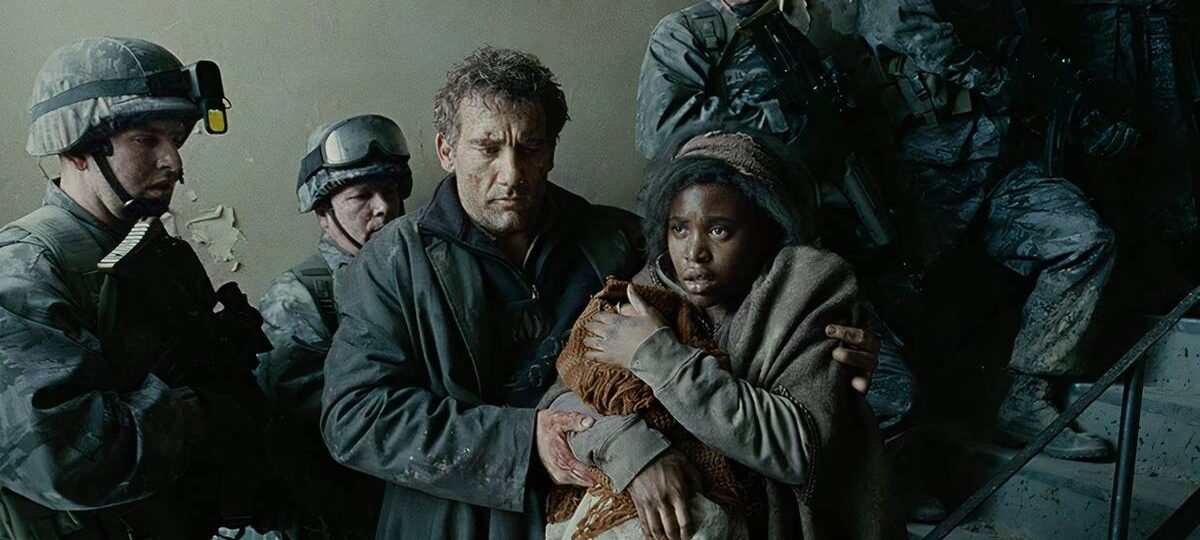
In a world where humanity has become infertile, civilization is left on the brink of extinction. But after young refugee Kee (Clare-Hope Ashitey) becomes mysteriously pregnant, Theo Faron (Clive Owen), a disillusioned activist, gets drawn into a mission to protect her. Navigating a Britain consumed by militarized borders, political violence, and anti-immigrant sentiment, the two must find a group that may offer humanity its last chance.
What makes Children of Men so powerful is how ordinary its apocalypse feels. Alfonso Cuarón fills the background with details of a society that has grown accustomed to cruelty and collapse, creating a future that feels disturbingly close to our own. Its long, immersive tracking shots place viewers directly inside the chaos, but the film’s true force comes from its own fragile sense of hope—one that will leave you aghast right as the credits roll.
Discover more from NAIRAVOICE.COM.NG
Subscribe to get the latest posts sent to your email.