
The World Cup 2026 is the first ever with 48 teams, the first ever played across three countries, and the first ever with regular hydration break, or better said, regular tv commercial slots. It is definitely not the first when it comes to frustration and desperation after a penalty miss, but a specific penalty technique is being scrutinized.
The player places the ball on the spot, walks several yards back and begins the approach. Then comes the first slowdown. A short step follows, then another. His eyes remain fixed on the goalkeeper, waiting for the slightest movement that might reveal where the empty side of the goal will be.
But, the goalkeeper stays where he is.
By the time the player reaches the ball there is little momentum behind the strike. The decision has still not been made, and the resulting shot is not strong and precise enough. The goalkeeper, who was once expected to gamble on a corner in which the penalty taker will shoot, makes what looks like a fairly normal save.
This has become one of the most familiar and frustrating sights at the 2026 World Cup.
According to Opta’s latest figures, only 39 of the first 60 penalties at the tournament were scored, including attempts in shootouts. The conversion rate of 65% is the lowest recorded at a single World Cup in the past 60 years.
The stutter-step cannot be blamed for every miss, but this tournament has exposed the growing weakness of a technique that too many footballers now appear to use by default.
Why the stutter-step once made sense
The purpose of a stutter-step penalty is easy to understand.
Instead of selecting a corner before beginning the run-up, the taker watches the goalkeeper. By slowing the approach and delaying the final decision, he tries to force the goalkeeper to move first. Once that movement begins, the ball can be rolled into the opposite side.
Its roots can be traced to the Brazilian paradinha, or “little stop,” popularized by Pelé and later pushed to its limits by Neymar. But, when the penalty rules changed, the conversion rates dropped significantly. Before, a player could even stop completely and then resume his run-up, but now the run-up needs to be continuous, and stopping is strictly forbidden.
The old paradinha gave the taker the final move. The legal stutter-step often leaves him trying to make two decisions at once.
Goalkeepers have learned to wait
For years, the biggest advantage of the stutter-step was the goalkeeper’s instinct to dive early.
A goalkeeper has very little time to reach a well-placed penalty. Committing before contact can be the only way to reach a shot going into the corner. That psychological battle gave a penalty taker something to exploit.
But, modern goalkeepers are far better prepared.
They have access to footage and detailed records of every penalty an opponent has taken. They know which players prefer to wait, which foot movements indicate a particular direction and which takers tend to lose power when the goalkeeper holds his position.
Statistical analysis also revealed why more goalkeepers should remain central, especially against players who frequently depend on an early dive. Standing still carries the risk of looking passive, but it completely removes the precise reaction that a stuttering taker is trying to provoke.
The tactical response does not always require the goalkeeper to remain motionless until the ball is struck. He only needs to delay the commitment long enough.
That fraction of a second changes everything. The taker has slowed his run to read the goalkeeper. The goalkeeper has slowed his dive to read the taker. Both are waiting, but only one of them has to kick the ball. The penalty taker often losses that standoff now.
Players often overestimate their abilities
A clean run-up gives the penalty taker several advantages.
He can build speed, establish a consistent final stride and plant his standing foot exactly where he wants it. His body arrives at the ball in a familiar position, allowing him to generate power or guide the shot toward a corner.
Repeated stutters interrupt that sequence.
The player shortens his stride, changes pace and often reaches the ball without the balance he would have during a normal strike. His attention is divided between the goalkeeper’s body and his own contact with the ball. When the goalkeeper refuses to move, the taker must suddenly choose a destination while also trying to recover enough power and precision to beat him.
Great technicians can still manage that process. Most players cannot do it consistently, especially under the pressure of a World Cup match.
This is why failed stutter-step penalties so often share the same appearance. They arrive somewhere between the center and the corner, at a saveable height, without enough pace to compensate for the placement.
The goalkeeper no longer needs to win a guessing game. He can react and make a normal save.
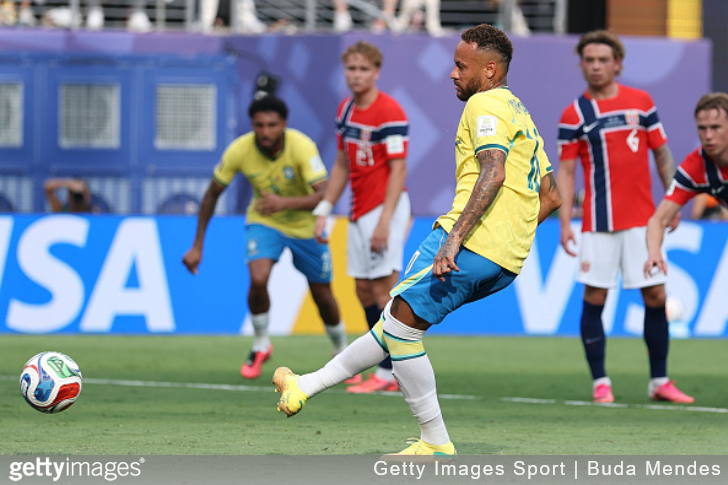
Brazil’s Bruno Guimarães provided one of the tournament’s clearest examples. He slowed his approach against Norway, but his eventual shot was close enough to Ørjan Nyland for the goalkeeper to push it away. If he scored from that penalty, Brazil would possibly sailed through the next round. Another example is Justin Kluivert, who struck the post after another hesitant attempt during the Netherlands’ shootout defeat to Morocco.
Harry Kane’s penalties against Croatia offered an even more direct contrast. His first stuttered attempt was saved, although it was retaken because Dominik Livaković had moved off his line too early. Kane abandoned the hesitation on the second attempt, used a straight approach and scored.
There are players who are still successful with this technique
Not all stutter-step penalties were saved. However, the success rate is even lower compared to 65% we mentioned earlier. Only 8 out of 15 penalties were scored by players using this technique. That’s abysmal. Imagine that you willingly lower your chances to 50% when taking a penalty kick.
The list of players who scored by using this technique is not long, and it showcases why every player should think twice before taking the penalty.
Raúl Jiménez has mastered it. The man never missed a penalty kick in Premier League, 14 out of 14. Cristiano Ronaldo, Neymar and Kylian Mbappé have all scored penalties using stutter-step on this tournament. This shows that only a player with exceptional balance, composure and control can keep watching the goalkeeper while retaining the ability to finish accurately.
These are special players, and the problem is when everyone else copies them.
A technique designed for players with remarkable control has become a standard routine for defenders, midfielders and occasional penalty takers. In a shootout, players who may take one competitive penalty every few years suddenly attempt a method that requires them to read an elite goalkeeper, adjust their choice during the approach and produce a precise finish from a broken stride.
The stutter-step can look effortless when performed correctly. That appearance hides how demanding it really is.
Pick a corner and strike the ball
A penalty already gives the taker an enormous advantage.
The ball is stationary. The goalkeeper must remain on the line until it is kicked. The target is more than seven meters wide, and the shot is taken from only eleven meters away.
A firmly struck penalty placed near the post remains extremely difficult to save, even when the goalkeeper chooses the correct direction. A shot into the upper part of the goal can be practically unreachable.
The taker does not always need to outthink the goalkeeper. He can simply produce a strike the goalkeeper cannot stop.
There will still be misses. Players will find the post, lift shots over the bar or encounter a brilliant save. At least those failures will come from attempting to use the fundamental advantage the penalty taker possesses.
The stutter-step surrenders part of that advantage voluntarily. It reduces momentum, delays the decision and allows the goalkeeper to wait for the strike, which will probably be weak and not precise enough.
Will we stop seeing stutter-step penalties after this World Cup? Certainly not. Successful examples will keep the technique alive, and elite players will continue searching for small psychological advantages.
However, coaching staff and statisticians must pay closer attention to this matter. Many players don’t have what it takes to successfully convert this type of penalty at a high rate.
That should lead them back to the oldest penalty advice of all: Pick a corner, run toward the ball, and strike it without hesitation.
Editorials
France vs Spain Bet Builder Tips – 6/1 World Cup Special, Analysis & Predictions
Editorials
World Cup 2026: Four Quarterfinals, Four Different Stories – Two Semifinals Worthy of a Final
Editorials
The Moment Everything Changed: How Thibaut Courtois’ Injury Sent Spain Past Belgium
Editorials
Argentina vs Switzerland Bet Builder Tips – 13/1 World Cup Special, Analysis & Predictions
Editorials
Michael Edwards Steps Away as Liverpool Faces Another Period of Change
Editorials
Norway vs England Bet Builder Tips – 6/1 World Cup Special, Analysis & Predictions
We use cookies to ensure you get the best experience on our website. By using our website you agree to our use of cookies in accordance with our Privacy Policy.
Discover more from NAIRAVOICE.COM.NG
Subscribe to get the latest posts sent to your email.