

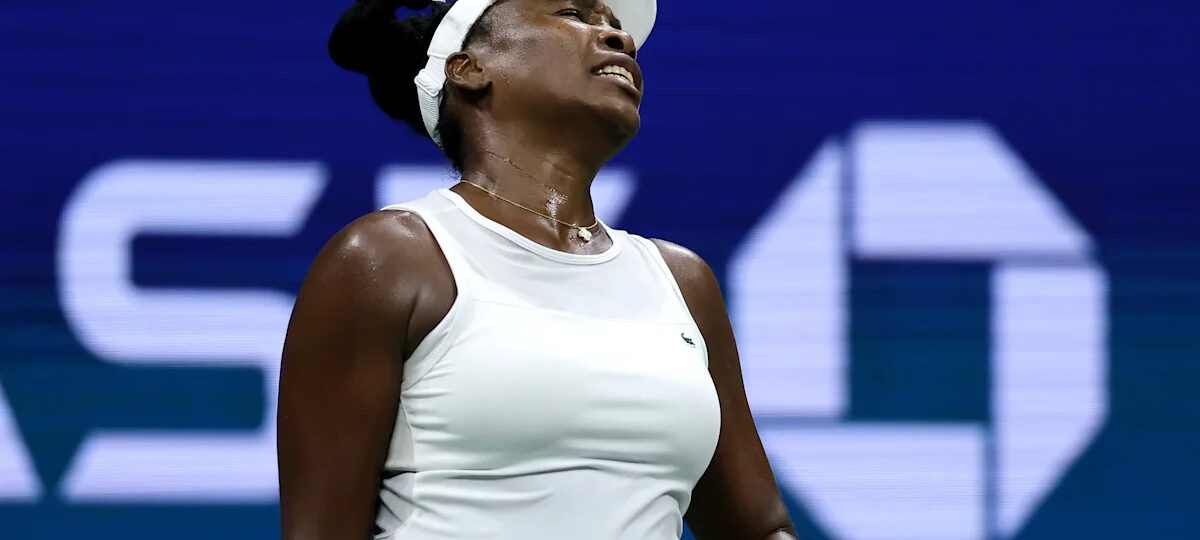
NEW YORK — Nobody who bought a ticket to Arthur Ashe Stadium for the first night of the US Open expected to watch Venus Williams beat Sofia Kenin, and she did not.
Instead, the bare minimum expectation was that the match would actually be played on Sunday — you know, the day it was scheduled.
Taking the court after midnight on Monday and finishing later than any first-round match in US Open history, the 46-year old who won this event in 2000 and 2001 did what she has done every other time she’s played in a singles tournament this year. She lost 6-2, 7-6 (8-6), dropping her record to 0-12 this year and 1-15 since last summer when she started asking for wild cards to get in events that her ranking (currently No. 618) would not otherwise allow her to play.
While trying not to be unkind here, it should be obvious to everyone — Williams most of all — that it’s time for this comeback to end. Wild cards are meant to be given at the tournament’s discretion, but even for someone who has meant and given as much to tennis as she has, there needs to be a limit. Williams is no longer competitive as a singles player, and putting her in a Grand Slam field at this stage feels decidedly unserious.
But it’s not as unserious as starting a sporting event after midnight.
Let’s back up for a moment before we get in the weeds on this one. Tennis, in general, has a scheduling problem at the Grand Slams.
It’s bad enough that when you buy a ticket to one of these events, you don’t know until the day before who you’re going to see or what time they’re going to play. That’s a strain on fans, but it’s kind of unavoidable.
On the other hand, there are ways to ensure that tournaments aren’t cheating their ticket-buying customers. And whether it’s Wimbledon’s 11 p.m. curfew that forces matches to finish the next day or the matches in Australia, Paris and New York that last until the wee hours of the morning, tennis is simply asking too much of the people who pay their hard-earned money to come to these events.
Look, there have been some classic, memorable matches at the US Open that lasted until 3 a.m. But the bigwigs in this sport have become entirely too comfortable with how often it happens, largely shrugging their shoulders whenever it comes up.
And to be fair, their job isn’t easy.
The US Open night session includes two matches — one men’s and one women’s match. The beauty of tennis and the problem with tennis is that there’s no clock. A women’s match could be 45 minutes or 3 1/2 hours. A men’s match, played in a best-of-five set format, could be 90 minutes or 5 hours.
And you can’t predict what’s going to happen. Nobody would have expected Novak Djokovic to play more than 4 1/2 hours before losing to Mariano Navone to begin Sunday’s night session. That’s why it took so long for Williams and Kenin to get on the court.
Logically, it would be better to put a women’s match first so that there’s no danger of waiting for a five-setter. But that’s also a TV decision involving which players ESPN wants to have in the heart of their primetime window. And ESPN’s vote matters — after all, they pay a lot of money for the rights to broadcast this event.
Nobody’s come up with a great solution for this.
The Australian Open has a similar problem to the US Open and will occasionally have matches that spill well into the next day. The French Open started a standalone match for its night session a few years ago to sell as a separate TV package. They’ve been criticized because nearly all of those matches have been men’s, with the reasoning being that you need to play a best-of-five in that slot rather than best-of-three to give ticket buyers the best chance at seeing a long enough match to justify the value. Wimbledon only has one session with three matches, and on a day where a couple of them go the distance, that causes problems because they are forced by local ordinance to shut down at 11 p.m.
In a perfect world, the US Open would start its night session earlier, but that idea has met resistance due to the difficulty of getting ticket buyers in the building on time if they’re coming from New York after work.
So, again, there are real problems no matter how you do it.
But starting a match after midnight and finishing just after 2 a.m. isn’t fair to fans, tournament officials or players. And it certainly wasn’t a great look for the US Open to put one of its former champions out there at such a late hour, in front of a mostly empty stadium, for what should ostensibly be her last-ever Grand Slam singles match. What’s the point of a goodbye if most of the country is already asleep?
Even if Williams-Kenin had gone first, that doesn’t solve the problem of how much it taxes everyone to conclude an evening of tennis so late. But until the sport’s bigwigs get in a room and decide that it’s unacceptable for matches to start at midnight, it’ll keep happening.
These aren’t easy problems, but you can’t solve them if you never even try.
Discover more from NAIRAVOICE.COM.NG
Subscribe to get the latest posts sent to your email.