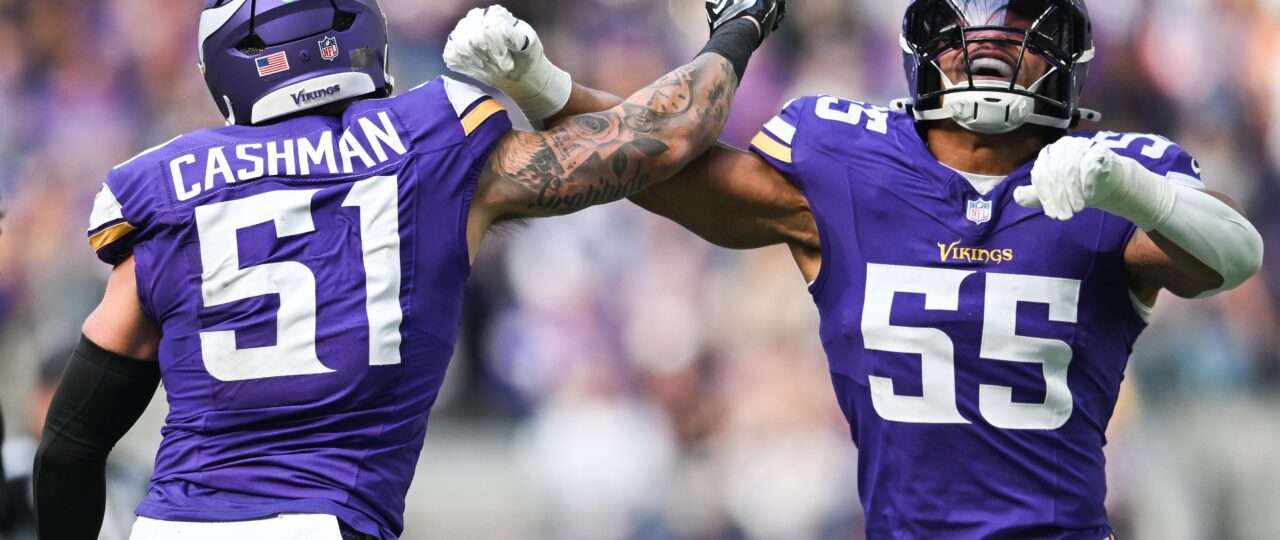

The Minnesota Vikings under defensive coordinator Brian Flores run a unique scheme that has become a hot topic around the league after dominating every opponent en route to a 6-0 start for the Vikings. It is a blitz-heavy scheme but it’s not about simply dialing up pressure and hoping not to get burned.
It’s Not Just About Rushing the Passer
The first thing to know about Flores’ blitz-heavy scheme is it’s not just about rushing the passer, it’s a total defensive philosophy designed to stop the run and pass, dictate the terms of engagement, and make execution for the offense more difficult- forcing mistakes. There are several intertwined elements to what is really a unique scheme in the NFL at the moment, which is rare.
Foundational Elements and Principles
The foundation of Brian Flores’ scheme is a five (or more) man front paired with a secondary playing zone coverage. That is what you are likely to see on around 80% of the Vikings’ defensive plays.
A 5+ Man Attacking Front
The defensive front operates an attacking, aggressive style, with defensive linemen penetrating gaps and linebackers blitzing and twisting. This contrasts with other schemes where defensive linemen are tasked with defending a gap-and-a-half or two gaps by catching blocks or taking on double-teams to keep linebackers clean. Edge rushers are tasked with setting edges, rushing the passer, or dropping into coverage. Beyond that, Flores will often place or walk-up other defenders to the line of scrimmage, either bringing or simulating additional pressure. The key in all of this is to pressure the quarterback and offense both physically and mentally- and not just occasionally but every down.
Zone Coverage
On the back end, the Vikings play a variety of zone coverages, frequently disguised pre-snap, and also man coverage on rare occasions. This contrasts with the man coverage that has typically accompanied blitzing fronts in the past. One key here is that the zone shell coverage is better able to prevent or limit the explosive plays that can result when a blitz doesn’t get home in time. The other key is that the coverages vary and can be difficult (or impossible) for a quarterback to differentiate pre-snap and often early post-snap as well.
Numbers, Angles, Matchups- and Chaos
The object of every football play or scheme is to create advantages in numbers (players), angles, and/or matchups. Brian Flores’ scheme is no different in that regard. But the high blitz rate on every down and the variability of blitz packages and coverages adds a degree or two of difficulty for opposing quarterbacks and offenses to deal with that can wear them down mentally as well as physically over the course of a game.
Flores’ pressure packages are designed to either create a free (unblocked) rusher by bring more numbers in a given space than the offense has blockers; and/or by creating angles that give defenders over their blockers; and/or by creating matchup advantages by forcing typically weaker blockers such as tight ends or running backs to block the Vikings’ edge rushers or blitzing linebackers.
Flores also uses numbers, such as 8-man fronts, to confuse offensive protection plans. Flores may end up actually rushing anywhere from three to eight men in such fronts, but which are coming and which are dropping is a constant struggle for offenses to identify. And even post-snap which players rush and which drop can be dictated by the blocking scheme employed. Deception and trickery are part of Flores’ scheme in this regard, as defenders may rush two steps to see if they are blocked or not and those that draw a lineman may then drop into coverage- leaving the lineman blocking nobody- while the ones that don’t draw a blocker continue their rush.
On the backend, the Vikings play a variety of zone coverages that are designed to both takeaway deep passes while also making underneath passing more difficult. The typical offensive counter to a blitz is to employ a ‘hot’ route, or a receiver running a quick route such as a slant or out or a screen that gives the quarterback a preplanned option in the event of a blitz. Or sometimes against man coverage the quarterback may throw a deep route hoping his guy comes down with it- particularly if there is a mismatch in his favor. Using a zone coverage shell makes that a guessing game as a quarterback is unlikely to know if his receiver is or will be open by the time the pressure arrives.
Zone coverage also differs from man coverage in that defenders have eyes on the quarterback while man coverage defenders are focused on the receiver. That can make hitting hot routes more difficult as defenders clue in on the target by watching the quarterback. Defenders also know based on the blitz call and offensive formation where the hot route is likely to be – and can look to shut that option down. And the variety of zone coverages- along with presnap disguises- forces a quarterback to try to read the coverage post-snap as the pressure in coming- which can lead to mistakes or holding the ball too long.
On running plays, stacking the line of scrimmage can also complicate run blocking assignments, overload blockers, clog rushing lanes, and either bring down the ball carrier or contain him in a small space until more defenders arrive to make the tackle.
Below is an excellent video outlining some of the main concepts Brian Flores employs as part of his scheme.
Setting the Terms of Engagement
Brian Flores’ uniquely aggressive blitz-heavy scheme allows him to set the terms of engagement, creating a playbook advantage as well. Opposing offenses are forced to react to what Flores and the Vikings defense is doing, rather than dictating the terms of engagement themselves.
The constant threat of pressure on every down through various blitz packages can limit opposing offense’s gameplan and playbook. Some plays and concepts simply won’t work very well against Flores’ scheme. Equally, Flores’ pressure packages can limit protection plans and route combinations. By forcing opposing offenses to adapt to Flores’ unusual scheme or pay the price, it adds a degree of difficulty not normally encountered on virtually every play- but particularly in the passing game. This creates a built-in advantage for the Vikings defense.
Experience is Tough to Beat
There is also the experience factor. Opposing offenses don’t face Brian Flores’ defensive scheme more than twice a year and most face it only once. They don’t have much experience working against this scheme. On the other hand, pretty much every starter on the Vikings defense and most of the backups have multiple years playing in Flores’ scheme and have developed a level of mastery that cuts down mistakes and allows them to play fast and with confidence. And every year the defense evolves and is fine tuned to correct flaws.
All that makes creates another advantage for the Vikings defense that is starting to be more appreciated. Most defenses don’t have the continuity the Vikings defense has had since Brian Flores came to Minnesota in 2023. Same coordinator, same general scheme, and for the most part the same players- especially the last couple years. And when an innovative, state-of-the-art scheme is mastered by versatile, veteran players that’s a combination that is tough to beat.
The Rubik’s Cube that Fights Back
The last aspect of Brian Flores’ scheme that even the imitators cannot replicate at this point is the communication and audibles in real time.
Quarterbacks may survey what the Vikings present presnap and make an audible to counter what he is seeing on the field, only for the Vikings to audible themselves and change the play as well, confounding the quarterback’s attempt to solve the defense. All the players are so experienced and fluent in the scheme that they can communicate and change calls in an instant to respond to whatever the offense is doing or changing. It makes it difficult to catch them off-guard with either a last second audible or even playing up-tempo.
Moreover, by giving his players the authority to make changes to the play calls, it becomes more difficult for opposing offenses to identify tendencies. Opposing teams may identify a defensive coordinator’s play call tendencies, but when those are altered by the players on the field based on what they see in real time, it becomes more difficult or impossible to gain much advantage in identifying and capitalizing on play calling tendencies.
And, at least so far, eventually opposing offenses get figured out before they figure out the Vikings defense. Through six games, the Vikings defense has given up fewer points each quarter as the opposing offense wears down- either mentally or physically or both. The Vikings defense has allowed an average of 4.3 points in the first quarter, 3.8 points in the second quarter, 3.7 points in the third quarter, and only 0.5 points in the fourth quarter.
So What Will Beat Brian Flores’ Scheme?
In the history of the NFL, there has never been a scheme that hasn’t eventually been countered and later fades away- sometimes coming back a decade or two later as the schematic cycle of the NFL continues. But at this point there are no obvious counters to Flores’ scheme. It is equally effective against the run and pass- pressuring the quarterback on passing downs and crowding the box on running downs. There has been some intermittent success with gap scheme runs compared to zone scheme, but I don’t know that it is a durable advantage. The Colts tried a run-heavy game plan against the Vikings as well but that didn’t work.
We have yet to see any offense have much success in the passing game as well. The Packers in week one had some explosive plays based on some defensive miscues rather than any sort of durable scheme advantage- and the Bucs had an explosive pass for a TD as well- also based on a player mistake rather than a schematic thing.
Future teams might have some success if they have receivers that are good at yards-after-catch and therefore can drive the field with a short passing game, but the Packers and Bears have good teams in that respect but still weren’t able to have much success in that area when it came to scoring points.
There hasn’t really been much success with opposing offenses generating explosive plays either as the shell coverages and pressure has effectively cut those opportunities down – as they were designed to do.
So, rather than opposing offenses figuring out counters to Brian Flores’ scheme, I suspect that in time it will fade with turnover. Maybe Flores gets a head coaching job and a new, less capable coordinator takes over. Or eventually the experienced veterans fluent in the scheme are replaced by those that aren’t as fluent- or aren’t as good- and mistakes become more common to the point where it is no longer effective. And of course there is always the threat of injuries that deplete the ranks of the experienced and fluent that could lead to decline as well.
We’ll see. What we do know is that Brian Flores’ scheme is facing its biggest challenges in the coming weeks with top ranked offenses including the Lions, Bills, and 49ers with the Packers also a solid and improving unit as well.
Follow me on X/Bluesky @wludford
Discover more from NAIRAVOICE.COM.NG
Subscribe to get the latest posts sent to your email.