
SOUTHAMPTON, N.Y. — Days at the U.S. Open are long and brutal.
“I’m tired,” said 36-hole leader, Wyndham Clark. “I’m going to really be looking forward to a nap.”
What did Wyndham do next? Walked straight to the driving range.
It made me wonder: What motivates players to head back to the driving range after a long day of grinding? What do they actually do there?
The U.S. Open is tracking every shot players hit on the driving range this week as part of the “RangeCast” feature on their app and website. And that data shows that players’ post-round practice sessions take a vastly different shape than their pre-round practices in a few specific ways.
Obviously, 100 percent of players go to the range before their round. But after their round, only 21 percent of players head back to the range.
The sessions themselves are shorter, too—they span 16 minutes and players hit 25 balls, compared to more than 20-minute sessions with north of 35 balls hit.
The shape of the sessions is different, too.
Pre-round sessions see players spend most of their shots on shorter wedge shots, then spread evenly the rest of their shots through the remainder of their bag.
Post-round range sessions see players focus heavily on one area of their bag.
- Dylan Wu, for instance, was the last player off the course Friday and went to the range to hit four shots—all 268-yard 3-woods. Hit a few good ones just to end the day with a good feel.
Dylan Wu, for instance, was the last player off the course Friday and went to the range to hit four shots—all 268-yard 3-woods. Hit a few good ones just to end the day with a good feel.
- Matt Fitzpatrick did something similar. 88 percent of the shots he hit on Friday afternoon were shots in the 260-yard range.
Matt Fitzpatrick did something similar. 88 percent of the shots he hit on Friday afternoon were shots in the 260-yard range.
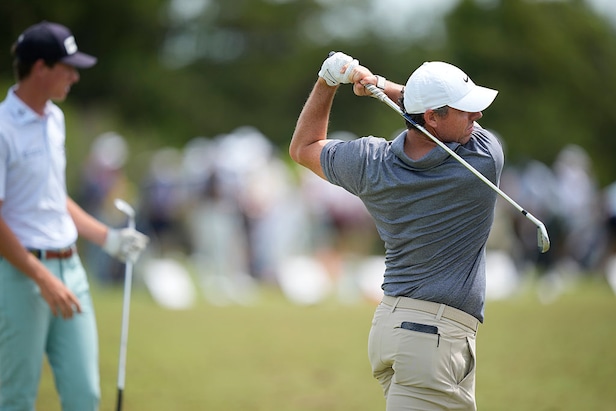
Others focus less on an area of their bag, usually a longer club, but rather pick one club to do their technical practice with. Lots of 6 or 7-irons they use to work on their golf swing.
Could also see the pair working on his setup.When his hands press and lift slightly, the clubface can open up pic.twitter.com/gN0agySnCA
Enjoying this article? Support our work with a small crypto donation.— LKD (@LukeKerrDineen) June 18, 2026
Could also see the pair working on his setup.When his hands press and lift slightly, the clubface can open up pic.twitter.com/gN0agySnCA
— LKD (@LukeKerrDineen) June 18, 2026
- Scottie Scheffler and Alex Noren are the best examples of this. They were each on the range for more than an hour on Thursday, and spent about 45 percent of that time hitting shots between 155 and 160 yards.
Scottie Scheffler and Alex Noren are the best examples of this. They were each on the range for more than an hour on Thursday, and spent about 45 percent of that time hitting shots between 155 and 160 yards.
All of which is to say that if the pros are any indication, you need to treat any post-round range sessions differently than what you do pre-round.
Pick one thing to work on for your post-round range sessions
Pick one club to hit about half your shots with
Hit wedges for feel and rhythm, but now isn’t the time to grind on them
Keep post-round range sessions under 30 minutes—and ideally closer to 15
A 5 minute, palate-cleanser range session hitting fewer than 10 shots to find a feel is totally normal
Do that and you’ll be following the same template the pros are using at the U.S. Open.
Discover more from NAIRAVOICE.COM.NG
Subscribe to get the latest posts sent to your email.