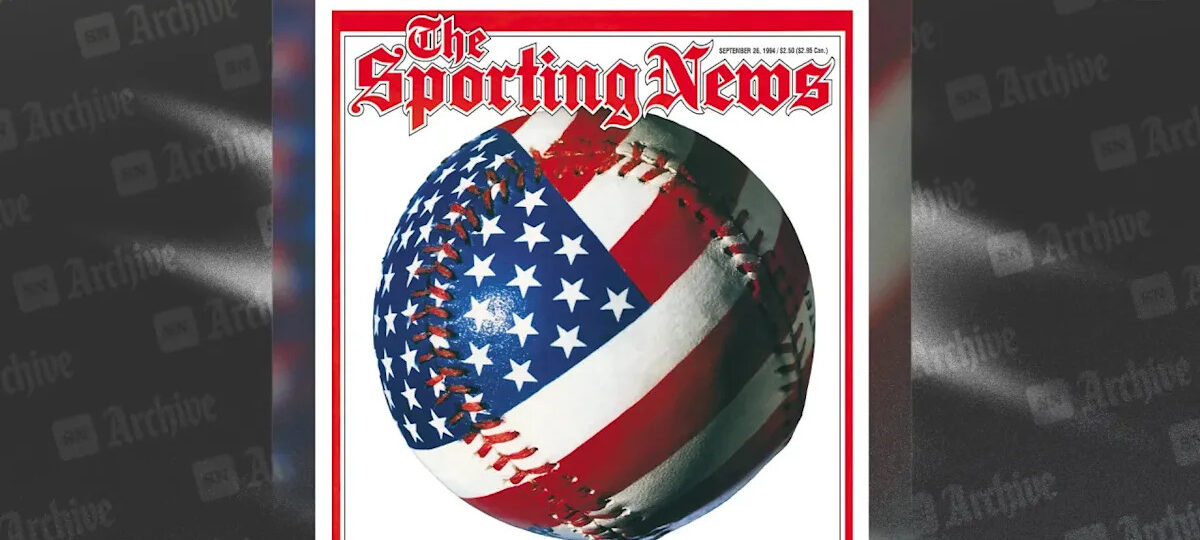

The October without a World Series (SN Archive — 1994) originally appeared on The Sporting News.
Add The Sporting News as a Preferred Source by clicking here.
This article, “Will they break?” by Steve Martinez, originally appeared in the Sept. 26, 1994 issue of The Sporting News.
Outwardly, the next phase of baseball’s strike is going to be fought in Congress, courtrooms and government agencies. But the only battle that matters may be taking place in the hearts and minds of players. The clubs are counting on it.
Because if all of the legal and political shots are fired over the next few months, and nothing gets settled, then there is a chance that next February the clubs will open their camps for business.
At that moment of reckoning, the Major League Baseball Players Association may be put to the most severe test of its triumphant, 28-year existence. As Red Sox General Partner John Harrington puts it, each player is going to hear a “guardian angel” whispering in his ear.
“The young guy is sitting there confused,” Harrington says. “He’s saying, ‘I’m supporting the strike — look at what the veteran players have done for me. Yet, deep down I want to play ball. I’m still trying to make it. I want to get going. I don’t want to give up the opportunity. I don’t want to sit around wondering if some replacement player is going to come in.'”
Harrington continues.
“And the guardian angel is whispering in his ear, ‘Remember, there’s a billion-dollar guarantee in there, and the owners are going to give you 50 percent of growth.’ And he’s saying, ‘Even if they impose their plan, it’s not so bad financially.'”
“That young man is going to be torn apart.”
“What about mid-career players?” Harrington is asked.
“The middle-level player is thinking, ‘Preserve my option for free agency. I want a shot at big money, too.’ And his guardian angel says, ‘You’ll get it after four years. That’s not a bad deal.'”
“And superstars?”
“The superstar is thinking, ‘I want to get back, it’s costing me too much money.'”
SN ARCHIVES: Access every SN issue since 1886, for free
When Bud Selig turned out the lights and locked the door last week, acting on a 26-2 vote of the clubs, he left behind him a house not only divided, but haunted, too.
Images of emptiness now carry the summer of 1994 into eternity: empty stadiums, clubhouses, parking lots, souvenir stores and hearts. Sports sections without box scores, sportscasts without baseball highlights. Children without understanding, adults without patience. Moguls and jocks without shame. Stories without endings, passion without climax.
One thing is certain. It can’t be long before a cultural guru puts one and one together and equates the collapse of baseball with the decline of America’s virtue — the metaphor is too tempting. For filmmaker Ken Burns is correct and baseball “offers us an opportunity to remember why we agree to co-here,” then it appears we will not be cohering for a while. Or coherent.
Losses are staggering: 52 days and 669 games from the regular season; the playoffs and World Series for the first time since 1904; $580 million in revenue from the owners; $230 million in salary from the players; and about 30,000 full- and part-time civilian jobs dependent on the baseball economy. Psychological loss is difficult to quantify, but if the embittered tone of sports pundits is an indication, then it is considerable. “The very word ‘baseball’ defines it now as never before,” writes Dave Anderson of The New York Times. “Too much of it is base. Not enough of it is ball.”
Over the next few months, lawyers and politicians will dominate baseball news.
The clubs are expected to implement their salary-cap plan, and the players are expected to challenge it before the National Labor Relations Board. The players are also expected to charge the clubs with unfair labor practices in a separate action.
Baseball business must be transacted, but nobody is sure how. Normally, free agents — about 195 this year — declare on October 15, or the day after the World Series, whichever comes first. Contracts are tendered in mid-November. Clubs can offer arbitration on December 7, and players can accept or decline by December 19. Contracts are tendered to players not eligible for free agency on December 20.
“It, in many ways, is embarrassing that the owners and players are responsible for shutting down an industry that the acts of World War I and World War II couldn’t do.” — Don Mattingly
All of these dates and decisions are up in the air. At the most, 170 players hold contracts that carry into next season. That leaves many players uncertain about the next few months. The union may recommend that players negotiate for next season, or it may advise them to wait for a collective-bargaining settlement. Even if it advises players to negotiate, it can continue to strike.
Activity on Capitol Hill could influence events before Congress goes home October 7. Bills in the Senate and House are seeking to modify the clubs’ antitrust exemption. Should they succeed, and the players gain a legal option, the strike could end immediately. President Clinton sounded an ominous note last week, saying, “If this has just turned into another business in America, then that’s an issue it seems to me that has to be examined.”
But legislation may have to wait until the next Congress convenes in January. That’s when Senate Majority Leader George Mitchell, unofficial commissioner designate, leaves office.
Will the union hold?
Ultimately, when the smoking guns of a thousand squint-eyed lawyers subside, and the pale sun of February lights the sky, that may be the only relevant question.
The notion that owners will use replacement players in an attempt to break the union is gaining momentum. Owners deny wanting to break the union, but their latent intentions may have been heard last week in the maverick voice of Reds Owner Marge Schott, whose vote was one of two (along with the Orioles’ Peter Angelos) acting against the season. Schott wanted to hold the playoffs using minor leaguers.

SN
“The fans would say, ‘Let’s see the real players instead of the million-dollar babies,'” Schott says.
Players and union officials no longer regard the possibility of replacement players as far-fetched, and are frankly apprehensive about withstanding such a tactic.
“They may very well break the union,” Blue Jays pitcher Dave Stewart says. “It’s not going to happen this year. We’ll have to see about next year.”
Already there is an indication that a few of baseball’s biggest names are reconsidering their position.
“In the owners’ wildest dreams,” says Lauren Rich, union assistant counsel, “they unilaterally implement an entire agreement and intimidate players across the board, young and old, journeyman and star, through … contractual negotiation tactics as if the union didn’t ultimately the contracts are. They threaten players with their jobs if they don’t sign in line. They then open the camps, invite in the minor leaguers, and wait for defections. They wait for defections and bring the players to their knees.”
But will such a plan work?
“The purpose of replacement games is to induce defections by individual players,” Rich says. “Why baseball hasn’t tried it is beyond me. It’s intimidating.”
“We don’t expect minor leaguers to come in — they understand what they have to benefit. Ninety percent of them expect to play in the majors.
“We tell our players if they stay unified it will play out well. If not, it won’t. Our players will hold firm. The clubs are making a tragic, costly mistake.”

SN
Would minor leaguers try to capitalize? The debate is forming. “I hope the players wouldn’t do that,” says Dave Silvestri, an infielder in the Yankees system for the past six years. “I know it wouldn’t be a scab. Those people up there are striking for everybody down in the minors.” Matt Arrandale, who won a combined 18 games for the Cardinals’ two Class-A affiliates this season, says, “That would be a tough situation. The opportunity to get to the big leagues — if I got that call, something inside would light up… But is it really big league ball? I don’t know what I would do.”
If the clubs are able to clear significant legal hurdles, then they try to “decertify” the union — that is, get a majority of players to renounce the union before the NLRB, says Marvin Miller, the union’s first executive director. Failing that, they may simply release all their players and, in Miller’s words, “start over.”
“They will attempt to get scabs to start the season, and they will be at least partially successful,” says Miller. “When you get careers that last only a few years, and you realize this is a multiple dispute, you’re bound to have some folding.”
But, Miller adds, “Even if you picture a defection here and there, I can’t picture a majority. It’s a numbers game. Two leagues of 14 teams. If you’ve got a lot of defections and you still couldn’t have a real schedule, what have you got?”
Recent history may prove instructive. In 1987, the NFL Players Association went on strike, and the clubs started the season with replacement players. A few veterans crossed the line — the Jets’ Mark Gastineau was spit upon — but by the third week, key players were back, on a team that included 49ers quarterback Joe Montana. When the Redskins decided to go in as a team, the 24-day strike ended with the rout of the NFLPA.
“The replacement games and the scabs hurt us,” recalls Dave Meggyesy, NFLPA western director. “Also the willingness of the networks to televise the games. The top dogs decided this had to be promoted. After a while, the public was given the impression that this was real football, no matter how sloppy it was. That scared the crap out of a lot of guys. Athletes tend to be pretty insecure anyhow. A lot of guys really wanted to get back. And the owners in football and the owners were very much like Selig. You had a couple of guys whipsawing the other owners.”
Comparisons between the football and baseball unions are gingerly made. For one thing, the baseball union has a $275-million strike fund. The football union had no strike fund. The football union did not have a fund.
Historically, the baseball union has enjoyed more solidarity, a byproduct of the game’s intrinsic culture, as well as aggressive leadership insisting that players be informed and participatory. Even so, small fissures have occurred. In the midst of the 50-day strike of 1981, cracks emerged when a group of player reps. In the 1990 spring lockout, Bob Boone and Paul Molitor rallied a group of players that challenged Donald Fehr’s position on salary arbitration, but the rift did not spill into the open.
Last week, the Yankees’ Don Mattingly issued a statement that was surprisingly self-critical: “It, in many ways, is embarrassing to me that the owners and players are responsible for shutting down an industry that the acts of World War I and World War II couldn’t do.”
Whether Mattingly’s bitterness reflects a sentiment that will lead to union defections remains to be seen. Owners can be expected to exploit natural fault lines between top-paid stars and minimum-salary players, and between old and young players. Although the average salary in 1994 was $1.2 million, the median was $480,000. An increasing number of veterans have been forced to take large cuts or sign minor league contracts.
“Thirty percent of the players are making 70 percent of the money,” Harrington says. “They have the same large-market, small-market dynamic as the owners.”

SN
Cracks, but no bats
Donald Fehr is touring the country to discuss the labor situation with players, and not a moment too soon. Cracks in his union are starting to show.
Jeff Bagwell, the Astros first baseman and probable National League MVP, became one of the first players to express concern about the union’s negotiating stances.
“What happened here so far is that the two sides sat there and said, ‘We want this and we want this,'” he tells the Dallas Morning News. “Well, that hasn’t worked. I think we might have to give something back to get this done.”
“Obviously the other way didn’t work. We’re sitting here without baseball, right? It’s embarrassing to me to be part of a baseball season that won’t have a World Series for the first time in 90 years.”
Market problem we do. I don’t think Fehr and his staff are concerned about the disparity of salaries.”
Players and union leaders do not deny differences exist, but say they are not divisive. At the same time, they acknowledge that fear and uncertainty are having corrosive effects.
“A strike is a scary thing,” Rich says. “Where you work is the second-most important place in your life. It’s where you have immense personal relationships. It’s not just a money issue, it goes to the core of personal security. When that is threatened, it’s scary. You kind of feel somebody has taken the floor out from under you.”
Sooner or later, each striking ballplayer will ask himself this question: If we lose, how much will it hurt?
Some are bound to answer: not too much. After all, the owners are offering 50 percent of revenues, with a baseline share of $1 billion. They are offering to raise minimum salaries above the $109,000 mark. There is money enough for superstar and journeyman alike.
When most unions lose a strike, their members are mad at a force they have beat. But baseball players are so far removed from financial discomfort, no pain will be felt.
Losing mostly means the erosion of a principle: freedom. Freedom to rise or fall on an unfettered labor market.
But how will that high-minded economic theory hold up against reality? Most American workers are limited in mobility and advancement: Openings for good jobs are rare and people are not fungible. Losing simply means that players will work under conditions similar to most Americans. If some players decide to settle for something less than ideal, if they accept the notion that making a living does not afford the luxury of idealism, then can they be faulted?
“Obviously, if nothing changes, next spring is going to be a big test of the players,” says the Astros’ Chris Donnels, a third-year player. “I hope the younger players realize that we’ve got what we have because the people before us made big sacrifices. If it takes us to make some sacrifices financially and professionally, then well, I hope some players take a long time and think through their decision.
“There’s going to be a select few who don’t care. They want what they have, and they’re going to play for themselves. There’s always going to be people like that.”
Over the fall and winter, players will be torn between conflicting impulses — one pragmatic, the other idealistic. The Blue Jays’ Stewart, who would be retiring after the season had the strike been averted, voices the former.
“You can’t expect guys not to take care of meaningful things like family,” Stewart says. “If guys think they have to play baseball, that’s what they have to do.”
Rangers pitcher Kevin Brown, who is in the prime of his career, expresses the latter.
“Self-respect means a lot to guys,” Brown says. “It’s a lot easier to look at yourself in the mirror. That’s something (clubs) don’t take into account. We know they don’t have our best interests at heart. They never have and never will. But we don’t believe they have rights to us like a commodity.
“A lot of guys are willing to say goodbye to the game and move onto other things and find other places to participate before they’re willing to accept those commiserations.”
Discover more from NAIRAVOICE.COM.NG
Subscribe to get the latest posts sent to your email.