
3Tips for you!
The shape of a World Cup is never defined solely by its established icons. Beneath the glare that follows familiar superstars, a new generation always emerges—players who arrive with raw momentum, ambition, and the sense that the tournament could mark the beginning of something much larger.
The 2026 World Cup, expanded in scale and global reach, offers perhaps the most fertile stage yet for young footballers to transform promise into permanence.
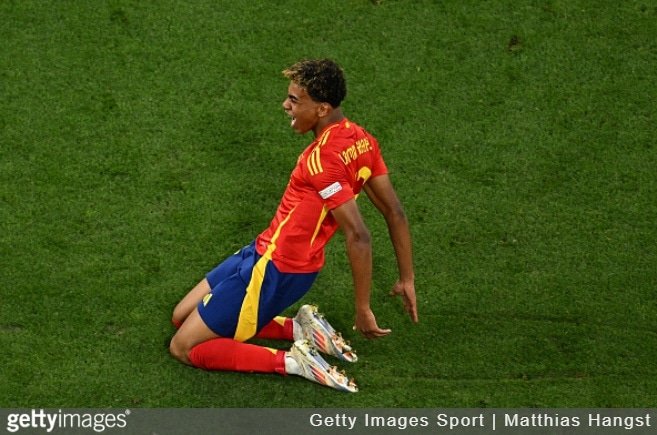
Lamine Yamal (Spain, 18) – Barcelona’s irrepressible creator
Few players of any age arrive at a World Cup with as much anticipation as Lamine Yamal, the 18-year-old Spanish international whose trajectory with Barcelona has been nothing short of extraordinary. Already a central figure in his club’s attack, the winger combines electric pace with a composure that defies his youth.
Operating primarily from the right flank, Yamal’s game is built around one-on-one superiority. His low center of gravity and instinct for cutting inside make him both a creator and a finisher, a prototype of the modern wide forward.
Transfer speculation has inevitably followed his rise, yet it is his symbolic value to Barcelona that shapes the narrative more than any concrete movement. In a market increasingly governed by youth potential, Yamal represents the idea of untouchability—a player whose worth transcends immediate transfer calculus. Even discussions of rumors tend to frame him less as a target and more as a benchmark for value in this generation, with reports of soaring market valuations reflecting his standing.
At the World Cup, his story is less about arrival and more about consolidation. This is a player expected not merely to participate but to influence matches decisively, potentially redefining Spain’s attacking hierarchy before he has even reached his twenties.
Endrick (Brazil, 19) – Brazil’s striking heir
Every World Cup seems to carry a Brazilian prodigy forward into the global conversation, and in 2026, that role appears destined for Endrick, the 19-year-old Brazil international whose rapid ascent has taken him from Palmeiras to Real Madrid.
Endrick plays as a central striker in the traditional sense but with distinctly modern traits: explosive acceleration, physical strength in tight spaces, and a ruthless finishing instinct inside the box. His presence as a focal point contrasts with Brazil’s recent reliance on fluid attacking rotations, suggesting a tactical evolution that could give structure to their forward line.
Transfer rumors surrounding him have largely subsided his season-long loan to Olympique Lyon, but the narrative has shifted toward how his standing at Real Madrid will influence his international role. The World Cup, in that sense, becomes a proving ground not just for Brazil but for his position within one of Europe’s most demanding environments.
It is this blend of expectation and uncertainty that makes Endrick compelling. He arrives not as an unknown but as a player whose club trajectory is already intertwined with the idea of global superstardom, waiting for international validation.
Warren Zaïre-Emery (France, 20) – Parisian control in the midfield
If attacking players often dominate conversations about youth, Warren Zaïre-Emery offers a reminder that control of games remains just as critical. The 20-year-old French international has already accumulated significant experience with Paris Saint-Germain, becoming a versatile presence capable of influencing multiple phases of play.
Nominally a central midfielder, Zaïre-Emery’s adaptability has seen him operate deeper or even wider when required, reflecting the tactical fluidity modern football demands. His strengths lie in positional intelligence and work rate, making him a conduit rather than a headline act—a player who dictates rhythm rather than simply reacting to it.
Transfer speculation around him has mirrored his growing importance. While PSG remains committed to his development, interest from across Europe underscores how rare his profile is: a young midfielder combining physical resilience with tactical maturity.
The World Cup could elevate his reputation further, particularly in a French side rich in attacking brilliance. Amid that depth, his role may be to provide balance—the quiet architect ensuring others can flourish.
Nico Paz (Argentina, 21) – The emerging Argentine conductor
Argentina’s tradition of producing technically gifted playmakers finds its continuation in Nico Paz, the 21-year-old Argentine international whose rise after leaving Real Madrid’s academy for Como has brought him into the spotlight. His breakout performances, marked by goals and assists, signal a player ready for a larger stage.
Paz operates primarily as an attacking midfielder, blending creativity with composure under pressure. His ability to carry the ball through midfield and unlock defenses aligns with Argentina’s historic playmaking lineage, yet his adaptability suggests he can function within more structured systems.
In terms of transfer chatter, his trajectory at Como has inevitably attracted attention from larger European clubs, particularly given his productivity and age profile. While specific moves remain speculative, his development is clearly being monitored by teams seeking creative midfielders capable of shaping games. Real Madrid reportedly want him back, Inter Milan are interested – but it seems Paz wants to stay with Como and play in the Champions League next season.
For Argentina, the World Cup could represent a passing of creative responsibility from an older generation to a younger one. Paz may not yet carry the burden of expectation, but he embodies the direction of the team’s evolution.
Aleksandar Pavlović (Germany, 21) – Bayern’s midfield successor
Germany’s search for midfield continuity after established figures looks increasingly resolved in Aleksandar Pavlović, the 21-year-old German international whose emergence at Bayern Munich has been both timely and convincing.
Pavlović’s role is that of a deep-lying controller, responsible for distributing possession and breaking up opposition play. His dual capacity as a ball-winner and playmaker places him at the heart of Germany’s tactical balance, a critical position in tournament football.
Transfer rumors, while present, tend to center on his long-term status within Bayern’s hierarchy rather than imminent movement. His importance to the club’s succession planning makes him a strategic asset rather than a negotiable one, though external interest reflects his rapid rise.
At the World Cup, Pavlović represents a broader narrative: Germany’s transition toward a new midfield identity. His performances could determine not just his personal reputation but the effectiveness of that shift.
The collective significance of these players extends beyond individual brilliance. Together, they reflect a broader trend in modern football: the acceleration of youth development and the increasing willingness of elite clubs to trust young talent at the highest level.
The 2026 World Cup, with its expanded format and increased exposure, is uniquely positioned to amplify that trend. More teams and more matches mean more opportunities for emerging players to step onto the biggest stage and carve out their reputations, echoing past tournaments where young stars have become global icons almost overnight.
In this context, the five names explored here are not merely prospects. They are symbols of a generational shift—players already embedded in elite environments, carrying the weight of expectation into a tournament that has always rewarded boldness.
The story of the World Cup has often been about legacy, but just as often it has been about first impressions. For these young footballers, 2026 promises to be both.
ABOUT THE AUTHOR
Veselin Trajkovic
Vesko is a football writer that likes to observe the game for what it is, focusing on teams, players and their roles, formations, tactics, rather than stats. He follows the English Premier League closely, Liverpool FC in particular. His articles have been published on seven different football blogs.
WE RECOMMEND
Most Popular Posts
Discover more from NAIRAVOICE.COM.NG
Subscribe to get the latest posts sent to your email.