A great movie ending can make an already fantastic film even more memorable. Sometimes, all it takes is a single shot to turn a movie into a cinematic masterpiece. The best final shots in movie history have a special way of sticking with viewers long after they leave the cinema or turn off their TVs. Masterful and legendary directors have earned their reputations because they understand how to end a film in an impactful way.
Here, we take a look at some of the films that have magnificent and memorable final shots. You’ll find films from great filmmakers such as Steven Spielberg, Stanley Kubrick, Francis Ford Coppola and Christopher Nolan. Whether it is a last-second twist or an ambiguous moment, these frames make an impact to the audiences as they cut to black. They can be triumphant, tragic, unsettling, or surprisingly simple, but they all share an ability to make a lasting impression with just a few seconds of screen time.
10
‘The Fabelmans’ (2022)
<<img src="https://static0.colliderimages.com/wordpress/wp-content/uploads/2026/10/the-fabelmans-ending.png?q=70&fit=crop&w=825&dpr=1" />
Image via Universal Pictures</figure>
In the final scenes of The Fabelmans, Sammy Fabelman (Gabriel Labelle) gets an unexpected opportunity to visit the office of director John Ford (played by David Lynch). During their conversation, Ford offers Sammy a blunt but valuable lesson about how the horizon should never be in the middle because it’s boring. After being dismissed, Sammy walks out of the studio with excitement. As he walks away, the camera’s framing initially places the horizon in the middle and then shifts up, as Ford suggested.
Based on Steven Spielberg‘s own story, the final scene with John Ford is a recreation of a real encounter between a young Spielberg and the legendary director. Sammy’s meeting with Ford is brief but foundational for him, and for Spielberg. The film’s adjustment of the horizon demonstrates that Sammy is not the only person learning something, the audience is also reminded of that. The initial shot is still beautiful, yet by having the camera slightly tilted, it also gives a different meaning. By pointing more towards the sky, it feels more hopeful than the shot before, indicating Sammy’s journey after the film ends. With this adjustment, the audience can feel that Sammy will become a successful filmmaker.
9
‘Fight Club’ (1999)
<<img src="https://static0.colliderimages.com/wordpress/wp-content/uploads/2022/11/fight-club-ending-scene.jpg?q=70&fit=crop&w=825&dpr=1" />
Image via 20th Century Studios</figure>
The ending of Fight Club comes after the Narrator (Edward Norton) realizes the truth about his relationship with Tyler Durden (Brad Pitt). The Narrator then tries to stop Project Mayhem’s plan to destroy buildings in the city. However, it is already too late. All that he can do is watch the buildings crumble together with Marla (Helena Bonham Carter). He holds Marla’s hands as everything collapses and the Pixies‘ “Where Is My Mind” plays over the scene.
The final shot of Fight Club captures the Narrator’s contradictions while leaving viewers with a memorable image. The Narrator finds the human connection he craves, just as his rebellion reaches its turning point. The Pixies’ song is perfect to accompany this moment, asking the state of mind of the film’s protagonist as well as being a killer soundtrack to end the film. There is also an uncomfortable ambiguity about whether the Narrator has truly escaped Tyler’s influence or simply carried his destructive philosophy to its conclusion. If you’re watching for the first time, it is a spectacular final shot that also gives the viewers time to think about the film’s famous twist.
8
‘Whiplash’ (2014)
<<img src="https://static0.colliderimages.com/wordpress/wp-content/uploads/2026/02/whiplash-2014-1.jpg?q=49&fit=crop&w=825&dpr=2" />
Image via Sony Pictures Classics</figure>
The ending of Whiplash culminates in an explosive performance that brings Andrew Neiman (Miles Teller) and Terence Fletcher’s (J.K. Simmons) destructive relationship to a head. After Fletcher deliberately humiliates Andrew by setting him up to fail during a public performance, Andrew initially walks offstage. However, he returns to the drums and begins playing an extended solo. Andrew’s boldness gains Fletcher’s respect and both fall into sync in the performance.
This memorable final shot from Whiplash delivers an exhilarating emotional payoff. The audience is treated to extended stressful situations just because Andrew cannot tell whether he’s rushing or dragging. The audience is still rooting for Andrew to be one of the best jazz drummers, and Fletcher, with his scare tactics, is still a formidable teacher. Their relationship is deeply abusive, yet Andrew’s final performance is exactly what Fletcher has been trying to cultivate. When their eyes meet and Fletcher acknowledges Andrew’s playing, the moment feels like a long-awaited mutual respect between the two. Damien Chazelle makes this an unforgettable and satisfying moment for both characters, as well as the audience.
7
‘Thelma & Louise’ (1991)
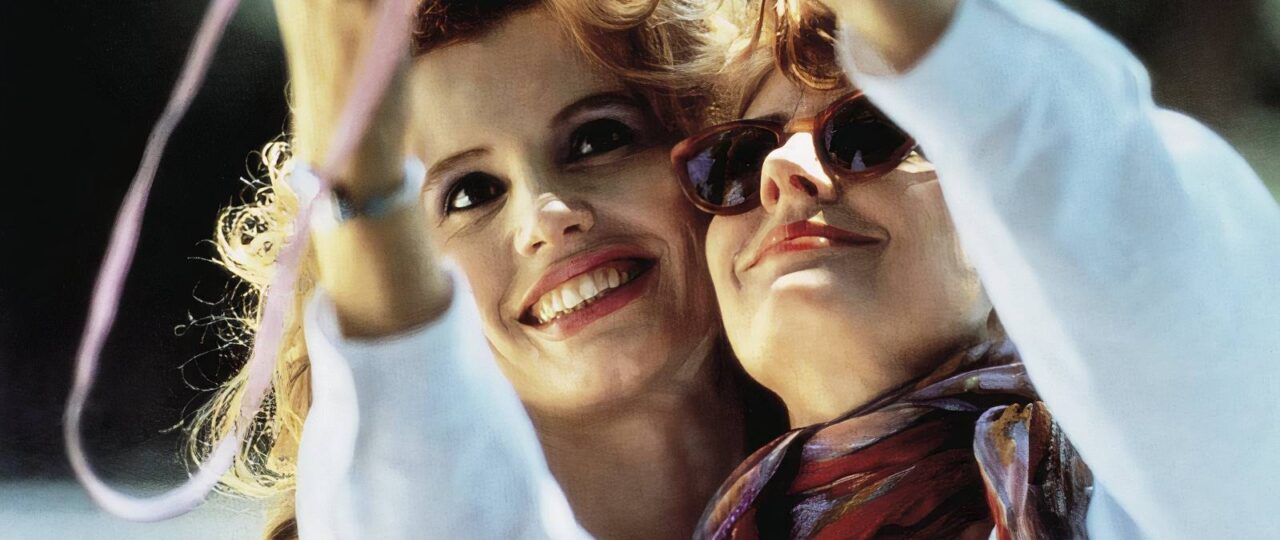
At the end of Thelma & Louise, the two women (played by Geena Davis and Susan Sarandon) are fleeing from the law. They find themselves surrounded by police officers who have pursued them across the American Southwest. Louise hesitates briefly when confronted with the prospect of arrest, but Thelma encourages her to keep going. The two share a final kiss, hold hands, and accelerate their car toward Grand Canyon’s edge.
The final shot of Thelma & Louise is unforgettable. Just because of this freeze frame, there have been countless debates about the fate of the two women. Throughout the film, Thelma and Louise discover how little control they have over their own lives. The leap to Grand Canyon can be interpreted as two things. If you’re being literal, that means Thelma and Louise do not see a way out and opt to kill themselves by plunging to the depths of the canyon. However, there is also another interpretation. This leap also symbolizes that they choose to be free. Their clasped hands reinforce the emotional core of the film: whatever happens next, they face it together. This final shot is so effective because it allows these interpretations to coexist without diminishing either one.
6
‘The Shining’ (1980)
<<img src="https://static0.colliderimages.com/wordpress/wp-content/uploads/2025/02/the-shining-jack-nicholson-overlook-hotel.jpg?q=70&fit=crop&w=825&dpr=1" />
Image via Warner Bros. Pictures</figure>
The ending of The Shining follows Jack Torrance’s (Jack Nicholson) final attempt to murder his wife and son inside the Overlook Hotel. When chasing them through the snow-covered hedge maze, Jack becomes lost and eventually dies of cold. The following morning, the camera moves through the hotel’s empty corridors before approaching a wall covered with photographs from the hotel’s past. Among them is a picture from a Fourth of July ball held in 1921, showing a younger-looking Jack standing among the guests.
Stanley Kubrick‘s final shot is one of horror cinema’s most enduring images. Throughout the film, the Overlook Hotel appears to possess a supernatural influence over its inhabitants. The photograph suggests that Jack has somehow always has a connection to the hotel, despite his apparent arrival as an ordinary man seeking employment. Some may argue that this shows that the hotel has taken Jack as part of its existence, and some say that Jack’s fate is written: he has to return to the place he belonged. It is a fascinating ending that invites more discussion. It elevates the experience of watching this classic, iconic horror film, leaving the audience with one more mystery.
Four franchises, four completely different ways of getting underneath
your skin. This is the one built out of your particular fear, why it works so well on you, and what
it would leave behind.
Your nightmare does not wait outside the door. It waits for you
to close your eyes, which you are going to have to do eventually, because nobody has ever
won that particular argument.
- Freddy is horror’s cruellest idea: a threat that lives in the one place you cannot
guard, cannot lock, and cannot avoid forever. - You are the one who is fine during the film and wide awake at two in the morning. Your
own head is where this does its damage. - These films understood exhaustion as a horror engine. The kids on Elm Street do not lose
because they are weak. They lose because they are tired. - You can lock every door in the house. You still have to sleep.
Your nightmare is not really the doll. It is the face of the
person you tell, and the way they decide, very kindly, that you have imagined all of it.
- Chucky works precisely because he is absurd. That is the trap: the more accurately you
describe him, the less anybody is going to believe you. - You are the one shouting at the screen because the characters are not listening. You
know that feeling from real life too. - The franchise is at its best when the adults in the room are the real obstacle, and you
have met those adults. - By the time somebody finally believes you, you will have handled most of it on your own.
Your nightmare has your number, knows your name, and has almost
certainly been inside your house before. The worst part is that you already know them.
- Scream is the only one of these where the killer takes the mask off and turns out to be
somebody who was at the party. - You are the person who calls the twist out loud before it lands. You watch people the
same way you watch films. - The franchise made the rules of horror part of the plot, which means the survivors are
the ones paying attention. You would be paying attention. - Everybody is a suspect, including the person who just offered to walk you home.
Your nightmare is not really about you. It is about the people
asleep down the hall, and the feeling that whatever is here is not interested in leaving.
- The Conjuring films are domestic horror. The house, the family, the perfectly ordinary
room that quietly stops feeling ordinary. - Your instinct is to get everybody into one room. Your fear is protective rather than
personal, which is rarer than it sounds. - This is the one franchise where belief is the weapon. The people who come through it are
the ones who are not alone and refuse to be. - Whatever is here did not come for you. It came for the household, and you are the one
standing in the hallway.
5
‘Memories of Murder’ (2003)
<<img src="https://static0.colliderimages.com/wordpress/wp-content/uploads/2026/06/memories-of-murder-song-kang-ho.jpg?q=49&fit=crop&w=825&dpr=2" />
Image via CJ Entertainment</figure>
The final moments of Memories of Murder bring Detective Park (Song Kang-ho) back to the scene of one of the murders that haunted him. Having left the police force and moved on with his life, Park stops at a drainage ditch where the body was found. A girl passing by tells him that another man had visited the same spot recently, because he had done something there in the past. When the girl mentions that the man looked ordinary, Park turns toward the camera and stares straight into the audience, his expression unsettled.
Throughout Memories of Murder, Park and his fellow detectives desperately search for a serial killer, relying on unreliable confessions and limited evidence. Their inability to solve the case becomes a devastating blow to them. However, Bong Joon-ho takes this failure one step further with this epilogue. Park’s gaze toward the audience realizes that the real killer is still roaming free and perhaps he might have met him during the course of his investigation. The shot also gains an extra layer of tragedy from the real-life case that inspired the film, as the serial murders remained unsolved when the movie was released. This final shot cemented the film as one of the best movies ever made.
4
‘Planet of the Apes’ (1968)
<<img src="https://static0.colliderimages.com/wordpress/wp-content/uploads/2024/04/final-scene-planet-of-the-apes-1968.jpg?q=70&fit=crop&w=825&dpr=1" />
Image via 20th Century Studios</figure>
The last moments of Planet of the Apes reveal the shocking truth behind Taylor’s (Charlton Heston) journey. After escaping from the ape-controlled society with Nova (Linda Harrison), Taylor travels along the coastline until he discovers the remains of the Statue of Liberty partially buried in the sand. He realizes that he did not land on another planet. Instead, he has been on Earth the entire time and its civilization has collapsed, replaced by intelligent apes.
Few final shots in cinema history have redefined an entire movie so effectively. For much of Planet of the Apes, audiences are set to believe that Taylor has traveled to a distant world where apes are the dominant species. The discovery of the Statue of Liberty completely overturns that assumption. The choice of including the Statue of Liberty instead of other landmarks is an effective one. What was once a symbol of freedom is now being used to symbolize that humanity has failed. Heston’s final cry seeing this makes the scene more harrowing. It’s a legendary final shot because it transforms the entire movie into a cautionary tale and delivers a twist that is not only shocking but also thematically essential.
3
‘Ikiru’ (1952)
<<img src="https://static0.colliderimages.com/wordpress/wp-content/uploads/2022/11/Ikiru---1952.jpg?q=49&fit=crop&w=825&dpr=2" />
Image via Toho</figure>
The final minutes of Ikiru see the playground that Kanji Watanabe (Takashi Shimura) has fought so hard to build before he died of stomach cancer. His efforts have created a place for children and families to enjoy. A police officer who has witnessed Watanabe’s dedication encounters a man sitting on a swing in the snow. The man is Watanabe, shown in a flashback from the final night of his life, quietly enjoying the playground he helped bring into existence while singing “Gondola no Uta”.
When Watanabe learns that he has terminal cancer, he initially responds with despair. He then turns that feeling into trying to create a lasting legacy that he also enjoys doing. The final image of Watanabe on the swing shows him enjoying the simple pleasure of seeing something meaningful come into existence. The shot also becomes more poignant when considered alongside the earlier gathering of his colleagues. Although they initially appear inspired by his example, their enthusiasm fades as they return to the very habits Watanabe challenged. This Akira Kurosawa film has been remade into a British film titled Living, which also holds up.
2
‘Inception’ (2010)
<<img src="https://static0.colliderimages.com/wordpress/wp-content/uploads/2026/08/inception-2.jpg?q=49&fit=crop&w=825&dpr=2" />
Image via Warner Bros.</figure>
The ending of Inception follows Dom Cobb (Leonardo DiCaprio) successfully returning to the United States after years of living on the run from the authorities. Cobb passes through immigration without being arrested and arrives at his family home, where his children are waiting for him. Before joining them outside, he takes the small spinning top to test whether he is dreaming or awake. But when his children call for him, he joins them and leaves his totem spinning in perpetuity until it cuts to black.
It is arguably the most discussed ending in the 21st century. Throughout the film, Cobb has been obsessed with distinguishing dreams from reality, using the spinning top as a physical reminder that he cannot afford to lose himself in an illusion. Christopher Nolan deliberately refuses to confirm that Cobb’s reunion is real, and he leaves it up to the audience to decide. There have been many theories about its ending, from people saying it is reality, a dream to the fact that Cobb might be using Mal’s totem to confirm his reality. This ambiguity has generated endless debate, yet the ending works precisely because it does not require a definitive solution.
1
‘The Godfather’ (1972)
<<img src="https://static0.colliderimages.com/wordpress/wp-content/uploads/2026/05/the-godfather-1972-10.jpg?q=49&fit=crop&w=825&dpr=2" />
Image via Paramount Pictures</figure>
In the final moments of The Godfather, Michael Corleone (Al Pacino) has consolidated his power as the new head of the Corleone crime family. His wife Kay (Diane Keaton) watches as several of Michael’s associates enter his office and address him as Don Corleone. One man kisses Michael’s hand, acknowledging his position as the family’s new leader, while Kay stands outside the office. One of the men begins closing the door, separating Kay from her husband.
At the beginning of The Godfather, Michael presents himself as a member of the Corleone family who wants nothing to do with his father’s criminal empire. However, his gradual transformation into a ruthless crime boss ultimately destroys that possibility. The final shot makes this transformation painfully clear without requiring another word of dialogue. The door effectively shuts her out of his life while protecting the secrets of his criminal empire. Francis Ford Coppola‘s The Godfather is considered one of America’s greatest films for so many reasons, and among them is the fact that this film has incredible blocking that speaks loudly, and it uses it to communicate the situation and the characters.
Discover more from NAIRAVOICE.COM.NG
Subscribe to get the latest posts sent to your email.