A New York native, Joe graduated from an avant-garde theater school upstate, where he was obsessed with sketch comedy. There, he and his lunatic friends founded The Sketchies — which still lives on at Skidmore College today. Living in New York City, a screenwriter friend of his then taught him how to write for film. This awakened a new passion in Joe. Since then his scripts have garnered over 200 festival selections, nominations, and wins all over the globe (including the BlueCat Best Feature award). Several of his screenplays have been made into feature films — some of them not that bad! Overall, he loves to create unique, hilarious, touching, and bizarre stories.
Oh, the 90s: what a time to be alive. The economy was booming, grunge music was flourishing, and just about every genre of film contributed at least one stunner with a glorious twist ending.
Obviously, this list is one giant string of spoilers — so, you are vehemently forewarned. Now, here are the most perfect movie plot twists of the 90s, a decade rife with intricately woven film devices. A lot of these flicks are in the thriller sphere, but there are also shocking gems that fall under drama, comedy, and action. Whichever way you classify these films, they all leave the viewer pleasantly head-spun.
10
‘Run Lola Run’ (1998)
<<img src="https://static0.colliderimages.com/wordpress/wp-content/uploads/2023/08/run-lola-run-1.jpg?q=70&fit=crop&w=825&dpr=1" />
Image via Prokino Filmverleih</figure>
Kicking off this list is a film that employs some major twists in a completely non-traditional way. This fantastically frenetic film begins with a very direct set-up, and then, almost out of nowhere, the action reverts, and the protagonist is given two different attempts to achieve her goal — all while German techno blasts, obviously.
Director/writer Tom Tykwer‘s movie begins with the Berlin baddie Lola (Franka Potente) receiving a call from her distraught boyfriend, Manni (Moritz Bleibtreu). He’s lost 100,000 Deutsche Marks on the subway and if he doesn’t recover this loot in 20 minutes, his drug kingpin boss is going to kill him. So, Lola literally races around the city trying to somehow find this specific amount of cash. Her first attempt fails in dramatic fashion…and then the clock resets. In a full exploration of chaos theory, she starts her mad dash again, this time with an alternate plan. Again, massive fail. So, she gets one more try…which leads to the final twist. She’s finally successful in her third attempt, but when she meets Manni, in this timeline, he’s recovered the cash himself, and so the whole insane endeavor was for nothing. Ah, that’s German ingenuity for you.
9
The Shawshank Redemption (1994)
<<img src="https://static0.colliderimages.com/wordpress/wp-content/uploads/2026/05/the-shawshank-redemption-1994-5.jpg?q=49&fit=crop&w=825&dpr=2" />
Image via Columbia Pictures</figure>
Mm-hmm, redemption indeed. The Stephen King novella, Rita Hayworth and Shawshank Redemption, turned feature film is one of the best movies of the 90s, without question. Capturing not only the mood of the decades featured in the action (the 40s through the 60s), but also that of the prisoner mentality of the time, director Frank Darabont‘s movie has lots of ups and downs, but no moment is as uplifting as the finale, which happens to contain quite the inventive twist.
Andy Dufresne (Tim Robbins) is an inmate in a penitentiary in Maine. He was wrongly accused of his wife’s murder and received a life sentence, but that doesn’t stop him from still trying to live his life to the fullest. His best buddy is the warmly wise Ellis Boyd ‘Red’ Redding (Morgan Freeman), and his nemesis is the Draconian, downright evil and corrupt Warden Norton (Bob Gunton). This man does everything in his power to suppress Andy’s seemingly indomitable spirit (along with those of all the other prisoners). Yet it’s Norton’s corruption that actually allows for Andy to have the last laugh. Andy systematically allocates the funds that Norton has pilfered and launders the cash — directing it to a bank account that only he can access under an alias (along with sending a newspaper a letter detailing all of Norton’s crimes against humanity). The ultimate twist comes when, after a routine cell inspection, it’s revealed that Andy is nowhere to be found. He spent the last twenty years chipping away at the wall of his cell (using a pin-up girl poster, of Rita Hayworth, to hide the hole) and digging a getaway tunnel to the sewer system — where he was able to eventually escape. The lesson, get busy livin’ or get busy dyin’, couldn’t be more heartfelt.
8
‘Funny Games’ (1997)
<<img src="https://static0.colliderimages.com/wordpress/wp-content/uploads/2022/08/funny-games-1997-michael-haneke-killers.jpg?q=70&fit=crop&w=825&dpr=1" />
Image via Madman Entertainment</figure>
Writer-director Michael Haneke is known for being quite the provocateur. His viscerally brutal yet philosophically compelling film Funny Games vividly illustrates this point. While he remade it into a nearly identical American version, with the same title, the original German-language film was a bit sharper, all around.
Two teen boys, Peter (Frank Giering) and Paul (Arno Frisch), come to the vacation house of a small family: Georg (Ulrich Mühe), Anna (Susanne Lothar), and their little son, Schorschi (Stefan Clapczynski). The teens ask for some eggs, and it initially seems innocent enough. Then the one kid drops the eggs, repeatedly, and Anna’s and the audience’s Spidey-Senses begin tingling; something is rotten in the state of Austria. The teens then begin systematically breaking down this little family, injuring them and holding them hostage. When the unthinkable occurs (the kid is killed), the viewer now inherently believes that justice is coming, and the teens will pay, big time. Eventually, Anna frees herself and shoots Peter dead. Aha. Karmic retribution. Well, not quite. Paul takes the handy TV remote and — completely breaking the fourth wall — “rewinds” the action, so that Peter is still alive and now sees Anna’s move coming before she can do anything. What the what? The twist here is that nothing is real; it’s a movie, after all. Yet, Haneke raises a bigger question to the audience: you’re invested in the characters, but why? You know they are fictitious entities going into the viewing, so why should it shock you that they are given a bum deal/unfair outcome? No matter how one dissects this sick work of blasphemous art, it always leaves a nasty taste in one’s mouth…and that’s exactly the pleasantly putrid point.
7
’12 Monkeys’ (1995)
<<img src="https://static0.colliderimages.com/wordpress/wp-content/uploads/2024/08/twelve-monkeys_aa7fqp.jpg?q=70&fit=crop&w=825&dpr=1" />
Image via Universal Pictures</figure>
While basically every decade since he hit the scene has been a good one for Brad Pitt, perhaps none showcased his range the ways the 90s did. One of his earliest, wildest roles takes place in the mind-bending Bruce Willis vehicle 12 Monkeys, directed by Terry Gilliam. While there aren’t any actual primates in the film, there is a lot of sci-fi monkey business going on, and the ending is truly bananas.
The plot of this film is crammed full of twisty turns, from the first act to the last. Set in 2035 (which eerily doesn’t seem that far off now…), most of humanity lives a subterranean life after a (man-made) virus has wiped out the majority of the world’s population. The good news is that some scientists have developed time travel; all they need is a test subject to go back in time to snag a pure sample of the early virus so they can create a cure, back (to the future) in the present. They pick a prisoner, James Cole (Willis), for the mission. What does he have to lose, right? It should be noted, the traumatized James has had a recurring dream since he was a mere boy; that of a man in an airport getting shot. Anyhoo, James goes back, appears to be a lunatic, links up with psychiatrist Dr. Kathryn Railly (Madeleine Stowe), and then ends up in a mental hospital where he encounters Jeffrey Goines (Pitt), an eco-warrior possibly responsible for the release of the nasty bug (he’s part of the “Army of 12 Monkeys,” which sounds less like an eco-terrorist group and more like an indie rock band). It’s not until the final sequence that it’s revealed that it was actually a deranged scientist, Dr. Peters (David Morse), who was responsible for the viral outbreak. James finds Peters in an airport, and before he can stop him, James is shot by airport police (he should’ve taken his shoes off before going through security), as a little boy watches this unfold — who turns out to be James himself (that’s where the dream came from). The swirly icing on this twisty cake is that once Peters boards a plane, en route to deploying the virus worldwide, the passenger next to him says her name is Jones (Carol Florence), and she’s “in insurance.” This final moment is a bit open-ended, but the ‘insurance’ quip seems to suggest she is there to get the pure virus sample, once and for all.
6
‘Being John Malkovich’ (1999)
<<img src="https://static0.colliderimages.com/wordpress/wp-content/uploads/2025/07/being-john-malkovich-1999.jpg?q=49&fit=crop&w=825&dpr=2" />
Image via Universal Pictures International</figure>
Most people that view this film are too busy trying to unpack all the metaphysical wackiness that occurred throughout the entire runtime to even let the bombshell ending twist really sit with them. While this hilarious Spike Jonze directed, Charlie Kaufman penned, work of sheer genius has wild turns throughout, its final mic drop of an ending is perhaps the film’s peak moment.
Craig Schwartz (John Cusack) is an out-of-work puppeteer, desperate to find work in his field. This is futile, even with all the support from his loving wife, Lotte (Cameron Diaz). Craig nabs a job at an odd company on the “7 and a half” floor of a building in NYC (in a nod to surrealist playwright Alfred Jarry, who lived in a “half floor” apartment in Paris, and also scribed the play Ubu Roi that was performed with puppets). Craig accidentally discovers an odd, fleshy hole behind a cabinet — that is a portal into the mind of the actor John Malkovich. So, Craig and his snarky co-worker Maxine Lund (Catherine Keener) open a covert business selling “rides” into Malko’s consciousness. Eventually, it’s revealed that Craig’s elderly boss, Dr. Lester (Orson Bean), has been readying himself and some senior citizen friends to enter the portal together and take over Malkovich’s body forever. There’s a lot more to this, but, basically, Craig wants to use Malkovich’s fame and money to lock down Maxine and enters the portal too late. He’s diverted to the subconscious of Maxine’s new baby — who Maxine raises with Lotte — where Craig is a silent prisoner, forever. It’s all quite heady.
5Enjoying this article? Support our work with a small crypto donation.
‘The Game’ (1997)
<<img src="https://static0.colliderimages.com/wordpress/wp-content/uploads/2024/01/the-game-1997.jpeg?q=49&fit=crop&w=825&dpr=2" />
Image via Walt Disney Studios Motion Pictures</figure>
Some games are fun. Some games are exciting. And then there’s The Game, which may or may not cause the player to intentionally plummet to their apparent demise. Master of the shadowy shot, David Fincher, directs this masterwork in manipulative mind games and, wow, is it ever decadently dark.
Nicholas Van Orton (Michael Douglas) is a rich dude who is so accustomed to having everything in life that basically nothing excites him anymore. His freewheeling brother, Conrad (Sean Penn), gets him a gift for his birthday, simply called “The Game.” Before Nicholas even realizes it, he’s playing. It’s just, this game is so exhilarating and disruptive, it seems that it’s veered off course and Nicholas’s life is actually in grave danger. After a series of incidents that are beyond harrowing, Nick finds himself on the roof of a very tall building, his entire fortune having been wiped clean, apparently being hunted by a vast network of high criminals — with seemingly no way out. He opts to jump, ostensibly ending his life…only there’s a big suicide prevention balloon underneath him. This was all part of the game, as Conrad and other birthday party guests pop out and congratulate Nicholas on a well-played adventure. Hmm. Fun.
4
‘Se7en’ (1995)
<<img src="https://static0.colliderimages.com/wordpress/wp-content/uploads/2022/04/Se7en-(1).jpg?q=49&fit=crop&w=825&dpr=2" />
Image via New Line Cinema</figure>
“What’s in the box?” Ah, a question for the ages. David Fincher’s pitch black, bleak, awful thriller is one of the most satisfyingly perverse films ever produced. With a dark mystery insidiously pulsing through the whole film, this wonderfully waterlogged movie is thrilling throughout, and culminates in a twist of pure, heartless beauty.
Detective Mills (Brad Pitt) is a newbie cop in town, whereas Detective Somerset (Morgan Freeman) is a veteran, on the verge of retirement. When a string of sick murders/assaults occur which appear to be under the religious umbrella of the seven deadly sins, the two gumshoes know they’re in for a wild ride of a case. As they try to home in on the culprit (before the seventh crime is committed/enacted), the alleged perpetrator, John Doe (Kevin Spacey, at his creepiest), turns himself in. It’s a baffling move, but he calmly croons that he will lead the detectives to the final crime site if they accompany him to a yet undisclosed location, alone. They comply, and that’s when it gets really interesting. A clueless delivery dude shows up with a box, meeting John, Mills, and Somerset, in a remote part of the Californian desert. Well, the box contains the head of Mill’s wife, Tracy (Gwyneth Paltrow). John explains that his own personal sin was “envy,” as he envied Mill’s nice, normal, wife-having life. The final sin left to commit is wrath…which Mills, between bitter tears, executes, putting a bullet in John’s head. It’s an ironic ending; John Doe, the villain, wins — even though his brains get blown out. All in all, a mind-blowing experience…for the character and the audience.
3
‘The Usual Suspects’ (1995)
<<img src="https://static0.colliderimages.com/wordpress/wp-content/uploads/2023/01/kevin-spacey-in-the-usual-suspects.jpg?q=49&fit=crop&w=825&dpr=2" />
Image via Gramercy Pictures</figure>
Who is Keyser Söze? That’s the main question at the heart of director Bryan Singer‘s crime-action-thiller-mystery The Usual Suspects. With one of the most well-crafted scripts of the decade, not to mention searingly stellar performances, brilliant direction, sharp cinematography, and crisp editing, this film hits all the right notes throughout its symphonic runtime. And, naturally, it concludes with one of the most jaw-dropping, and coolest, twists in movie history.
The film is framed with a very nifty device; a low-level career criminal, Verbal (Kevin Spacey, having a banner year), is interrogated by the bullish, blowhard detective Dave Kujan (Chazz Palminteri), in a precinct room. The loquacious Verbal, who has a disability that impedes his arm and leg from functioning normally, reluctantly provides Kujan with info surrounding a boat heist gone wrong. Verbal and a deliciously diverse cadre of crime types, including the clownish McManus (Stephen Baldwin), the wisecracking Hockney (Kevin Pollak), and mumbling Fenster (Benicio Del Toro), were given faulty information and most of them ended up dead during the botched robbery. Kujan presses Verbal about the de facto leader of the group, Keaton (Gabriel Byrne), accusing him of being the notorious Söze. Eventually, Verbal is released, and that’s when it hits Kujan: Verbal was giving an Upright Citizen’s Brigade-level improv class, as he took random words, names, and phrases from around the office and spun them into a long-winded yarn about the whole criminal endeavor. As Verbal loses his limp and lights a cig, we collectively realize that he was the lethal rapscallion Keyser all along. Mind. Blown.
2
‘Fight Club’ (1999)
<<img src="https://static0.colliderimages.com/wordpress/wp-content/uploads/2022/12/owning-you.jpg?q=49&fit=crop&w=825&dpr=2" />
Image via 20th Century Studios</figure>
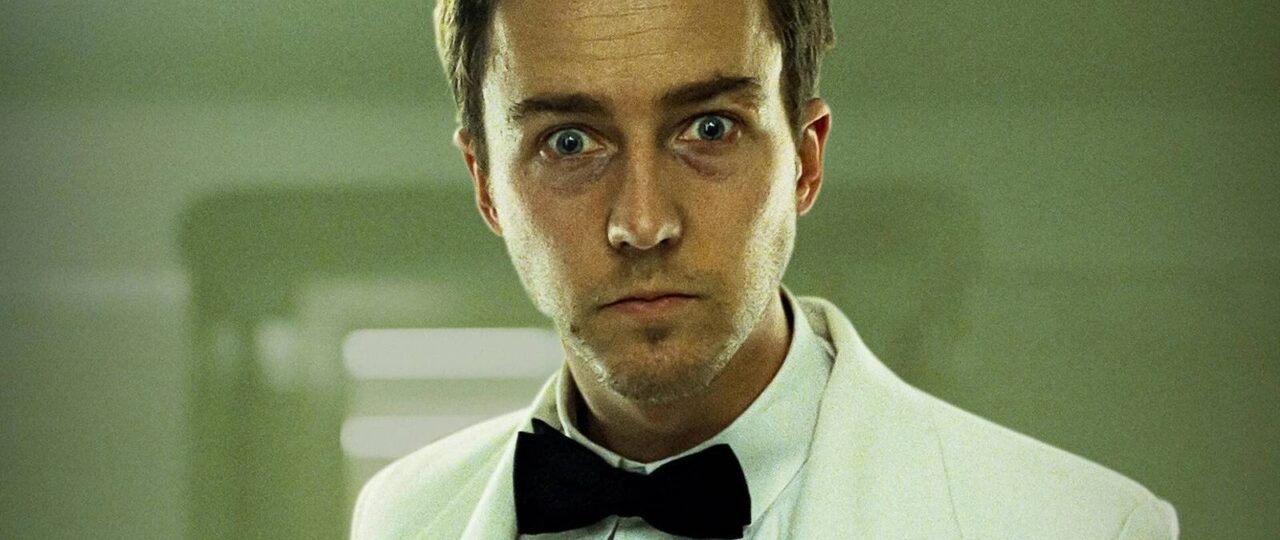
The first rule of Fight Club may be that you don’t talk about Fight Club, but here, we simply must. The phenomenal Chuck Palahniuk novel turned David Fincher film begins with the explosion of the unnamed protagonist’s condo, and never lets its filmic foot off the gas. Yes, this movie is the physical manifestation of octane fuel mixed with 100-proof testosterone, but there’s oh so much more to it than just boys masquerading as manly men.
The Narrator (Edward Norton) is a milquetoast dude, working a boring job, living an Ikea-inspired life. He has chronic insomnia that eventually becomes a major factor in the twist ending. He begins going to nighttime support groups (for afflictions that he doesn’t have). Here he meets Marla Singer (Helena Bonham Carter), a tsunami of disaster in cool sunglasses. Also, during his travels, he encounters what can only be described as his polar opposite: Tyler Durden (Brad Pitt), the badass artisanal soap entrepreneur who is everything the Narrator wishes he could be. After starting an underground fight club, which blossoms into a national movement of chaos and calculated destruction, the Narrator eventually comes to a disturbing conclusion: he is Tyler. The real fly in the ointment is that Tyler wants him dead, and seems pretty intent on making this happen (along with blowing up all the financial institutions in the city). Probably the most entertaining examination of multiple personality disorder caught on celluloid, Fincher’s darkly comedic thriller has one of the coolest twist endings ever — accompanied by the perfect Pixies song.
1
‘The Sixth Sense’ (1999)
<<img src="https://static0.colliderimages.com/wordpress/wp-content/uploads/2025/03/the-sixth-sense-1999.jpg?q=49&fit=crop&w=825&dpr=2" />
Image via Walt Disney Studios Motion Pictures</figure>
Unless you’ve been living under a rock, that’s buried under a boulder, that’s housed in an end-of-the-world bunker, you probably already know the brain-exploding twist that drops at the end of The Sixth Sense. If not, whoo-hoo, are you in for one sensationally spooky spoiler (even comic Nate Bargatze made fun of people who don’t know the end of this movie by now). Seriously, if you don’t know what the big reveal is, stop reading this article immediately, find auteur creator M. Night Shyamalan‘s supernatural mystery streaming somewhere, and watch the heck out of it.
Cole Sear (Haley Joel Osment) is a boy with a unique gift that actually is much more of a curse: he sees dead people (as the now infamous lines goes). He connects with a child therapist, Malcolm Crowe (Bruce Willis), who has a knack for helping disturbed children, even if his track record is not exactly perfect (one of his former patients, Vincent Gray (Donnie Wahlberg), shot him). So, Malcolm spends the majority of the film trying to help Cole navigate the unsettling world of the undead…only to finally realize that he is a ghost as well. It’s probably the most perfectly executed twist in cinema history, but hey, that’s just the opinion…of basically everyone.
Discover more from NAIRAVOICE.COM.NG
Subscribe to get the latest posts sent to your email.