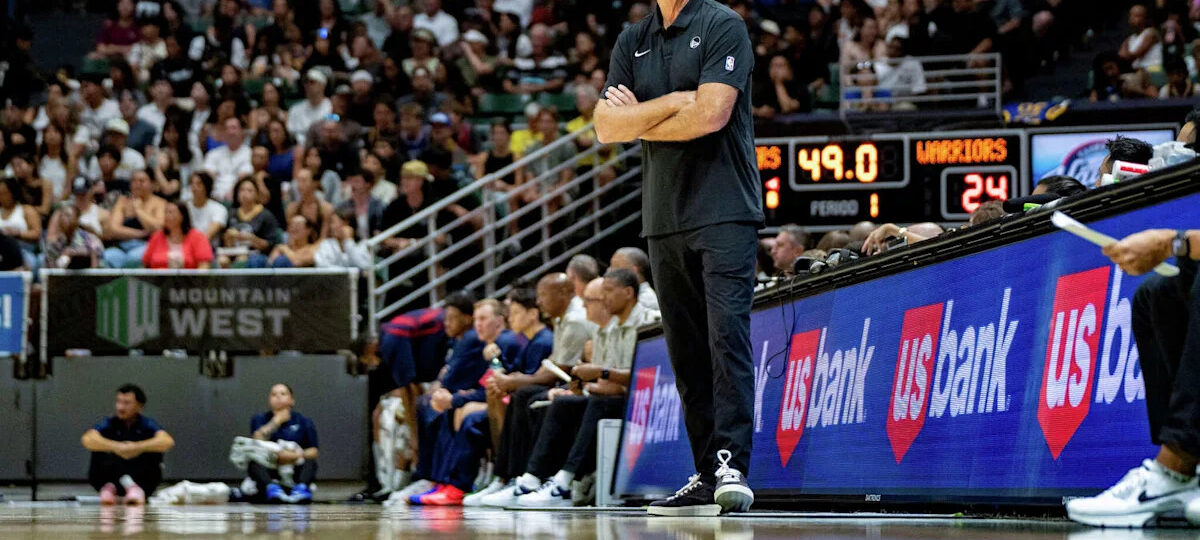
This should be the most relaxed day of the year, and yet Steve Kerr stands at attention along the baseline, arms folded and ready for demonstration. His Warriors are not where he wants them to be – or needs them to be – and never mind the thousands above at Chase Center, wanting simply to enjoy a Sunday-afternoon matinee. The show is not operational, yet.
New point guard Brandon Williams grabs an outlet pass, and down-shifts. A week ago, Kerr had a 10-minute conversation with the lightning-quick Williams about the importance of taking care of the ball. Here, though, Williams charges down the floor without much looking up, spins a yo-yo dribble, and promptly smokes a layup off the backboard. Good as a turnover.
This is not a game. Not even a scrimmage. Just some five-on-five at an open practice. Kerr, still, turns to nobody in particular, shakes his head, drags his hands through his roots, and rips them down with disgust.
“He said recently, ‘That ball is gold,'” Warriors assistant Anthony Vereen told the Chronicle, a few days earlier. “‘Gold. You don’t hand out gold.'”
The Warriors, Kerr knows, need to win in the margins in 2026-27. He returned this offseason on a two-year deal – in favor of walking away – on a belief he could coach them there. When those margins are ignored, he ignites, a nine-time NBA champion who has found his spirit again.
At the start of an open practice during training camp in Hawaii, Kerr stopped a sloppy action and yelled “What the f-!” as soon as reporters entered the gym. After a fourth-quarter turnover against the Lakers in Las Vegas Oct. 13, he yanked at the spiky strands atop his head, as if pulling the follicles out would reveal answers. He went viral after Golden State’s second preseason game in early October, TV cameras catching Kerr clapping and shouting in fury after – to assistant coach Kris Weems’ recollection – two-way youngsters LJ Cryer and Graham Ike messed up a sideline out-of-bounds play.
“It,” Weems recalled, “had been building up.”

Warriors head coach Steve Kerr speaks to Stephen Curry during an Oct. 6 preseason game against the Lakers. (Ezra Shaw/Getty Images)
By the end of last season, Kerr was drained. He felt he failed the Warriors, in a 37-45 season awash with injuries and confounding losses. He thought he might move on, and he thought Joe Lacob and Mike Dunleavy might want to move on from him, with his contract expiring. Bruce Fraser, Kerr’s longtime assistant and close confidant, felt his old friend’s hair was greyer. So was his face.
“He was starting,” Fraser told the Chronicle, “to lose some of his life force. And I think that was a part of what he wanted back.”
It is back, in Year 13. Kerr’s staff sees it. Draymond Green, a man similarly fueled by spirit, sees it, too. Kerr looks “refreshed,” Green said after that preseason game in Vegas.
The Warriors looked a mess in a season-opening, 127-105 loss to the Lakers in Los Angeles Wednesday. Four ostensible starters – Jimmy Butler, Moses Moody, Kristaps Porzingis, Brandin Podziemski – were out. The roster is patchworked with holes at wing and center. The challenge is as great as it’s ever been, because Kerr is coaching against time itself.
“I’ve been at a point in my career where people think I’m done – even early in Steph’s career, he’s been at a point where people thought he was done,” Green told the Chronicle Oct. 13, referring to Stephen Curry‘s early career ankle issues. “Steve, as a coach, has never been at a point in his career where people thought he was done.
“So I think in saying that – I think once the thing drew him in, it’s like, ‘Oh, y’all think so? All right, motherf-er,'” Green continued, grinning. “Because that guy is competitive as s-.”
The daisies
Why, exactly, is Steve Kerr back, after it looked like he had hugged Curry and Green goodbye in the final moments of Golden State’s play-in elimination last spring? Hours later, he held court in a nook of the lobby bar at the Arizona Biltmore with longtime assistant Bruce Fraser, associate head coach Terry Stotts and ESPN reporter Wright Thompson, nursing a beer and the wounds of a failed season.
“I honestly thought,” Fraser recalled, “that he was going to walk away.”
Kerr is an open novel with Fraser, a longtime Golden State assistant and a long-ago former teammate at the University of Arizona. Too open, last season. Fraser told Kerr, at one point, that he had to stop pulling daisies. Win, and he was staying. Lose, and he was going to retire. The game loved him. It loved him not. Endless petals, for 82 games. We’re not doing this, Fraser told Kerr.
But they were doing it again, at the Biltmore, after the Phoenix Suns bounced the Warriors for an unceremonious end to an unceremonious season. And Fraser could sense, above all, that his friend was tired.
“The feeling much of last year was, we were swimming upstream,” Kerr recalled, in a long phone conversation with the Chronicle last Sunday night. “I also believe in karma. And we didn’t earn our karma last year. We didn’t have the right approach, to get luck on our side.”
After that Phoenix loss, Kerr took two weeks away to recharge and wrestle with the future. His agents and Mark Bartlestein – Kerr’s former player-agent across a 15-year NBA career – made sure he knew the other NBA jobs available. Kerr’s camp, Bartlestein said, had “all kinds of people knocking on our door.” But Kerr was set on returning to Golden State if returning at all.

“We needed a lot of work,” Steve Kerr said of the 2025-26 Warriors. “We needed a lot more focus.” (Yalonda M. James/S.F. Chronicle)
This was a two-way street. Kerr, firstly, wanted to ensure the Warriors’ brass still felt he was the right man for the job. He is blatantly honest: He didn’t feel he did a good job coaching last season. When Golden State traded for Jimmy Butler midway through 2024-25, it instantly shifted into the league’s best defensive team and won a first-round playoff series over the Rockets.
Kerr came into last year, he reflected, taking that for granted. Figuring the Warriors could simply pick back up where they left off.
“And frankly,” Kerr said, “I was wrong about that. We needed a lot of work. We needed a lot more focus.”
Golden State’s season, Kerr feels, didn’t simply implode with Butler’s ACL tear in January. It turned on a two-game trip to Milwaukee and Indiana in late October, losing to a Bucks team with no Giannis Antetokounmpo and a Pacers team with no Tyrese Haliburton. The Warriors had to win those games, Kerr recalled, his voice still crackling with notes of fury a year later.
“So, this is on me,” Kerr said, after saying he could name “10 games” that the Warriors should’ve won last season. “That’s how I looked at it.”
Kerr wasn’t sure if he was the fit, anymore, too. Golden State is a franchise in transition, stuck somewhere in the no-man’s-land between a full-scale rebuild and a last-gasp all-in push. He wanted to ensure that Lacob and Dunleavy still had a plan to remain competitive, Kerr acknowledged. And the two sides laid out enough, ultimately, for Kerr to return on a two-year extension, matching a potential ending timeline for Curry.
For one, Kerr still feels aligned with Lacob, the owner who hired him in 2014 to usher in a dynasty. Public whispers have flitted that Kerr and Lacob have clashed privately over Kerr’s outspoken, progressive-minded political views.
Kerr doesn’t exactly deny this. But he sees a larger picture.
“Modern life is just really difficult on people with political differences,” Kerr said. “Because technology and society pit us against each other. People know this, right? Literally, the algorithms are designed to pit us against each other. And so I think it’s important to cut through all that stuff in our daily lives, and it’s important to be able to have relationships with people who have a different political opinion than you do.”
His voice twinkled with knowing mirth.
“But, Joe and I are a good example of that. We get along great, and we want the same thing for the Warriors, and for the players.
“We don’t always agree,” Kerr continued, a few sentences later. “Definitely – we definitely don’t agree politically. But we respect each other, and we enjoy working together.”
For two, he describes himself as if in lock-step with Dunleavy, a general manager who’s drawn increasing heat for his handling of Golden State’s assets. In the past three years, the Warriors have gotten little in return for Jordan Poole, traded Jonathan Kuminga for – potentially – 15 total regular-season games of Kristaps Porzingis, and left Kerr early this season to rely a little too heavily on aging veterans and two-way hopefuls for important rotation minutes.

Warriors head coach Steve Kerr laughs with forward Georges Niang during media day last month. “We’ve explored all kinds of trades to bring in great players, and the process has been really good,” Kerr said. “And I see the logic in everything we’re doing.” (Jeff Chiu/AP Photo/Jeff Chiu)
Kerr, though, called Dunleavy a “brilliant basketball mind,” and said he had “great confidence” he’d find an impact rookie at the Warriors’ No. 11 pick in June. He did, Kerr feels. Yaxel Lendeborg fell direct into Golden State’s lap.
“I think there’s been some clarity since last season in terms of, where this thing is going, what we’re trying to do,” Kerr said. “We’re doing a really good job in the draft. We’ve got cap space next summer, there’s flexibility. We’ve explored all kinds of trades to bring in great players, and the process has been really good. And I see the logic in everything we’re doing, and I like being a part of it.”
The reckoning
In July, a fan pulled up next to Kerr at a stoplight. “Hey, we need to get LeBron, man,” they said. Kerr, without missing a beat, deadpanned: “Oh, we got him.”
The fan’s video of this interaction went viral, as Kerr knew it would. This was him making fun of social media and “modern life,” he told the Chronicle, a few months later.
Because, despite a copious amount of agent-leverage media-jockeying, Kerr never actually thought the Warriors were going to sign LeBron James.
“I know LeBron well enough, now, having coached him at the Olympics, to know that he researches everything,” Kerr said. “When he’s serious about something, he’s going to do his homework. And there was no homework being done, on his part.
“Like, I know he was talking to Steph and Draymond,” Kerr continued. “They were recruiting him. But that’s different. That’s player-to-player. Once free agency started, and all those rumors were out there – trust me, there would’ve been very serious conversations. And there never were. And so I never felt like we were even in the mix.”
James, indeed, never walked through that door, and neither did Anthony Davis, or Giannis Antetokounmpo, or Trey Murphy III, or any of the Warriors’ rumored big-game targets. Instead, recognizing both the shape and age of his roster, Kerr has been singularly focused on rectifying Golden State’s internal process. Immediately after – and even before – he put pen to paper on an extension, Kerr began challenging his Warriors assistants to bring him fresh ideas.
“It wasn’t like, a complete personnel shift,” Kerr said. “It was more, sort of, a reckoning. Like, we can’t continue to operate the way we are and expect to win.”
His Warriors were undisciplined too often last season. A 12-point fourth-quarter lead evaporated in Toronto under full-court pressure, in a December loss. They chose to foul up three late in a March matchup with the Bulls and were burned, in an eventual overtime loss. They finished 27th in the NBA in turnovers, and didn’t have any dynamic equalizer. So Kerr sat down with his staff and sketched out every aspect of the coming week’s training camp in Hawaii.
There are granular changes galore. The Warriors are practicing more than ever, and implemented 30-minute walkthrough sessions before gamedays this preseason. Coaches are splicing film directly into drills rather than showing a bundle of clips at the beginning of practice, showing quick examples of plays before actually running through new concepts.
More broadly, Kerr has directed the Warriors to shift to more of a five-out offense – five players around the perimeter – to start possessions. They call this “Flow,” as guard De’Anthony Melton has said. Internally, Golden State has observed and is trying to adapt to a trend popularized by the Celtics, the Jazz, the Thunder and the Trail Blazers where big men trail to the wings, rather than flying down the middle of the floor. This can create different screening angles for big men to open up easier rolls to the rim or pops to the 3-point line.
“I think, what people just think about is, like, everyone just standing on the 3-point line, launching threes,” assistant Seth Cooper told the Chronicle, on the concept of a five-out offense. “Like, it’s really, ‘No, let’s use space to then get paint threats and rim threats and layups and fouls.'”

Warriors head coach Steve Kerr has some fun at media day last month, before embarking on a season of change. “Your values can’t change. But your ideas have to,” he said. (Jeff Chiu/AP Photo/Jeff Chiu)
Everything is new, as Melton said Tuesday. Curry and Green, the backbone of Golden State’s offense for more than a decade, are adjusting. So is the man who’s implementing such change. Kerr is well aware the modern game Golden State helped usher in has since evolved beyond them, and beyond him, and is increasingly leaning on a staff full of former G League Santa Cruz head coaches: Weems, Cooper, Kerr’s son Nicholas.
Kerr, in fact, has turned over most of his strategic, practice-planning and drill-planning to his younger assistants. “By necessity,” as he told the Chronicle.
“A lot of things we’re doing over the last year, now, are foreign to me,” Kerr said. “And so I’m learning from our coaches … a lot of the drill work, and philosophical stuff.
“But the way I like to put it, though: Your values can’t change. But your ideas have to.”
The storm
Kerr still believes, at this moment, that the 2026-27 Warriors can make the playoffs. Can win in them, even. On opening night in Los Angeles, though, his team looked miles away.
A first-quarter Curry flurry gave way to second-quarter mind-games between Luka Doncic and Lendeborg, and the rookie’s visible frustration proved an omen of a bad-body-language clinic and total third-quarter collapse. Golden State could not stop Lakers center Walker Kessler, and could hardly stop Doncic or Austin Reaves from probing at will. Turnovers came in second-half bunches. On Thursday morning, Kerr rattled off a laundry list of defensive breakdowns: not sending ballhandlers in the right direction, communication errors, not knowing coverages, reaching in on fouls too often.
The Warriors can fix all of them capably, and it still might not be enough. The best point-of-attack defender on the roster is a 33-year-old Gary Payton II. The center rotation is in tatters. There is little immediate hope of getting a real return for Porzingis.
“We’ve got everything we need to weather the storm,” Kerr told reporters Thursday. “And, you know, it’s going to be stormy, for sure.”
The only possible answers are internal. The Warriors are still a ways off from grasping Kerr’s new system, and from playing with the defensive teeth that new associate head coach Frank Vogel is trying to instill.
Did Kerr have a thought, in Los Angeles, that this whole thing would be more difficult than he anticipated? No, he shook his head Thursday.
“I could be out on the course hitting a seven-iron, but if I did that for three days I’d shank a couple, and I’d be like, ‘Why the hell am I playing golf every day? It sucks,'” Kerr cracked. “So I prefer coaching basketball, and playing golf every once in a while. It’s a better rhythm, for me. Fewer shanks, too.”
There’s more color in Kerr’s face these days, Fraser feels. Eyes a little sharper. This is what he signed up for, after all.
“We have a lot to prove,” Kerr told the Chronicle Sunday night. “I feel my competitive spirit rise, when I read stuff, when I see everyone counting us out.
“Hell yeah, it’s a challenge,” he finished. “Let’s go find a way to prove everybody wrong.”
Discover more from NAIRAVOICE.COM.NG
Subscribe to get the latest posts sent to your email.