
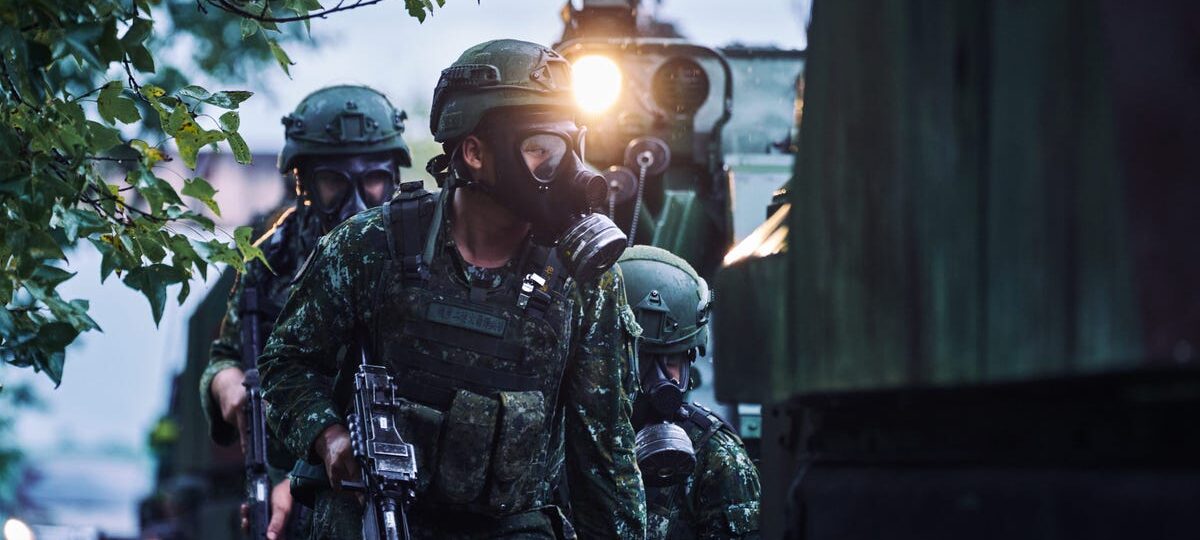
TAIPEI — There’s a term in Taiwan for the hardened, military-aged Americans who mysteriously pop up at the island’s annual simulation of a Chinese invasion. “English teachers.” Vaguely employed and surprisingly fit, they are often spotted in small groups, chatting with local soldiers, walking double-time on the streets, and giving death stares to any camera-toting reporters as the Taiwanese prepare and execute their live drills.
Local media estimated that over 100 of these foreigners — rumored to be unofficial US military advisors and observers — were present at this year’s Han Kuang exercise, which featured 10 intense days of drills across Taiwan.
The US sells weaponry to Taiwan, but overt military ties with the island are politically sensitive, and the American military presence there is covert.
A 2021 report by The Wall Street Journal found that small teams of US special operations forces, a few dozen strong, had spent at least a year training Taiwanese troops on the island.
In the so-called “English teachers,” a similar kind of quiet, persistent US military presence was noticeable at this year’s Han Kuang. “A lot more ‘American English teachers’ will be showing up where they need to be,” its defense minister, Koo Li-hsiung, said to reporters before the exercise began. “But you won’t be able to spot them everywhere they operate.” US-Taiwanese military collaboration “is far closer than you might imagine,” he added.
I ran into a group that fit the “English teacher” bill one late Friday night.
Typhoon Dolphin was dumping rain on central Taipei that evening, and I’d shown up at the wrong subway station exit for a military police exercise.
Two white, raincoat-clad men with crew cuts there eyeballed me wordlessly as I, believing them to be fellow international reporters, attempted to introduce myself.
They spoke briefly with a Taiwanese officer at the exit before disappearing down the station escalator.
The local soldier awkwardly told me they weren’t journalists, though he wouldn’t say more.
As military police prepared to cover the area around the station after midnight, I glimpsed the same men in civilian raincoats walking about briskly in the rain, raising their collars and turning away to shield their faces from cameras.
I couldn’t confirm their identities.
When asked about US involvement in the Han Kuang, a State Department spokesperson told Business Insider that the US remains committed to its one China policy, and to preserving peace across the Taiwan Strait.
The spokesperson did not confirm if there are military personnel on the ground.
However, they said the US makes available to Taiwan the defense resources and services necessary to defend itself according to the threat it faces, which they added has grown considerably.
Taiwan’s defense ministry and the US Pacific Command did not respond to requests for comment from Business Insider.
Chieh Chung, a senior analyst with the Taiwan government-backed Institute for National Defense and Security Research think tank, said the US also has an incentive to observe, not only advise, Taiwanese forces.
Taipei has been adopting broad US recommendations in recent years, for areas such as training methods, modernizing its kill chain, and special forces operations, he told Business Insider. “This makes it necessary for the US side to observe live exercises to assess the effectiveness and shortcomings of its recommendations and of bilateral military exchanges, providing a basis for subsequent adjustments and revisions,” Chieh said.
Among the American influences on the exercise, this year’s Han Kuang marked the first time during the drills that Taiwan has incorporated the “backbrief,” a practice in US military doctrine in which junior commanders explain to their superiors how they understand their mission and orders.
It’s a decades-old concept that’s been standard across NATO militaries.
Now, it’s part of Taipei’s push to drill and empower small unit commanders to make independent decisions if communication with senior leadership is cut off. “This highlights an area where Taiwan’s military culture urgently needs to evolve,” Lin Ping-yu, a former Taiwanese special forces paratrooper who is now a city councilor for New Taipei City, told Business Insider. “The traditional mindset of ‘mission accomplished at all costs’ is ill-suited to modern battlefields,” he added.
Perhaps the most overt American element in Taiwan’s Han Kuang was the island’s deployment of some of the most iconic US weapons systems.
Patriot missile batteries were towed into central Taipei’s parks, and M1A2 Abrams tanks were hidden in nearby cities, while F-16 Fighting Falcons patrolled the island and M142 High Mobility Artillery Rocket System units dispersed to concealed positions.
Taiwan’s arsenal includes a mix of US, European, and locally produced equipment, but the three systems featured on this year’s Han Kuang emblem were all American-made.
Altius 600M loitering munitions, made by Palmer Luckey’s Anduril, were one of the three, alongside the Patriot PAC-3 and HIMARS.
Taiwan bought 291 of the Anduril attack drones in June 2024.
The Anduril connection could eventually forge more US-Taiwanese military ties.
Luckey said in June that he hopes to establish a significant manufacturing presence in Taiwan, drawing comparisons to his company’s flagship factory in Ohio, Arsenal-1. “We have not found the right thing to build a similar thing here, like a, you know, like an Arsenal-T.
We’ve not gotten quite there yet, but I’m feeling very optimistic about it, and it’s something that I would love to do,” he said.
Discover more from NAIRAVOICE.COM.NG
Subscribe to get the latest posts sent to your email.