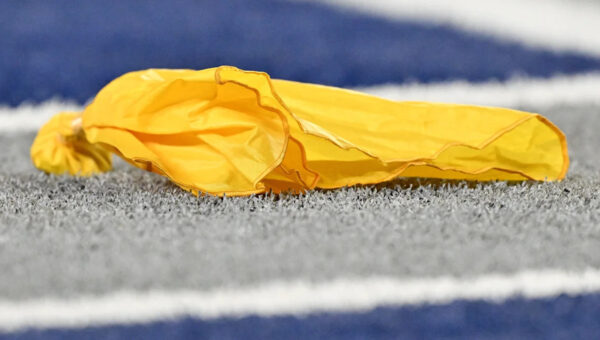

With 1:48 to play in the first half of the New England Patriots-Buffalo Bills game on Sunday, the officiating crew made an announcement.
“Unsportsmanlike conduct, head coach for New England.”
The Bills were awarded half the distance to the goal in yardage that would set them up for a game-tying touchdown less than a minute later.
Patriots head coach Mike Vrabel, upon hearing the officials, looked taken aback. Penalty yards for telling the official that a defensive holding flag was a “fing terrible fing call”?
“I’ve said that 87 times since I’ve been a head coach,” Vrabel said after the Patriots’ 29-26 win. “There was nothing derogatory. You know, you’d have to ask him. I think he was a little sensitive …
“I probably shouldn’t have swore. But I can tell you that in my history of being on the sidelines as a head coach, I’ve said that.”
By day’s end, the comments of Vrabel — one of six head coaches currently serving on the NFL’s competition committee — would take on heightened import.

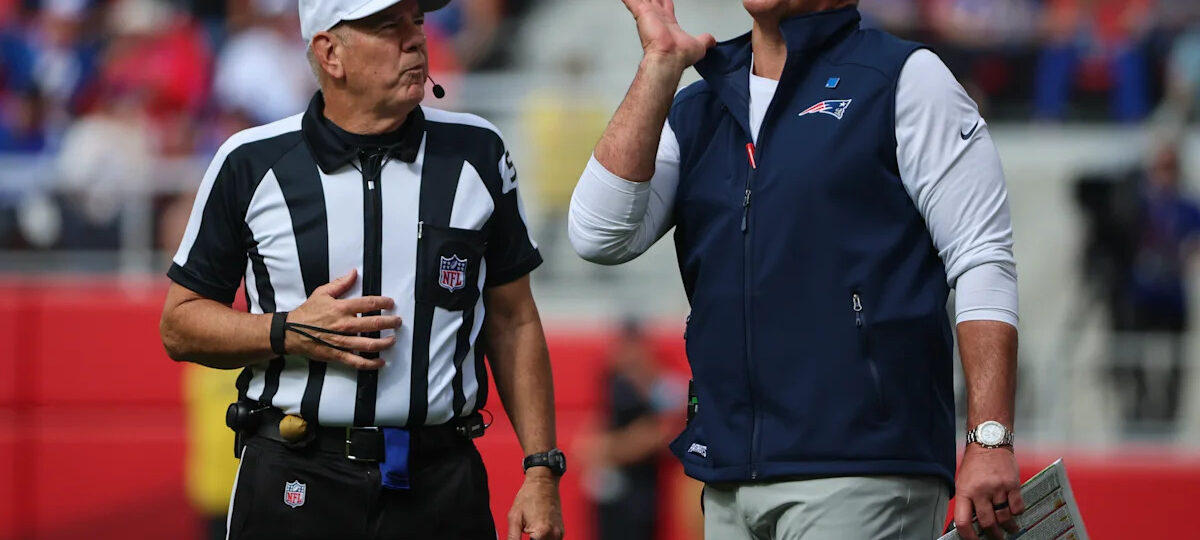
Patriots head coach Mike Vrabel shares a moment with referee Bill Vinovich in Week 4.
Because across the league, tension between officials and players hit a rare high last week. Line judge Jeff Seeman, in view of a broadcasting camera, told Arizona Cardinals tight end Trey McBride “f*** you.” Referee Adrian Hill appeared to motion demonstratively and emotionally at Minnesota Vikings linebacker Eric Wilson after a tangle with Miami Dolphins running back Ollie Gordon knocked Wilson into Hill, who fell to the ground. (Wilson appeared to offer Hill a hand to get up).
The suspensions, against the backdrop of Vrabel’s public comments that he has regularly used profanity in interacting with officials, beg the question: What is the threshold of acceptable conduct from officials toward players and coaches, and in reverse? How should the system work and what explains the seeming increase in tension through the NFL’s first four weeks?
Yahoo Sports canvassed league sources to better understand the dynamic of an often-charged relationship that seems tenser than usual. What awaits the rest of the season?
“It’s a really tough job to be a ref,”Shocking suspensions, f-bombs and a flurryPittsburgh Steeler wide receiver Michael Pittman Jr. told Yahoo Sports by Zoom this week. “They take a lot of verbal abuse from coaches, players, fans. So definitely it’s not for the thin-skinned.”
It’s impossible to determine how and whether contentious collective bargaining agreement (CBA) negotiations between the NFL and officials this spring have trickled over into the early weeks of the season.
Ask some team and league executives, and they’ll say it’s coincidence that these suspensions occurred the same week and coincidence this timed with multiple high-profile coaches questioning officiating.
Ask others, and the proximity of this tension to the leagueShocking suspensions, f-bombs and a flurrythreatening replacement officials seems “impossible” to deny, in the word of one NFC executive.
What is clear: The league pressed the officiating union for more accountability measures ahead of the new CBA. And the league just suspended two officials a full eight seasons after the last known officiating suspension.
Before this week, the last known officiating suspension (officially an “administrative leave”) was Roy Ellison’s 2018 due to an official-player confrontation. Side judge Rob Vernatchi was suspended one game in 2015 due to a game-clock error, and Ellison was also suspended one game in 2013 after profanity against a player. Before that, the last suspension dated back to 1984 in response to an official’s conduct toward fans.
So suspending two officials in a season, much less in one week, is unusual.
The officiating union issued a Tuesday statement saying it would “challenge the severity of those suspensions and meet with the NFL Officiating Department to discuss the League’s disciplinary standards.”
“NFL officials have a responsibility to conduct themselves professionally on the field, and the actions in these incidents fell short of that standard,” NFL Referees Association executive director Scott Green said. “Accountability matters, but that should not result in discipline that is excessive or inconsistent with established precedent.”
Coaches and players can, via flag and fine, receive discipline for their words and actions toward officials. This most often occurs if a player or coach repeatedly tests the boundaries with an official in a game, officials often warning coaches or players before issuing more discipline.

This incident between referee Adrian Hill and Vikings linebacker Eric Wilson resulted in a suspension for the official.
League sources do not believe frustration with a player or coach warrants a foul heated response.
“If they think somebody crosses the line, then they can drop the flag,” one league source with knowledge of officiating discussions told Yahoo Sports. “Ultimately, the expectation is that these guys should not be in altercations and should walk away from it.”
Neither Seeman nor Hill did that. Add to that bye weeks reducing the number of officials needed in Week 5 and Week 6 relative to the first four weeks, and the officiating bench now offering a deeper roster since the signing of the CBA, and the league chose to act at a rate it hasn’t in league history.
Less-drastic accountability, league sources say, is not unusual. Each week, each official is graded not only on the consistency and accuracy of their calls, but also on behavioral considerations such as their field positioning, administration, mechanics, communication and speed. Those grades influence playoff assignments, with the most successful officials earning the highest-profile and most-coveted matchups. (The union sought to negotiate playoff assignments based on seniority rather than performance in the spring, and the league did not budge.)
Some coaches and players approach officials before a game to discuss their top concerns about their opponents’ flag worthiness as well as ask for clarity on how a call will be officiated. Others try to minimize their interactions with officials and hope for the best.
“I don’t like to talk to the refs,” Pittman said, speaking in partnership with Toyota NFL FLAG. “They make me mad. When I was a younger player, I used to bark at them. But I always found that to come back and bite me.
“So now I just bite my tongue. I don’t say anything.”
There are times, as it relates to officiating, that coaches and players are instructed not to say anything.
A defensive pass interference call in the final two minutes of the Los Angeles Rams’ loss to the Denver Broncos brought that conversation back into public focus.
With 1:15 to play in the fourth quarter, Rams cornerback Josh Wallace was called for pass interference on a Bo Nix pass intended for Pat Bryant. The Broncos scored the game-winning touchdown after the drive stayed alive, and officials told Rams head coach Sean McVay in the days that followed that they agreed Wallace did not actually commit pass interference. McVay acknowledged that admission after he was asked about it multiple times during his news conference that week.
The league responded by sending a memo to teams reminding them conversations on officiating reviews are expected to be confidential.
“If something’s obvious and the whole world wants to know ‘hey, what ultimately happened?’ then you’ve got to address it …” a high-ranking NFC executive told Yahoo Sports.”But rehashing, that’d be like saying, ‘OK, we’re going to go over every grade of every player in the NFL last weekend and we’re going to show it to the fans.’ Is that transparency? I don’t know.
McVay said he was focused more on the coaching point moving forward.
“The only thing that matters to me is how to educate our players,” said McVay, who is also on the competition committee. “What I am interested in is if there’s any sort of feedback that says this is in alignment with what would be correctly officiated as a DPI?
“That’s the only thing that I’m really worried about.”
League sources were split on whether there’s reason to worry more broadly about officiating calls and conduct as Week 5 is underway.
On one hand,Shocking suspensions, f-bombs and a flurryper ESPN data, the NFL saw the most accepted penalties through four weeks since play-by-play data became available in 1978. The 271 accepted penalties in Week 4 marked the second-most of any week in that span, per ESPN.
Others in the league counter that measuring “accepted” penalties rather than called penalties skews officials’ performances. After all, officials don’t choose whether to accept penalties. And some accepted penalties, like delay of game, can reflect strategy rather than overzealous officiating.
Delay of game and false start penalties are each at 10-year highs,Shocking suspensions, f-bombs and a flurryper NFL data. More than half of the 63 delay-of-game penalties are on fourth down, when teams strategically prompt it, while an uptick in false starts could reflect the increased use of presnap motion by league offenses. The decrease in preseason participation by starters also has led to some less-disciplined play in recent years.
“You can’t look at one penalty in abstract,” a high-ranking team executive countered when told this information. “You have to look at game flow and what’s actually being called and what’s determining it. Because ultimately, that’s what people were responding to.”
NFL team owners and executives will meet Oct. 20 and 21 in New York City to discuss a range of issues with an agenda that historically has included officiating updates. It’s rare any officiating or rule changes would occur during the season, though the NFL and NFL Players Association have already worked to clarify and reduce touchdown celebration penalties after a rash of fines.
What solutions league sources are interested in exploring: grant coaches one challenge flag to be used on currently unreviewable calls like defensive pass interference; issue two-minute reports of late-game officiating like the NBA does; allow broadcasts to stream the audio of officiating conversations as NCAA and UFL games do.
NBA and MLB each allow a coach’s/manager’s challenge per game, with stipulations; NHL allows coaching challenges as well albeit with penalty for incorrect challenges.
In the short term, it’s unlikely any changes will occur. Multiple league sources predicted these suspensions, paired with the typical adjustment of players and coaches as a season elapses, will be enough to return officiating to perhaps not popular levels but at least normal ones.
Cardinals head coach Mike LaFleur and Vikings head coach Kevin O’Connell each expressed a desire to move past the incidents between their respective players and officials. LaFleur added that “I do want to give the man a little bit of grace.”
Vrabel knows he, too, will need to watch his language and positioning after referee Bill Vinovich told a pool reporter that Vrabel leaving the box and cursing prompted “pretty much a given” penalty.
“I apologized to him,” Vrabel said. “Again, players responded [to the penalty yardage]. It was unfortunate. And I have to be better in those moments.”
Discover more from NAIRAVOICE.COM.NG
Subscribe to get the latest posts sent to your email.