

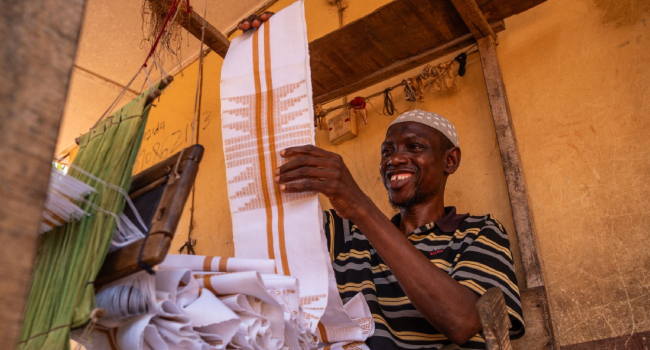

The Senate has asked the Federal Government to impose an outright ban on the importation of foreign textile materials as part of efforts to revive Nigeria’s struggling textile industry and stimulate local cotton production.
The upper chamber also urged the Federal Government, through the Ministries of Agriculture and Trade and Investment, to take urgent steps to resuscitate textile manufacturing across the country, particularly along the Kaduna-Kano industrial corridor, citing its potential to create jobs and address rising youth unemployment and insecurity.
The resolutions followed the adoption of a motion titled ‘urgent need to revive the textile industries in Nigeria with particular reference to the Kaduna-Kano Axis’, sponsored by Senator Sunday Katung (APC, Kaduna South) and co-sponsored by several lawmakers across party and regional lines.
Presenting the motion, Senator Katung recalled that Nigeria’s first large-scale textile manufacturing mill was established in Kaduna in 1957, a development that later spread to other regions and contributed significantly to industrial growth and employment generation.
According to him, government intervention policies in the 1960s and 1970s, including restrictions on textile imports, encouraged investment in local production and helped the industry flourish.
He noted that by the late 1970s and 1980s, Nigeria had about 167 textile mills employing more than 500,000 workers directly, making the sector the second-largest employer of labour after the Federal Government.
Katung further lamented the sector’s steady decline, attributing it to obsolete equipment, inadequate capital, inconsistent power supply and policy challenges.
The senator expressed concern that more than six decades after the industry’s golden era, Nigeria’s textile sector has deteriorated significantly, leaving once-thriving industrial facilities abandoned and reducing the industry to one of the weakest segments of the nation’s manufacturing sector.
Lawmakers who supported the motion underpinned the need for deliberate government intervention to restore the industry’s competitiveness, boost local production, reduce dependence on imports and create sustainable employment opportunities for Nigerians.
The Senate subsequently called for increased funding to the Bank of Industry (BoI) to support the revival of textile companies and requested the Federal Ministry of Agriculture to intensify efforts to encourage cotton farming, describing cotton production as critical to the survival of the textile sector.
Following deliberations, the Senate adopted the motion and urged the Federal Government to implement policies aimed at revitalising the textile value chain, from cotton farming to manufacturing and distribution, as part of broader efforts to strengthen the country’s industrial base and economic growth.
Discover more from NAIRAVOICE.COM.NG
Subscribe to get the latest posts sent to your email.