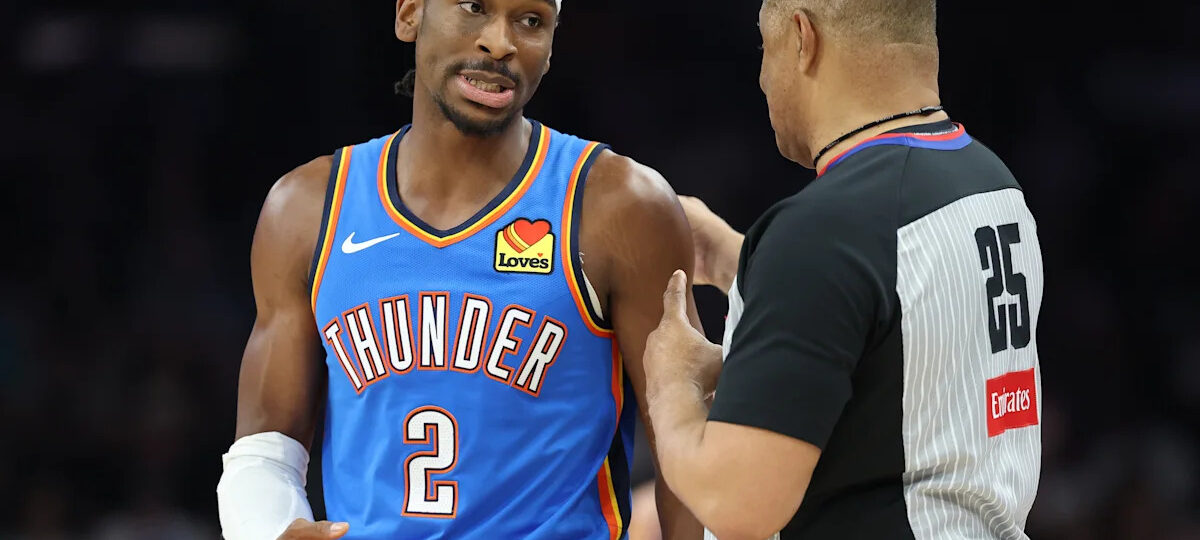
All fans have specific things they’re focusing on at the start of a new NBA season: particular players, pairings, lineups and decisions they’re keeping a close eye on as the games get underway. So, too, do the players on the court, the coaches on the sidelines, and the referees entrusted with overseeing the action. Their points of emphasis, though, tend to be a bit more granular — and focused on specific nettlesome problems and issues that the league’s decision-makers want to see addressed on the floor in the season ahead.
“As we roll into this season with a lot of anticipation for what’s to come, we just always want to make sure that we’re doing everything that we can to balance offense and defensive opportunities,” said James Jones, the NBA’s head of basketball operations, during a Thursday information session with reporters.
Join or create a Yahoo Fantasy Basketball league for the 2026-27 NBA season
The four main “high-volume or high-impact” areas that the NBA’s stakeholders highlighted as points of emphasis meriting increased scrutiny heading into the 2026-27 campaign:
Off-arm push-offs by offensive players to knock a defender back and create space for a shot;
Two-hand shoves while setting screens (“one very finite area of screening — we’re not tackling all of screens, but a certain type of screen that we want to get better at,” clarified NBA head of referee development and training Monty McCutchen);
Freedom-of-movement violations, in which off-ball defenders grab, clutch and wrap up offensive players to try to slow them down and impede their ability to move toward the action;
And straight-line pathway plays, where both drivers and defenders alike might create contact on one another to try to either deter a shot attempt or create the contact that can lead to free throws.
See below for Part 1 of the 2026-27 Points of Emphasis video (narrated by SVP, Head of Referee Development and Training Monty McCutchen), which provides examples and guidance regarding Off-Arm Push Offs by Offensive Players and Freedom of Movement – Screens: pic.twitter.com/zMMmOK3Kxq
— NBA Official (@NBAOfficial) September 29, 2026
Push-offs will be governed by what McCutchen termed “the four Fs.” If officials determine that the offensive player was merely feeling his defender or firming up his position — “doing most of the work with his legs,” McCutchen said — then that’s a play-on. If they think the offensive player crossed the line into deliberately making forceful contact to gain an advantage, or fully extending that off-arm to create space, then it’s time to blow the whistle.
“The competition committee was really clear: Get rid of the full extensions,” McCutchen said. “They have a high expectation from our staff that we have a good visual syntax on ‘full extension.'”
Sticking to that syntax can be pretty tricky in practice, though. If you find yourself thinking that differentiating between and among the Fs sounds like it might be at least somewhat subjective … well, you’re not alone.
“I think reasonable people will think that one thing is firming up, while another person may say that it’s forceful,” McCutchen said. “That’s fair.”
The goal, though, is to establish a more consistent framework for making those bang-bang decisions — one informed, McCutchen said, by more frequent early-season meetings with the league’s competition committee to “get good, proper feedback from them about what is firming and what is forceful” — in hope that, as the regular season progresses and gives way to the playoffs, the calls will become steadier and more uniform.
“There were too many plays this past season in which, on Thursday night, [the push-off] was called, and on Saturday night, it was not,” McCutchen said. “We have to get more consistent here. And we will.”
See below for Part 1 of the 2026-27 Areas of Focus video (narrated by SVP, Head of Referee Development and Training Monty McCutchen), which provides examples and guidance regarding Flopping and Closeouts on Jump Shots – Landing Space: pic.twitter.com/Pbma6PyyPi
— NBA Official (@NBAOfficial) September 30, 2026
The NBA also says officials will take a harsher stance toward flopping, which the league has long since identified as a nagging issue, but hasn’t always been one that the league consistently focused on nipping in the bud, whether by calling non-unsportsmanlike technical fouls on floppers during the game, resulting in the opposing team taking a free throw, or by delivering after-the-fact warnings that can result in fines and eventually even a suspension.
“Coaches, players, fans, competitors — they don’t like it,” Jones said. “We don’t like it. It’s not good for our game.”
Officials will determine whether a player has flopped by considering what they call the “STEM” criteria: “secondary, theatrical, exaggerated movements,” including excessive flailing of arms, “a considerable distance traveled” by the purported flopper, and whether the player’s excessive movements have the potential to injure another player (such as by sliding into someone’s lower legs).
McCutchen said officials need to be more consistent with penalizing players who thrash about, windmill their arms and take dives in service of drawing a whistle — while also not allowing that to obscure what could have been legitimate contact prior to the histrionics.
“What we can’t do is balance things out,” McCutchen said. “‘Oh, you flopped, therefore I’m not going to call the offensive foul.’ Both can be true. We can call an offensive foul, and also, if the standard for a flop has been met — that secondary, theatrical, exaggerated movement — if that occurs, there may be a legitimate offensive foul, and also secondary, theatrical movement.”
(One specific note McCutchen offered on Thursday: Head snaps, by themselves, will not be viewed as flops. Just something to keep in mind the next time you see Jalen Brunson’s braids flying.)
“We want to make sure that, one, the game is played on its merits, not the theatrics of the merits,” McCutchen said. “And we want to make sure that we find the right balance of not giving in to overt theatrics while still allowing the player to draw attention to what they feel is an illegal act, which we label as an embellishment and legal.”
See below for Part 2 of the 2026-27 Points of Emphasis video (narrated by SVP, Head of Referee Development and Training Monty McCutchen), which provides examples and guidance regarding Freedom of Movement – Perimeter & Post and Straight-Line Pathway Plays: pic.twitter.com/hcEjI3RGTN
— NBA Official (@NBAOfficial) September 29, 2026
Ultimately, whether you’re talking about offensive players pushing off, defenders flopping to accentuate contact, or bang-bang plays where they’re trying to beat one another to the spot, players are looking for every edge they can find in what boils down to a tooth-and-nail battle for a few extra steps’ worth of real estate.
“We all know, in games where the games are determined by one or two possessions, creating space is valuable,” Jones said.
How that space is created is also the key focal point when it comes to screening. Especially, as Jones noted, in an evolving offensive ecosystem in which smaller players are setting more screens — and not always with the same level of body positioning and technique that better-versed big men might bring to the encounter.
“As our teams play five-out, positionless basketball, we start to see more and more guard-to-guard screens,” Jones said. “Rather than using their bodies, [those guard screeners] were using their arms and pushing toward half-court, and it just created an advantage that the defense could not overcome. So we just wanted to make sure that we stayed diligent with that.”
Regardless of the size of the screener, though, the league’s looking to disincentivize the kind of two-hand pushes to dislodge a defender that privileges brute force over precision and skill.
“We never want strength to be the thing that dictates,” McCutchen said. “Basketball is a strong game, but it’s also a game that fundamentally is rooted in positioning, quickness and getting to spots first — creating advantages with pump fakes or jab steps. We want to make sure that strength never overrides the other things that make our game beautiful.”
Increased attention to these particular points of emphasis tends to result in a higher-than-usual number of whistles in the opening weeks of the season. That volume, however, tends to dwindle as teams get deeper into the schedule — due partly, perhaps, to players quickly and effectively adapting to the new state of play.
“If you look at the 100-plus possessions for each team, and 200-plus possessions in the game, the micro-adjustments that have to be made within 24 seconds — our players do that better than anyone in the world,” Jones said. “And so, as we try to stay current and try to stay proactive in front of the adjustments that players make, we just need to make sure that we’re diligent. Because NBA players are great at testing boundaries.”
That includes boundaries with how, um, forcefully some of them might communicate with officials — particularly ones who are younger, or earlier in their NBA careers than some of the more seasoned pros.
“What we do know, and what we tell [our officials] is, no answers is not an acceptable thing as you start to take this,” McCutchen said. “You can’t just be silent. It is always interpreted as an inapproachability or arrogance, and we have to work against that and start the arduous process of gaining good relationships, earning trust.”
The most direct pathway to developing that line of credit with players and coaches? Calling it both ways, as cleanly and often as possible.
“I don’t think that any of us will expect perfection here […] but I think if we’re making 10 inconsistent errors right now, I think we’re gonna reduce this considerably and get better at our work,” McCutchen said. “That’s all that we can hope for.”
The better the refs get, and the more consistently the game is called, the more it allows the players on the court to shine.
<
p style=”text-align:left”>”It just allows our players to go out there and compete,” Jones said. “And when they compete, they give some really lasting, compelling plays and experiences for everyone.”
Discover more from NAIRAVOICE.COM.NG
Subscribe to get the latest posts sent to your email.