
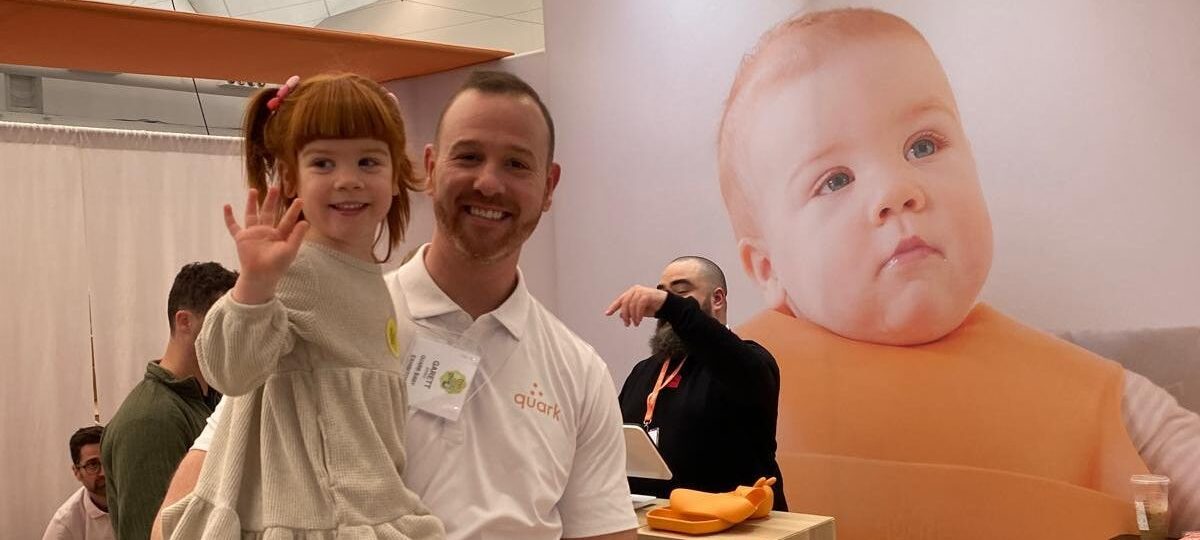
This as-told-to essay is based on a conversation with Garett Senez, the 39-year-old founder and CEO of Quark Baby.
It’s been edited for length and clarity.
We make baby-feeding tech and accessories.
We’ve got a network there, our factories are there, our molds are there, our lines are there.
The tariffs were a huge shock for us.
The most immediate thing was: where we can, let’s resource out.
We took a look at all the other countries where you can produce, like Indonesia, Thailand, Vietnam, Cambodia, and Korea.
We ended up resourcing a lot of our production to Korea.
They have a very high-quality manufacturing base.
There are a lot of free-trade agreements that were set.
You can move your molds, because a mold is just a metal press.
But it’s not just the mold that you own.
There’s a secret sauce of doing things at scale on a production line that you learn over time.
You can’t just learn that right away.
I’d estimate that, with molds and cost of production, it cost us just under $1 million.
We’re a Canadian company, thank god.
The Canadian government has lots of safeguards and things that will help small businesses in times of trouble.
We’re able to leverage the government a lot, but it absolutely hit the bottom line.
It was a gut punch because we had large purchase orders that we had to say no to because that SKU became unbuyable.
There were products that were out of stock because I could not bring them in when shipping was so expensive.
The biggest thing that kills anything is uncertainty.
It’s the uncertainty of not knowing, if I bring something in, am I going to make margin?
If I order a certain quantity, am I going to be able to ship it?
Those things get really complicated, really quickly.
As of now, I’ve found ways around most of those opportunities.
Our business is great now, and we’re back on a steady track.
From a Canadian perspective — and we’re still a Canadian holding company — we asked: what does our transfer pricing look like?
We’re going to ship stuff from Korea to the US; can we move that up to Canada?
We have four warehouses, and we move stuff between Canada and the United States all the time.
They canceled the $800 minimum, where we could ship our Canadian goods to the United States without having to file.
Our entire drop-shipping business to the United States stopped, and we had to find a new warehouse in the US.
There’s now a tariff block between my warehouses.
There are still stranded goods, and I’m on my third drop-shipper.
All in, it’s probably hit my business to the tune of $2 million, including IP, resourcing, and lost sales.
That’s probably 90% from the tariff on China and 10% from the tariff on Canada.
Baby goods were among the preferred goods they didn’t target; if I were in aluminum or cars, it’d probably be different.
If Canada doesn’t get an agreement with the United States, I may relocate to the US.
I’m here, and our employees are here.
But, from an operational perspective, it may not make sense to be in Canada longterm.
Cross-border doesn’t make sense; it’s just too tough.
It’s mind-boggling how this relationship has frayed.
There’s a galvanizing action that Canada’s had: “Let’s band together, elbows up.” I do believe that there’s a localized movement that will help buoy our business.
Do I think it will make a long-run difference?
As a small business, you’re a small sailboat in a big ocean being tossed around.
It feels like I’ve lost a lot of control.
That said, the baby industry is very small, everybody knows each other, and there’s been a really good sharing of resources.
There’s been good sharing of resources from an industry perspective, but from a tariff perspective, it’s been so hard.
Sometimes you just can’t find capital; I wrote another $300,000 check in April this year just to keep this business going.
So yeah, it’s been emotionally tough.
I’ve seen 30% of the businesses I know in this industry already die.
That’s very sobering, but it’s also galvanizing toward action.
Particularly in entrepreneurship, the ones who refuse to quit are the ones who actually last.
So we’re just fighting all the time.
We had a really cool product in 2022 that was called out on Twitter by Elon Musk.
The next year, everyone has their knockoff of our product.
Continuously innovative, doing things better, and then winning.
Tough times don’t last, but tough people do.
The business environment will always be competitive, but the nuances and externalities will change.
Try to find a way to keep yourself motivated, even when it’s dark.
As an entrepreneur, it’s super lonely.
Discover more from NAIRAVOICE.COM.NG
Subscribe to get the latest posts sent to your email.