

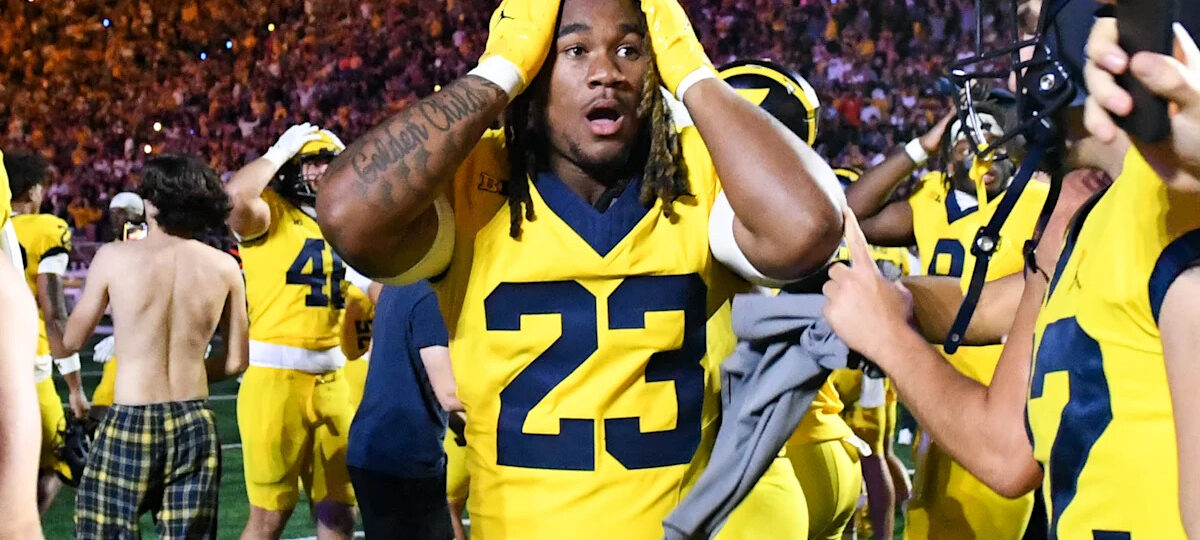
The controversy surrounding Michigan’s win over Western Michigan is far from over.
After initially accepting the Big Ten’s explanation for how one second was added back to the clock for the Wolverines to throw a Hail Mary in their 13-12 win over the Broncos, the Mid-American Conference issued a statement Tuesday saying that replay protocols were actually not followed and Western Michigan should have won the game.
“After further study and investigation, it is now evident that replay protocol was not properly followed in determining whether time remained on the game clock at the conclusion of the Western Michigan vs. Michigan football game,” the statement said.
“The established replay protocol requires that the game clock displayed on the program feed be used in determining whether time remained. Instead, the Big Ten Conference replay crew relied upon the clock feed embedded within its replay system. AS a result, one second was placed back on the game clock and an additional play was awarded.
“This was not a judgment regarding the proper amount of time to place on the clock. It was an error in the application of the established replay protocol governing this specific end-of-game timing situation. Had the protocol been properly followed and the program-feed clock been used, no additional play would have been awarded and Western Michigan would have won the game, 12-7.
“As a result, the Mid-American Conference has submitted formal appeals to the NCAA FBS Oversight Committee and the College Football Playoff. The MAC is requesting that those bodies recognize Western Michigan as the actual winner of the game for purposes of their respective rankings, evaluations and selection deliberations and take such other corrective action as may be within their authority.”
“After further study and investigation, it is now evident that replay protocol was not properly followed in determining whether time remained on the game clock at the conclusion of the Western Michigan vs. Michigan football game,” the statement said.
“The established replay protocol requires that the game clock displayed on the program feed be used in determining whether time remained. Instead, the Big Ten Conference replay crew relied upon the clock feed embedded within its replay system. AS a result, one second was placed back on the game clock and an additional play was awarded.
“This was not a judgment regarding the proper amount of time to place on the clock. It was an error in the application of the established replay protocol governing this specific end-of-game timing situation. Had the protocol been properly followed and the program-feed clock been used, no additional play would have been awarded and Western Michigan would have won the game, 12-7.
“As a result, the Mid-American Conference has submitted formal appeals to the NCAA FBS Oversight Committee and the College Football Playoff. The MAC is requesting that those bodies recognize Western Michigan as the actual winner of the game for purposes of their respective rankings, evaluations and selection deliberations and take such other corrective action as may be within their authority.”
Michigan’s initial Hail Mary attempt fell incomplete with seemingly no time remaining before officials added a second back to the game clock after determining that WMU Micah Davis touched the ball — after he leaped from out of bounds — before time expired.
In its formal appeal to the FBS oversight committee, the MAC says the “established protocol” for replay reviews is for the in-stadium game clock to be inserted on the program feed and that “the replay official/replay center official then determines whether time should be restored to the game clock based solely upon the game clock insert on the program feed.”
The game clock that was inserted into NBC’s replays showed the clock at 0:00 when Davis touched the football. In its explanation hours after the game was over, the Big Ten showed that there was one second remaining on the clock its replay center had a camera trained on throughout the game.
“Rather than relying upon the designated game clock displayed on the program feed, the Big Ten replay crew relied upon a separate clock embedded within its replay system. The two clock feeds were not synchronized,” the MAC wrote.
“The game clock displayed on the program feed showed that the clock had expired. The clock embedded within the replay system, however, showed time remaining. Despite the protocol expressly requiring replay officials to rely solely upon the game clock displayed on the program feed, the replay crew utilized the unsynchronized replay-system clock and restored time to the game clock.”
“Rather than relying upon the designated game clock displayed on the program feed, the Big Ten replay crew relied upon a separate clock embedded within its replay system. The two clock feeds were not synchronized,” the MAC wrote.
“The game clock displayed on the program feed showed that the clock had expired. The clock embedded within the replay system, however, showed time remaining. Despite the protocol expressly requiring replay officials to rely solely upon the game clock displayed on the program feed, the replay crew utilized the unsynchronized replay-system clock and restored time to the game clock.”
The MAC goes on to say that “the outcome of this game was not changed by a discretionary judgment made within the rules” but rather that “it was changed because the established procedure for determining whether time remained on the game clock was not followed, and an unsynchronized clock was used in place of the clock specifically desgnated by the governing replay protocol.”
Discover more from NAIRAVOICE.COM.NG
Subscribe to get the latest posts sent to your email.