
Australia’s national carrier is preparing to launch new 10,000-mile flights that could last up to 22 hours nonstop — and it needs a custom Airbus jet with extreme endurance to pull them off.
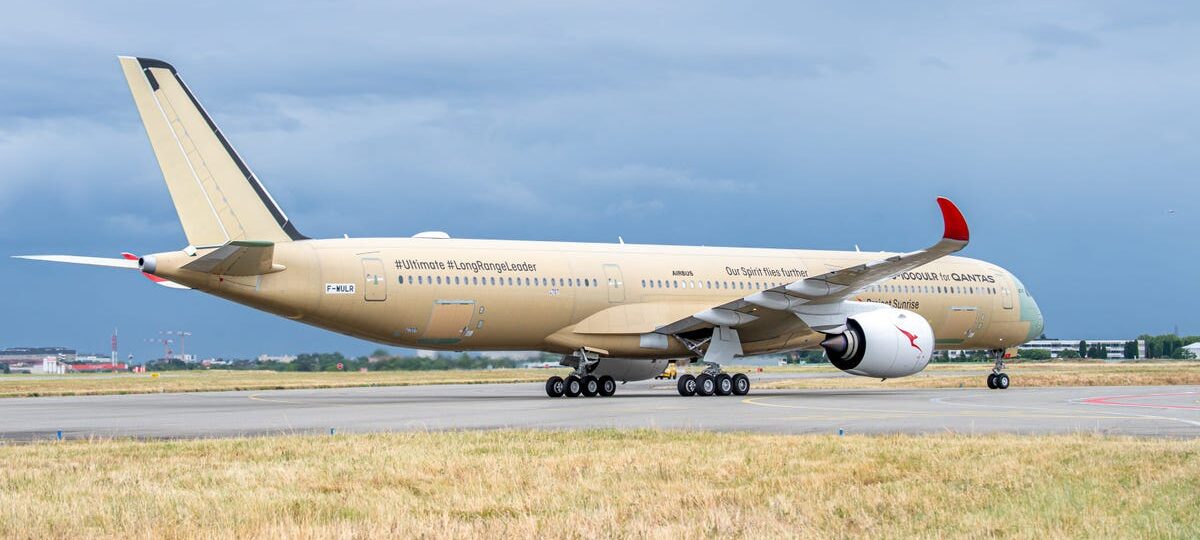
After years of delays, Qantas last week finally unveiled the centerpiece of its “Project Sunrise” initiative: a specially modified A350-1000ULR with extra fuel tanks, structural enhancements, ultra-premium first-class cabins, and a dedicated “wellbeing zone.” The nose-to-tail enhancements — based on Qantas’ years of research into how ultra-long flights affect passenger movement, sleep, and alertness — are designed to make nearly a day in the air more bearable.
Airbus has begun flight testing the modified A350-1000ULR in France as it works toward European certification.
If all goes to plan, bookings for the first Project Sunrise flight between Sydney and London will open in February 2027.
The inaugural will take off in October 2027.
This will effectively eliminate Qantas’ current one-stop routing and cut travel time to London by four hours.
It will also dethrone Singapore Airlines’ current world’s longest flight between Singapore and New York, which takes 19 hours and covers about 9,500 miles.
The timing for nonstop service to New York — Qantas’ second planned Project Sunrise city, which will take a slightly shorter eastbound route across the Pacific — and other international destinations will be announced next year.
Project Sunrise is expected to open new market opportunities for Qantas by attracting premium leisure and business travelers willing to pay for the convenience of these new nonstop flights.
But flyers will likely pay a premium for tickets because of the plane’s lower capacity, higher fuel and crew expenses, and its exclusivity on the nonstop route.
For reference, a Qantas one-stop to London this summer often costs roughly $2,000 round-trip; first class can exceed $20,000.
The project is about five years behind schedule due to a combination of COVID-related constraints, the complexity of the A350 redesign, defects on the plane’s Rolls-Royce Trent XWB-97 engines, and supply chain bottlenecks.
Still, Qantas’ long-awaited Project Sunrise flights will be a full-circle moment: the name is a nod to the airline’s “double sunrise” route that, more than 80 years ago, connected Australia and England via several stops over multiple days during World War II.
Qantas’ special A350 needs a handful of key modifications to achieve the record-breaking range.
This includes a new 5,300-gallon rear-center fuel tank that complements three others in the belly and the wings.
Airbus said the tanks have “highly sensitive sensors” that continuously monitor fuel flow, temperature, and overall performance.
The aircraft also features a new galley cooling system that reduces weight and keeps catering fresh for longer.
But these novel systems must first be thoroughly tested before certification.
Since the test aircraft is the same one destined for Qantas’ fleet, Airbus had little room for error and custom-built five metric tons of monitoring equipment to support the program.
For example, to ensure the galley system maintains a comfortable environment, Airbus is using “dummy” passengers to simulate the body heat of real people and monitor cabin temperature.
The tests are being done by highly specialized Airbus experimental test pilots and flight test engineers.
More than 360 pilots and 1,200 flight attendants are being trained for Qantas’ planned fleet of 12 Project Sunrise A350-1000ULRs.
Qantas’ ULR fleet will feature a low-density, premium-heavy cabin with 238 seats, far fewer than the roughly 400 passengers a typical A350-1000 variant can accommodate.
The seats are split across four cabins: six in first class, 52 in business class, 40 in premium economy, and 140 in regular coach.
First class is expected to be highly priced.
The exclusive cabin features a sliding door, a separate recliner and 80-inch bed, a full-length wardrobe, and space for two people to chat or dine together.
Think of it like a mini hotel room.
Lie-flat business class will also be suite-style with a door, while premium economy will feature leg and footrests and winged headrests.
Qantas said economy class will offer more legroom than on any of its other planes.
Beyond the seats, there will be a wellbeing zone in an open space between economy and premium economy for stretching, movement, and hydration.
The entire cabin also features enhanced lighting and circadian rhythm systems, including 12 lighting scenes such as “Sunrise,” “Sunset,” and “Awake,” designed to help passengers adjust to their destination time zone and mitigate jet lag.
Qantas is also relying on meal timing and flexible dining options to further improve the experience. “This aircraft has been designed from the ground up for ultra long-haul travel, with a cabin built around science and combatting jetlag, with an onboard experience purpose-built for the length of the journey.” Qantas Group CEO Vanessa Hudson said in a press release.
Discover more from NAIRAVOICE.COM.NG
Subscribe to get the latest posts sent to your email.