In golf, one error can wreck an entire round. In advertising, one error can wreck an entire brand.
One week ago, the YouTube golf/merch/lifestyle brand Good Good was flying high, its videos racking up hundreds of thousands of views, its merchandise for sale in major golf outlets nationwide, its logo soon to adorn an actual PGA Tour event. Now, thanks to an entirely unforced error, the brand is deep in the muck, everything it built at risk from an entirely unforced error.
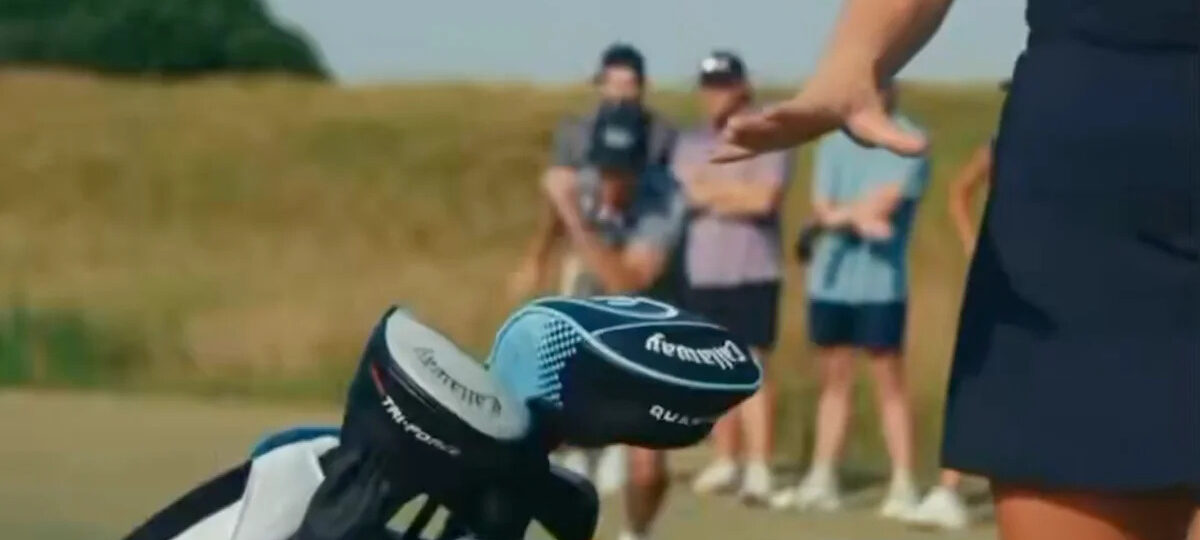
Last Friday, Good Good and partner Callaway Golf released an ad that was supposed to use Good Good’s personalities to promote a new Callaway driver. And in a case of careful-what-you-wish-for, everyone is indeed talking about the ad.
In the spot, Good Good personality Alexis Miestowski reaches toward a driver in a golf bag. Good Good’s Garrett Clark then rushes over, knocks her to the ground, and growls as he looms over her, “Do not touch my driver.”
The ad provoked immediate social media backlash for its depiction of violence against a woman, with many observers questioning how such an ad — which managed to be offensive, amateurish and unfunny — was even released in the first place.
“We posted a video to our channels that ultimately depicted actions that are not aligned with our values as a brand. We have since taken that content down, and sincerely apologize,” the brand said on Saturday morning. “Good Good has always stood for making the game of golf more inclusive for all, and we will continue to ensure that is our mission moving forward.”
“We are disappointed by the content that was posted, and are appreciative of Good Good for addressing this. We look forward to working together to ensure a more inclusive space in golf,” Callaway said in its own statement.
“The PGA Tour believes in golf’s ability to bring people together and create a welcoming environment for all,” the Tour added in its own statement. “We do not condone violence in any form, and the since-deleted video does not reflect our values or commitment to inclusivity and respect.”
But unlike most social media pearl clutching, which dissipates before it breaks containment into the wider world, the heat on Good Good continued to rise even after the first round of statements. In his state-of-the-game press conference on Tuesday morning, PGA Tour CEO Brian Rolapp didn’t give Good Good the benefit of the doubt. When asked whether he thought the brand had taken sufficient responsibility for the misfire of an ad, Rolapp responded, “I think initially, no. I think what we saw was concerning, is clearly not aligned with PGA Tour values. We take it very seriously. I think their initial response was disappointing. It was a bit defensive and late.” He acknowledged that Good Good and Callaway had been taking some more positive steps, but the poor judgment and poor initial response, in the Tour’s eyes, clearly linger.
The foundation began cracking under Good Good soon afterward. Golf retailer Golf Galaxy pulled out of a deal to sponsor a new iteration of the golf reality series Big Break co-branded with Good Good, and both Golf Galaxy and PGA Tour Superstore have yanked Good Good’s merch off their shelves.
Now, the brand’s sponsorship of the mid-November Good Good Championship in Austin, Texas, is under scrutiny. When asked directly about the brand’s future with the tournament, Rolapp only described the situation as “fluid,” offering no assurances whatsoever that the tournament’s name was safe, a stunning potential fall for what had been, to this point, a true good-news brand story.
Until this controversy, Good Good epitomized grass-roots sports media success. Created in 2020 as a YouTube channel, Good Good has become a full-fledged multimedia lifestyle brand embodying golf course camaraderie. (The brand’s name derives from mutual respect — “Good-Good” is a declaration you make in match play when you and your opponent are both close enough to the hole to call both short putts as made.)
YouTube golf influencers share a sport with the likes of Scottie Scheffler and Rory McIlroy, but not much else. The emphasis for YouTube golfers is on performance rather than technical skill, personality rather than steely perfection. And it’s paid off; Good Good, with 2.1 million YouTube subscribers, is one of several golf influencer crews with seven-figure follower counts. (YouTube golf is such a compelling proposition that even LeBron James has joined the field.)
But as their profile grew, they morphed from social media influencers into a full-fledged brand. Now, they aren’t only promoting themselves, but are being paid to promote their partners, which include Callaway Golf.
Good Good’s ad, promoting a co-branded driver with Callaway, was apparently supposed to be a riff on the horror movie “Obsession,” but the combination of awkward execution and reference to a cult-but-not-mainstream movie fell flat on the turf. Had Clark shoved one of the other male members of Good Good, the ad would’ve been like any other social media quick-hit video — flashing across phones for a day or so, and then forgotten. But with no one apparently able or willing to step in and say, “Hang on, maybe we shouldn’t have a guy throwing a woman to the ground in this ad,” Good Good is now in an existential crisis.
As with any social media pile-on, it’s worth asking whether the punishment fits the crime. Does Good Good deserve to have its entire carefully-built business torched because of one ill-advised ad? The problem here is that Good Good is playing in a space where image is everything, and where the sport is actively trying to work against its long history of misogyny and exclusiveness. The ad leaned into and reinforced the worst possible golf stereotypes and imagery. However this ends — and it’s not looking good for Good Good — it’s a true shame for Good Good’s sake that no one thought to save them from themselves.
As anyone who’s played golf knows, one bad shot at the worst possible time can tank your entire round.
Discover more from NAIRAVOICE.COM.NG
Subscribe to get the latest posts sent to your email.