
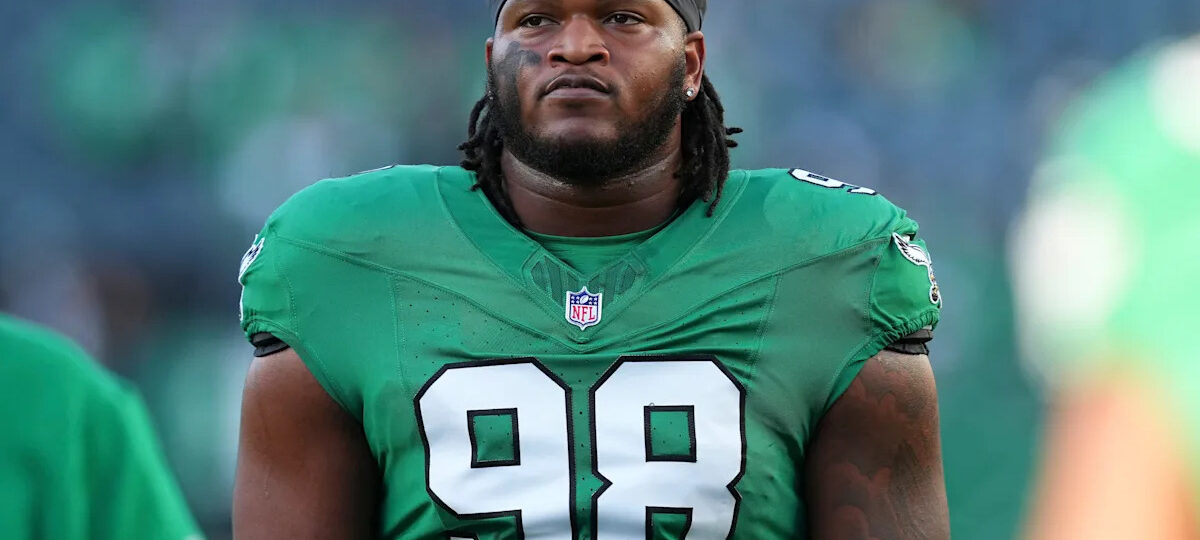
The Philadelphia Eagles have earned a reputation for rewarding their best players early. That’s why the ongoing conversation surrounding Jalen Carter remains one of the more fascinating storylines of the offseason. But the question has been asked: Do the Eagles have “all the power” in negotiations with Carter? From a contractual standpoint, it’s easy to understand why someone would reach that conclusion. Carter is entering the fourth season of his rookie deal.
Philadelphia has already exercised its fifth-year option. Barring something unexpected, the Eagles control his rights through the 2027 season. That gives Howie Roseman and the front office plenty of flexibility. As 97.5’s Bill Colarulo suggests, one might even argue that they can still use a franchise tag if talks linger into 2028.
Unlike teams negotiating with players entering the final year of their contracts, Philadelphia isn’t operating under a deadline. The Eagles can afford patience, to some degree. They can continue evaluating Carter, monitor the defensive tackle market, and decide when the timing makes the most sense for both sides. If they choose to wait another year, they have the contractual mechanisms in place to do so. That is real leverage.
It also explains why some believe the Eagles hold all the cards. One might also wonder if that has anything to do with why an extension hasn’t been announced yet.
Leverage doesn’t necessarily equal ‘complete control.’ NFL contracts continue to grow at an astonishing rate with each one that is announced. Every offseason brings new market-setting deals. Every elite player who signs raises the bar for everyone who follows. That’s the risk Philadelphia must consider. The Eagles could wait. They may even prefer to wait. The question is, can they afford to?
But if Carter continues performing like one of the NFL’s premier defensive tackles, his asking price is unlikely to decrease. More often than not, the opposite happens. The Eagles know this better than anyone. Their history of extending players early is built largely on the understanding that tomorrow’s price is often higher than today’s.
Jeffery Simmons’ three-year, $105.8 million extension with the Titans raises the financial stakes for the Eagles and their All-Pro defensive tackle. Simmons, one of Tennessee‘s franchise pillars, earned the payday after a dominant season in which he posted a career-high 11 sacks, broke Jurrell Casey‘s franchise record for sacks in a season by a Titans defensive tackle, and led NFL interior defensive linemen in solo tackles, tackles for loss, sacks, sack yards, quarterback pressures, pressure rate, and forced fumbles. Carter was Philadelphia’s lone Pro Bowl starter last season despite playing through two badly injured shoulders, finishing with 33 tackles, 41 quarterback pressures, 11 quarterback hits, and three sacks in 12 games. Through three seasons, he has 108 tackles, 25 tackles for loss, 13.5 sacks, and four forced fumbles. The production, age, and upside create the leverage. Carter has not yet stacked the same long-term résumé as Simmons, who has appeared in 99 games with 97 starts and accumulated 383 tackles, 42.5 sacks, 27 passes defensed, eight forced fumbles, and six fumble recoveries over seven seasons. Simmons is also a five-time captain, four-time Pro Bowler, and three-time All-Pro who has become one of the Titans‘ defining players on and off the field. That matters in negotiations because Tennessee did not pay only for the projection. It paid for sustained elite production, leadership, and franchise identity.
Another consideration shouldn’t be overlooked. Contract negotiations are about more than numbers. The Eagles view Carter as a foundational piece of their defense. Assuming that remains the case, maintaining a strong relationship throughout this process is important. Front offices can win negotiations while simultaneously creating unnecessary frustration if players feel undervalued.
No one is suggesting that’s happening now. Still, it’s worth remembering that these situations involve people, not just salary-cap figures.
The Eagles possess significant leverage in any potential negotiation with Carter. They have earned that position through smart roster management and the structure of the NFL’s rookie wage scale. Whether they have “all the power,” however, is another conversation entirely.
The Eagles can afford patience. The question is whether patience ultimately benefits both sides. Time will soon tell the tale on both sides of the discussion.
Discover more from NAIRAVOICE.COM.NG
Subscribe to get the latest posts sent to your email.