
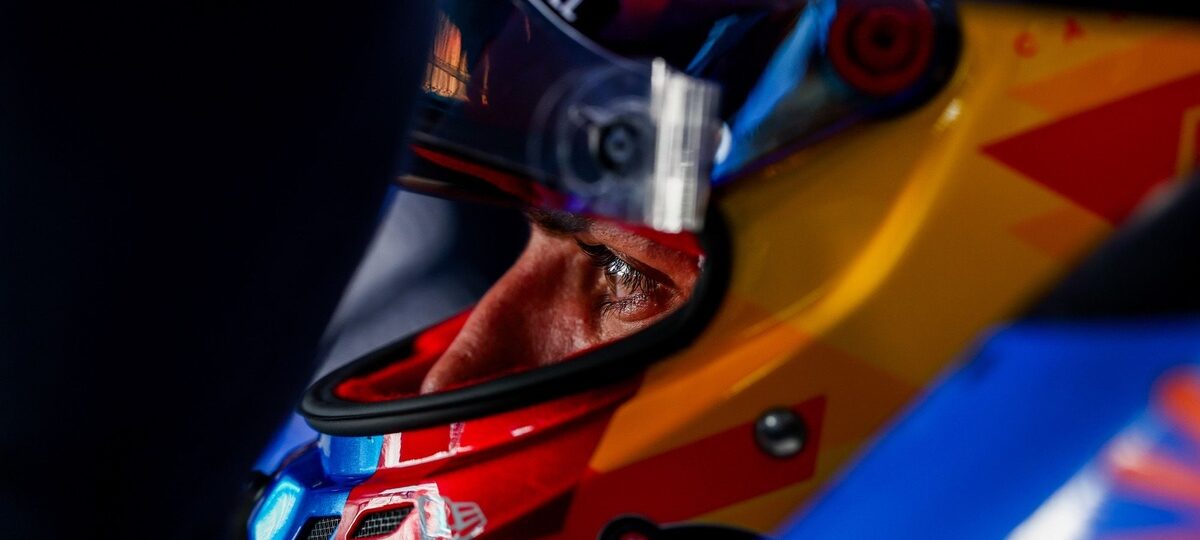

Williams driver Carlos Sainz admitted the team’s disappointing 2026 campaign came as a shock, but said the action plan the team has put in place has restored his faith in the squad.
When Sainz signed for Williams after losing his Ferrari drive, there was clearly no doubt that the move would be a downgrade, at least for a considerable period while Williams embarks on a transformation from an underfunded, antiquated also-ran into a top team to go toe-to-toe with F1’s big four.
But while Williams vastly exceeded Sainz’s wildest expectations in year one, 2026 has swung the opposite direction with a FW48 car that has been well adrift due to a lack of downforce and excess weight, despite spending most of 2025 focusing on the new regulation changes.
Read Also:

Why it will ‘take time’ for Williams to cut weight off its heavy 2026 F1 car
In public, Sainz and the team have kept the peace, but it is clear – and understandable – that there has been real frustration that the Grove squad isn’t making the expected progress after all the emphasis that had been placed on this season and beyond. Williams’ move to the front was always going to be a long-term, gradual process, but that didn’t make its sudden step backwards less of a shock, Sainz admitted.
“I think we acknowledge that fundamentally even without the weight issue, this car is not good enough for what it could have been or should have been,” was Sainz’s verdict in Monaco, after he and team-mate Alex Albon combined for only seven points over the first five race weekends.
“Speaking very bluntly this year, we’ve underdelivered in many, many areas and that’s why we’ve hit a pretty big bump because I think we didn’t expect to underdeliver in so many of those areas.
When asked if 2026 tested his faith in his choice for Williams, he replied: “Tested my faith? For sure. When you go from scoring podiums at the end of last year to suddenly being where we were – two seconds off the pace at the beginning of the year – it’s a big test of faith or a big shock to the system.”
Carlos Sainz can’t escape his Ferrari past

The 2026 season has been particularly painful due to the stark contrast with an unexpectedly strong 2025, when the team placed fifth in the standings and Sainz took two surprise podiums in Azerbaijan and Qatar. In hindsight, it feels like the team outperformed the real level of its operational capabilities, with it then trying to pull off more than its processes could handle as it developed and built the 2026 car.
“I think last year we over delivered as a team,” the Spaniard added. “The FW47 was a good race car with its strengths and weaknesses, but we definitely managed to create a car that was able to score podiums. In my first year with the team, I was not expecting that. I was expecting to maybe be a solid midfield car but not to at [some] races be fighting with Mercedes and Ferrari head-to-head on outright pace. And that probably also raised my expectations for 2026. Then 2026 came and it was almost the opposite.”
The biggest topic is now how Williams will respond. Team boss James Vowles has never shied away from the idea that perhaps he has pushed through more systemic change through Williams’s organisation than it was able to cope with. But the hope is the 2026 slump has exposed more weaknesses that the team can now address, and which otherwise may have stayed under the radar.
Sainz has likened Williams’s situation to the McLaren team from three years ago, an oft-used analogy, when McLaren languished at the back of the grid before making rapid progress.
Carlos Sainz: Williams slump was

“I was the first one to say to James and to the management that it was not expected, but at the same time we had very open and clear conversations of where things started going wrong,” Sainz detailed.
“We did a very thorough analysis with some very important members of the team, and I think once we all understood where it had started to go wrong and how, I very quickly realised that it might have actually done good things for the team.
“The road to recovery of a team is never a straight line. The best example is McLaren at the beginning of 2023, they were really far down, and they ended the year on a high and from there came the big progress.
“It propelled some very interesting changes inside the team [in terms of] mentality, changes of approach that were needed that maybe without the bump we would have never changed, and we would have never corrected.
“Thanks to the shock of that bump, James and his team put [in place] a very strong action to correct them, to erase them from the system. That made me recover a lot of faith and belief in the project.”
Read Also:

Ferrari’s Fred Vasseur to skip Saturday at F1 Monaco GP

Why Audi does not want major F1 engine changes for 2027
Meanwhile, more changes to its current car are coming, with Williams trying to strategically let its weight saving efforts coincide with suites of aerodynamic upgrades to spend its resources efficiently.
Next season, Williams is planning to skip a year with the naming logic of its chassis and go straight from FW48 to FW50. That gesture is intended to celebrate the 50th anniversary of its first F1 entry in 1977. Sainz and Albon will also be hoping it coincides with the historic team taking two steps forward instead of repeating 2026’s one step back.
To read more Motorsport.com articles visit our website.
Discover more from NAIRAVOICE.COM.NG
Subscribe to get the latest posts sent to your email.