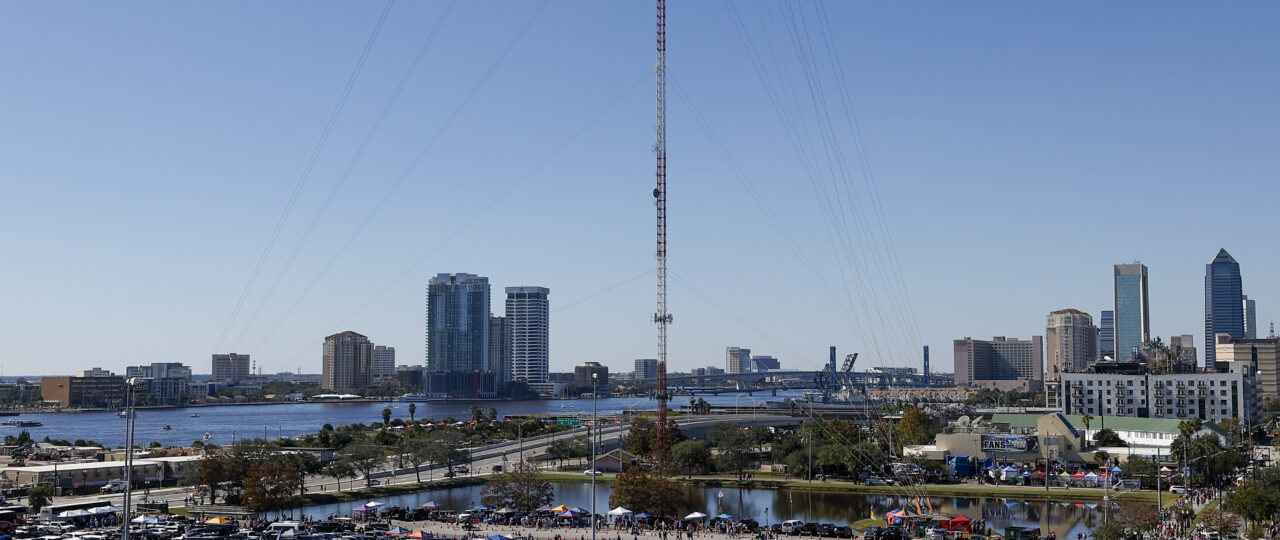
College football in the 2020s is a never-ending war between commerce and tradition, between a deep desire to preserve universities’ distinctive identities and an even deeper desire to make money off those distinctive identities. One of the war’s most notable battles is unfolding on the shores of the Atlantic Ocean in Jacksonville, Florida, where two of the SEC’s rivals meet every year in a celebrated, anticipated, cherished battle. (Well, not every year, but we’ll get to that.)
Florida-Georgia — or Georgia-Florida, depending on whether you’re wearing red or blue to the game — is one of only three standing rivalry games played at a neutral site every year. (Texas-Oklahoma and Army-Navy are the others.) It’s achieved legendary status for both institutions; a pilgrimage to Jacksonville is a must for every Dawg and Gator.
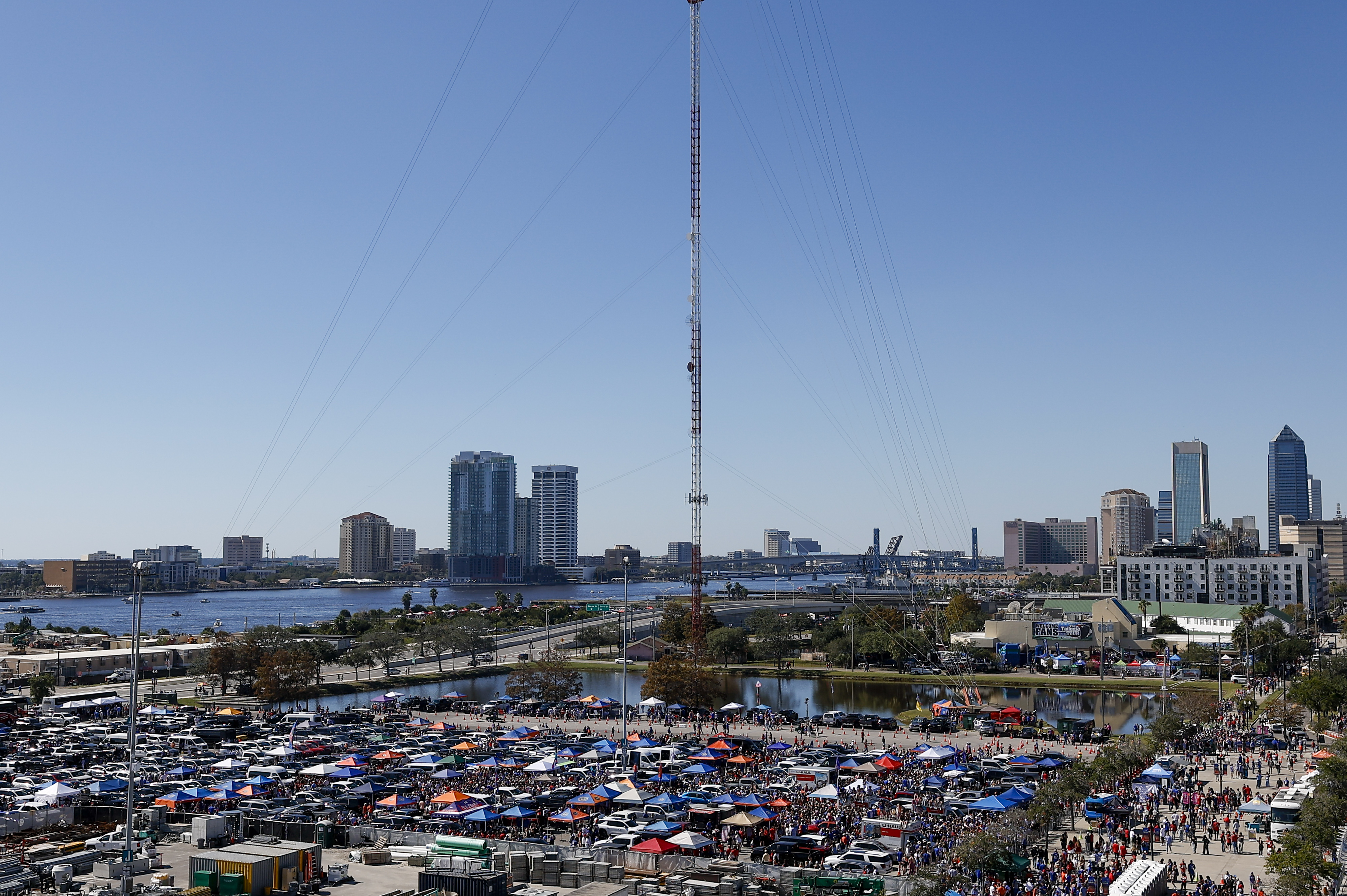
“It’s one of the few events where twice as many people come to experience the game than actually go into the game,” says Michael Corrigan, president and CEO of Visit Jacksonville. “The stadium holds some 80,000 people. Well, there’s 150,000 people that are tailgating or participating some way in that particular weekend. … It’s a three-and-a-half to four-hour commercial about Jacksonville, Florida on national TV.”
“Jacksonville being a border town, there’s just a lot of history and tradition,” Florida athletic director Scott Stricklin told Yahoo Sports. “It just holds a unique place in college football lore, and it’s important for our school to maintain that part of the rivalry.”
It’s a fantastic tradition, yes, but it’s also immensely lucrative, and as we’ve seen everywhere across the college football landscape, tradition doesn’t stand a chance against money. And what happens next in the Georgia-Florida-Jacksonville equation — which now includes Atlanta and Tampa for the next two years — could herald changes ahead for other major programs across the country.
 Icon Sportswire via Getty Images
The World’s Largest Outdoor Branding Opportunity
Corporate and brand-minded interests have dubbed this year’s Florida-Georgia game the “Invesco QQQ Atlanta Gridiron Classic,” but everyone involved knows it by its traditional name: the World’s Largest Outdoor Cocktail Party. When you’re a student, you hang wherever you can find a beer and a bed; Frat Beach in nearby St. Simons Island is a longstanding Georgia tradition. When you’re an alum with a bit more disposable income, you rent a Duval County Airbnb and whip up themed cocktails. And everyone, young and old, descends on Jacksonville’s EverBank Stadium, dividing neatly into “Georgia” and “Florida” quadrants.
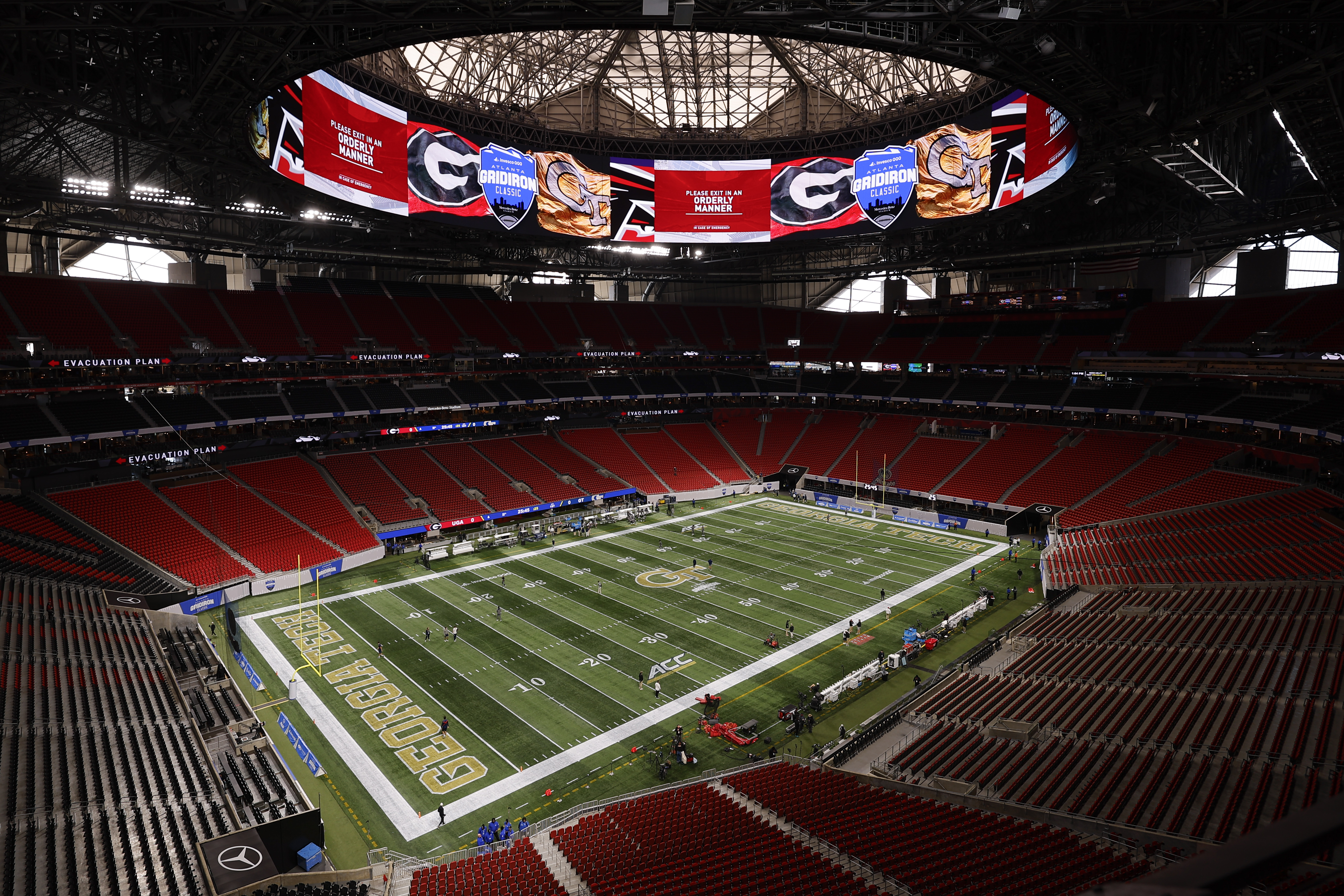
Well, except this year and next. Because EverBank is undergoing massive renovations, the party has moved to Atlanta this weekend and Tampa next year. The game will again take place in NFL stadiums — Mercedes-Benz in Atlanta, Raymond James in Tampa — before returning to Jacksonville in 2028 on a four-year contract.
The improvements to EverBank are both substantial and necessary for Jacksonville to keep pace with the expectations and demands of the NFL and other major entertainment entities. The $1.4 billion-plus renovation will include the installation of a canopy over the stadium, along with other fan-friendly improvements like widened concourses, in-stadium gathering spots and technology upgrades.
Jacksonville factored the Georgia-Florida game into its design and decision-making process; the stadium will feature tranches of permanent seats that can be deployed to increase the stadium’s capacity by many thousands of fans, from 63,000 up to 70,000. Georgia and Florida are even featured in renderings of the stadium’s future appearance.
“When they come back in ’28, when Florida and Georgia walk in, the fans are going to be blown away at all the pageantry that we’ve had for all these years, plus the best stadium in the state of Florida for sure,” Corrigan says. “It’s going to be a great experience for those fans.”
But these developments will take time. This year, the Jaguars are playing their home games before a significantly reduced capacity, which is part of the reason why several Jacksonville “home” games are in Europe. (If the Jaguars make the playoffs, they’ll be playing in front of some of the smallest crowds in NFL postseason history, even with a sellout.) Next year, the stadium work will be so substantial that the Jaguars will relocate to Orlando for a season.
The ongoing stadium construction presents an opportunity for both Atlanta and Tampa to refine their big-event capabilities. Both cities have hosted Super Bowls, and both cities would be open to much more. Massive NFL stadiums, and the teams that own them, want to enhance their bottom lines with a piece of the lucrative college football Saturday experience.
“At Raymond James Stadium, we’ve always had double tenants, the Buccaneers, obviously, as well as the USF Bulls,” says Lanness Robinson, executive director of the Tampa Bay Sports Commission. “USF is building their own on-campus stadium, so that means that there’s going to be some availability at Raymond James Stadium. (Georgia-Florida in 2027) really gives us a sneak peek at the neutral site game options that will now be there for us to consider how we’re going to go forward, and what opportunities might exist out there.”
“(Stadium) owners have put in hundreds of millions of dollars for stadiums that sit empty 350 days a year, because there’s just not many World Cup games that you can put in there,” says Victor Matheson, a professor of economics at Holy Cross. “There’s not many Bruce Springsteens and Kendrick Lamars that can fill an entire NFL stadium. So you have these gigantic facilities that are wildly expensive that sit empty the vast majority of the time, so anything you can do to fill those up is a benefit and a little bit of gravy for those NFL owners.”
 Todd Kirkland via Getty Images
College games in NFL stadiums: Here, and growing
Unless and until there are more college football games in a season — not out of the realm of possibility, but that’s another story — the behemoth NFL stadiums will have to lure already-existing competitions to their buildings. And that presents a very real opportunity for universities … and a threat to fans who enjoy the on-campus experience.
In a world of spiraling NIL costs and financially strapped athletic departments, universities are looking for alternative sources of revenue, and moving a game from campus to an NFL stadium is a quick way to drum up some necessary revenue. Sometimes that’s an easy switch … sometimes not.
In return for a $10 million check, Georgia Tech moved last year’s installment of Clean Old-Fashioned Hate, its rivalry game with Georgia, to Mercedes-Benz Stadium. But that wasn’t a significant lift; Tech’s own stadium is just one mile away. More notable was Auburn’s decision to move its season-opener against Baylor this year to Mercedes-Benz, more than two hours northeast of campus. Both Auburn and Baylor fans weren’t pleased with the move, but then they weren’t writing big enough checks to offset it.
From Florida’s perspective, the game works on its own, but not as a pathway to other neutral site games. “You’re taking games away from campus, and we value those as well,” Stricklin says. “The historic nature of Florida-Georgia makes that worth doing on an annual basis from a neutral site standpoint. … There might be a one-off here and there, but it’s not something we’re going to be very invested in for regular-season games.”
Georgia’s Kirby Smart has gone on record many times about his distaste for neutral-site games — coaches hate any disruption to routine, and Smart hates anything that cuts into his on-campus recruiting blitzes — but he’s fighting a losing battle. Neutral-site games are just too lucrative for universities to resist for long.
For instance, according to the Athens Banner-Herald, Jacksonville is paying both universities $1.5 million apiece this year and next, even though the game isn’t being played anywhere near Jacksonville. That figure rises to $10 million apiece in 2028 and 2029, and $10.5 million in 2030 and 2031.
Beyond that, who knows? Perhaps the two schools and Jacksonville will continue the arrangement that’s worked so well for so long. And perhaps the schools will begin a profitable pilgrimage around the Southeast, rotating through the massive, competing stadiums in the region.
“We are going to maintain traditions, but also try to make it our own at the same time, because if they ever are looking for another place, we want to be considered,” says Robinson of Tampa’s 2027 hosting duties. “Jacksonville has done a great job with the game as long as they’ve had it. But if there’s ever another opportunity for another renovation or whatever, we want to be right there and be great hosts, because we always are looking to bring events back.”
“Restarting Florida-Georgia here in ’28 is extremely important, because it’s going to send an instant signal to all the other great sporting events that we want to hold in the new stadium,” Corrigan says. “Everything from major concerts to football games. We want to be much more in the conversation about college football playoff late-round games.”
The campus scheduling experience isn’t dying, but it is changing.
“One of the exciting things about the expanded playoff is more on-campus game playoff games,” Stricklin says. “We all have really cool stadiums on our campus, and we’ve got to make sure we continue to drive really compelling matchups to those campuses. I think the campus is always going to be the backbone of college football scheduling.”
Stricklin speaks from a position of strength; he already has his lucrative neutral-site game locked in for the future. Will other ADs and institutions be quite so campus-focused with so much money on the line? That’s very much an open question.
So raise a legally sanctioned beverage to the way Georgia-Florida, and college football as a whole, used to be. There’s no guarantee it’ll be that way going forward.
Discover more from NAIRAVOICE.COM.NG
Subscribe to get the latest posts sent to your email.