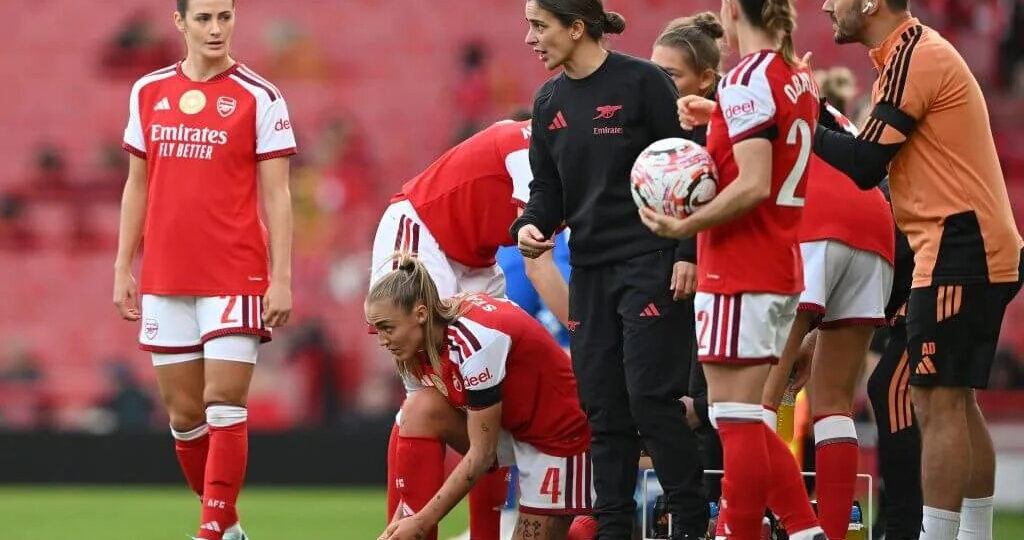
 What are Arsenal Women?
Six weeks ago, the answer was easy: Women’s Super League title contenders with the infrastructure to match.
It is now easier to answer what Arsenal are not than what they are.
For one, they are not title contenders. They are not good at figuring out a way through a low block. They are not putting away chances. They are not defending with cogency.
What Arsenal are is more sobering.
They are eighth in the WSL. They are winless in five successive WSL matches for the first time in their history. They are a team that has scored five and conceded seven, the only team that failed to put at least two past newly-promoted Birmingham City and not put at least one past newly-promoted Crystal Palace.
It’s grim reading. The draw with Birmingham at home is also an extension of the theme. That this came so swiftly after an international break in which Alessia Russo, Olivia Smith, Frida Maanum, Georgia Stanway, Geraldine Reuteler and Stina Blackstenius scored goals and after staff met for a “review of the season” is cause for concern.
Against Birmingham, Arsenal once again couldn’t think their way through a low block. They registered 43 touches in the opposition box and 27 shots, yet managed to put just four of those on target. They were undone by a counter-attack down their left side, where Birmingham focused 40 per cent of their attack. Leah Williamson and Lotte Wubben-Moy struggled to find fluency, the latter at fault for allowing Neve Herron to slip a pass through her and into the feet of Oceane Hurtre on the other side.
In many ways, the performance was a microcosm of the woes afflicting Arsenal at both ends of the pitch.
Arsenal’s attacking collapse
The headline source of anguish for Arsenal fans this season has been the team’s underperformance in front of goal.
For the past five seasons, Arsenal have tended to overperform. Under Jonas Eidevall in the 2021-22 season, they outperformed their expected goals by 24.3, scoring 65 goals from an expected 40.7. Of the 65 scored that season, Vivianne Miedema and Beth Mead got 25 of them (14 and 11 respectively, just under 40 per cent).
Arsenal did not reach those heights in subsequent seasons, but the overperformance remained steady — until this season. Arsenal have scored five goals in the WSL, six fewer than the quality of their chances suggest they should be given their xG of 11.2.
Arsenal rank third in the WSL for shots taken, yet their conversion of those shots has been strikingly poor. At 4.1 per cent, they have the worst conversion rate in the WSL. The next lowest is Everton at 6.9 per cent. Arsenal’s percentage of shots on target that actually beat the goalkeeper (14 per cent) represents a league low.
Former Arsenal forward Kelly Smith was appointed as an assistant coach ahead of the 2023-24 season to work with the attacking players. In the 2023-24 season, Arsenal’s attacking conversion rates increased to 16.1 per cent, before dropping back down to 13.2 per cent (still higher than previous seasons) before plummeting this season.
The source of the profligacy this season is difficult to pinpoint.
Arsenal added attacking players in the summer, winger Lisa Baum and forward Selina Cerci, but other than Baum (who has two goals in the WSL, the most of any Arsenal player), head coach Renee Slegers has relied on familiar faces in Russo, Smith, Caitlin Foord and Blackstenius.
Only Smith and Russo have managed a goal in the WSL. This time last season, Arsenal’s attacking line boasted 14 goals, with Blackstenius responsible for four, Russo and Frida Maanum three apiece, Chloe Kelly two and Smith and Foord one apiece. Neither Kelly nor Maanum have started a WSL match this season due to injury.
Slegers spoke of a front line lacking confidence. Arsenal’s expected goals per shot has slightly dropped, suggesting lower-quality shots in general, albeit not commensurate with the drop-off this season. Their shots on target have also decreased this season to 30.6 per cent vs 38 per cent as an average of the previous five seasons.
That Arsenal have not managed a win in any of their home games this season can seem baffling. Against Palace, Arsenal boasted 76 per cent possession and 70 touches in the opposition final third, the most by a team without scoring in a WSL match since 2018.
In the 1-1 draw with Manchester United, Arsenal had 59 per cent possession and 59 touches in the final third, as well as four big chances. United, by contrast, managed three touches in Arsenal’s final third.
Yet possession does not equate to threat. Arsenal have registered a league-high 2,173 passes in the opposition half (excluding crosses) and a league-high 1,403 passes in the final third. Yet, many of their performances this season have been marked by ponderous build-up play and an inability to puncture low-to-mid blocks. Some opposition also cited a predictability (and inefficiency) to Arsenal’s attack. Arsenal rank second in the league for open-play crosses (104), according to Opta, yet ninth for successful open-play crosses (20.2 per cent).
Russo remains the focal point, and though the England striker is known to drop deep to help build up attack through the middle, she’s actually having more touches in the box this season (7.1 per 90) than she was in the previous two (6.8 and 5.4).
Still, some variation in attack could be welcomed. Fitness issues have deterred the use of Germany forward and summer signing Cerci, who underwent a knee procedure last week, according to the club. The club also confirmed fitness has played a role in the lack of minutes provided to Geraldine Reuteler, who joined in the summer as an option in the No 10 position.
Defensive issues and vulnerability to the counter-attack
As The Athletic wrote earlier this season, a blueprint is emerging for how teams approach Arsenal: sit in a low-to-mid block and put the attacking onus on them.
Another plan has also begun to take shape: attack down Arsenal’s left on the counter.
Of the attacking touches Arsenal have conceded this league season, 41.6 per cent have arrived down the left flank, the highest proportion in the WSL and an uptick from previous seasons when it was 36 per cent, 36.9 per cent and 39 per cent respectively.
Long-time left-back Katie McCabe departed the club in the summer upon the expiry of her contract, joining rivals Chelsea. McCabe, a natural left-footer, was replaced by Ona Batlle, a right-footer who has predominantly played at right-back throughout her career.
While playing a right-footed player on the left is not in itself a problem, it is notable that when centre-back Steph Catley (left-footed) is not deployed regularly alongside Williamson as was the case last season, Arsenal’s backline of Emily Fox, Williamson, Wubben-Moy and Batlle are all right-foot dominant. Opponents have picked up on and targeted this (Birmingham head coach Amy Merricks remarked after her side’s draw that she swapped Hurtre from the left to the right for this reason).
Birmingham mustered three chances on the break amounting to 0.72 xG, including a miss from Lily Crosthwaite on 16 minutes and Hurtre’s goal. The week prior, Manchester City found joy on the counter when they sliced through Arsenal with just two quick passes before Khadija “Bunny” Shaw finished off the move to give City their final goal in the 4-2 win.
Arsenal are conceding around 0.17 xG per game from Opta-defined fast breaks this season, a jump from 0.03 last season. Meanwhile, Arsenal rank 11th in the league for percentage of duels won (46.6 per cent).
Watching Arsenal defend these situations, a lack of fluency between defensive partners is notable, something unhelped by the inconsistency of the centre-back pairing, with Wubben-Moy starting the past three matches due to injury to Catley.
Yet, the lack of fluency is not an exclusively defensive problem. As The Athletic reported two weeks ago, a lack of clarity on the pitch has been a problem cited by some within the squad. This was visible in the 1-0 defeat to Chelsea in September when Slegers made a triple substitution for Stanway, Mariona Caldentey and Baum on the hour, with Foord, Kelly and Blackstenius brought on. Captain Kim Little shouted back to the bench, “Am I playing as a six now?” as players attempted to suss out where they were meant to be.
While substitutions have represented a source of frustration for fans amid the squad’s ongoing struggles, Slegers sits top for the number of subs made per game this season, having used all five substitutions in every game apart from last weekend’s defeat to Birmingham when she made four.
Given Arsenal’s 25-player squad (so large that Slegers lobbied UEFA to expand the acceptable matchday squad size for European competitions), such rotation is necessary, though the tangible impact of the substitutions has been disappointing, as the City defeat showcased. As The Athletic reported previously, pressure to perform could be a factor, as well as drifting confidence amongst players.
Six fixtures into the season, Slegers has already ruled Arsenal out of the WSL title race. Arsenal still have the Champions League and FA Cup trophies for which to fight. Slegers remains in post despite the poor results, but one thing is clear: significant improvements in all areas are needed if Arsenal are to recover anything from this season.
This article originally appeared in The Athletic.
Arsenal WFC, Women’s Soccer
2026 The Athletic Media Company
Discover more from NAIRAVOICE.COM.NG
Subscribe to get the latest posts sent to your email.