In the early 2000s, 24 revolutionized the idea of must-see television. Airing on Fox in 2001, the spy thriller was successful by implementing the idea that fans could not miss an episode. 24 follows Jack Bauer (Kiefer Sutherland), an intense and uncompromising agent for America’s Counter Terrorism Unit. What set this story apart from others of its kind was the structure; each episode takes place in real time, with only an hour elapsing. With 24 episodes to a season, each one tells its story over the course of one full day. It’s a format that we’ve become familiar with thanks to HBO’s The Pitt, but long before Dr. Robby was running the ER, Jack Bauer was running around trying to save the world.
Finding a new life on streaming, 24‘s iconic format made the show a part of the zeitgeist, making everyone feel like they needed to tune in. The first season is a classic as Jack gets called into work because of a threat to the life of a presidential candidate, David Palmer (Dennis Haysbert), while simultaneously, his teenage daughter, Kim (Elisha Cuthbert), goes missing. These two events ultimately dovetail at the end of a breakneck-paced Season 1, where Jack loses practically everything. The show earned acclaim upon its release, garnering praise from critics for its unique approach to spy thrillers in a post 9/11 world. This momentum continued in a series that would usher in the start of the golden age of television.
’24’ Defined Television of the 2000s
 Image via 20th Century Fox Television
- Image via Kelsey McNeal / TM and Copyright © 20th Century Fox Film Corp
- Image via © 20th Century Fox Film Corp
- Image via FOX
- Image via Ray Mickshaw / © FOX / courtesy everett collection
 Image via 20th Century Fox Television
 Image via Kelsey McNeal / TM and Copyright © 20th Century Fox Film Corp
 Image via © 20th Century Fox Film Corp
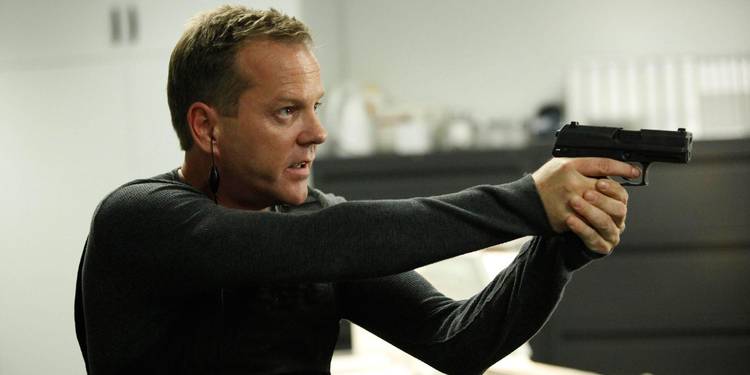 Image via FOX
 Image via Ray Mickshaw / © FOX / courtesy everett collection
- Image via 20th Century Fox Television
- Image via Kelsey McNeal / TM and Copyright © 20th Century Fox Film Corp
- Image via © 20th Century Fox Film Corp
- Image via FOX
- Image via Ray Mickshaw / © FOX / courtesy everett collection
 Image via 20th Century Fox Television
 Image via Kelsey McNeal / TM and Copyright © 20th Century Fox Film Corp
 Image via © 20th Century Fox Film Corp
 Image via FOX
 Image via Ray Mickshaw / © FOX / courtesy everett collection
Immersive series of the aughts, such as Lost, defined the decade as far as television programming was concerned. The shows delivered on twists and turns and offered long seasons that encouraged fan discourse. Even in a time before social media, there were some TV shows you simply had to talk about, and 24 was one of them. 24 maintained its unique structure throughout the series by establishing time jumps between seasons. Jack Bauer didn’t have a terrible day every day, just once every couple of years. Season 2 follows Jack 18 months after the gripping season finale, covering the threat of a nuclear bomb set to detonate in Los Angeles.
Four action series. One of them is built around exactly the way you
handle pressure, people, and a room that has just gone very quiet. Here is where you would survive
the trilogy, and probably headline it.
You are precision with a grudge. You don’t posture, you don’t
escalate, and you don’t warn anybody twice. That is exactly why the people who know you are
so careful never to be the reason you start.
- The Wick films run on discipline: an underworld with actual etiquette, a hero who
honours every rule of it, and a world that unravels the instant someone breaks one
against him. - You share that quality. You are extraordinarily reasonable right up to the line, and
then completely immovable past it. - Focus, commitment and sheer will. You’d be the one carrying grief through three sequels
and turning it into technique rather than noise. - People wouldn’t call you dangerous. They’d say your name quietly and let that do the
work.
You understand the thing the whole franchise is secretly about:
the cars are spectacular, but the crew is the point. You collect people, you keep them, and
you’d drive through a building for any one of them.
- This series went from street racing to orbit without ever changing its actual subject,
because loyalty scales and plot doesn’t have to. - You have the same instinct. You build a family out of whoever turns up, and then you
defend it past the point of reason. - You’d thrive here because the franchise rewards exactly your strengths: warmth, nerve,
an absolute refusal to leave anyone behind, and a relaxed relationship with physics. - The mission can wait. The barbecue cannot.
You over-prepare and then take the dangerous part yourself
anyway. It looks like control, but it’s really responsibility. You have never worked out how
to ask somebody else to carry the risk.
- This is the franchise of the plan that collapses on schedule: the team, the mask, the
rooftop, and the one person sprinting flat out because sprinting is all that’s left. - You share that refusal to accept an outcome. Told the odds, you treat them as an
administrative error. - You’d thrive here because these films reward competence and loyalty in equal measure.
The mission matters, but nobody on the team gets left on the wrong side of a door. - Some people delegate the cliff. You have never once been that person.
You are not the most trained person in the building, the best
equipped, or the one anybody would have picked. You are simply the one still standing at the
end, which turns out to be the only qualification that matters.
- Die Hard invented the modern action hero by making him mortal: outgunned, out-planned,
bleeding, and extremely funny about it. - You share that stubbornness. Adversity doesn’t make you noble, it makes you sarcastic,
and then it makes you unstoppable. - You’d thrive here because these films reward improvisation and nerve over preparation,
and you’ve never had the luxury of preparing anyway. - You didn’t want any of this. You just declined to be the person who let it happen.
As the seasons progressed, some concepts would get more outrageous, such as Jack’s dependency on heroin, but the series was a hallmark of network television. It was so popular that it was rare for an actor not to make some sort of guest appearance during the run of the show. Many notable guest stars include Sean Astin, Annie Wersching, and Shohreh Aghdashloo. The series ran an impressive eight seasons before it concluded, and it remained such a crowning achievement of television that Kiefer Sutherland returned to the role of Jack Bauer some years later. 24: Live Another Day was marketed as a limited series and ran for 12 episodes, and worked around this by only showcasing the most significant hours of Jack’s day. Mary Lynn Rajskub reprised her role as the fan-favorite Chloe in the series that aired in 2014.
At a time when procedurals and sitcoms dominated television and genre fare was still quite niche, 24 looks like the sign of the dawning of a new age. Today, it feels like a relic of another time, though still a joy to revisit for fans. This innovative series encouraged others to take risks in TV, especially when it came to the format of how to tell a story. Until that point, television had long been considered the budget version of film, and you would rarely ever see movie stars moving to the TV screens. But 24 premiered at a time when that attitude was starting to change; viewers keep coming back to these dramatic stories time and time again, and it’s not hard to see why.
All episodes of 24 are now available to stream on Hulu and Disney+.
Discover more from NAIRAVOICE.COM.NG
Subscribe to get the latest posts sent to your email.