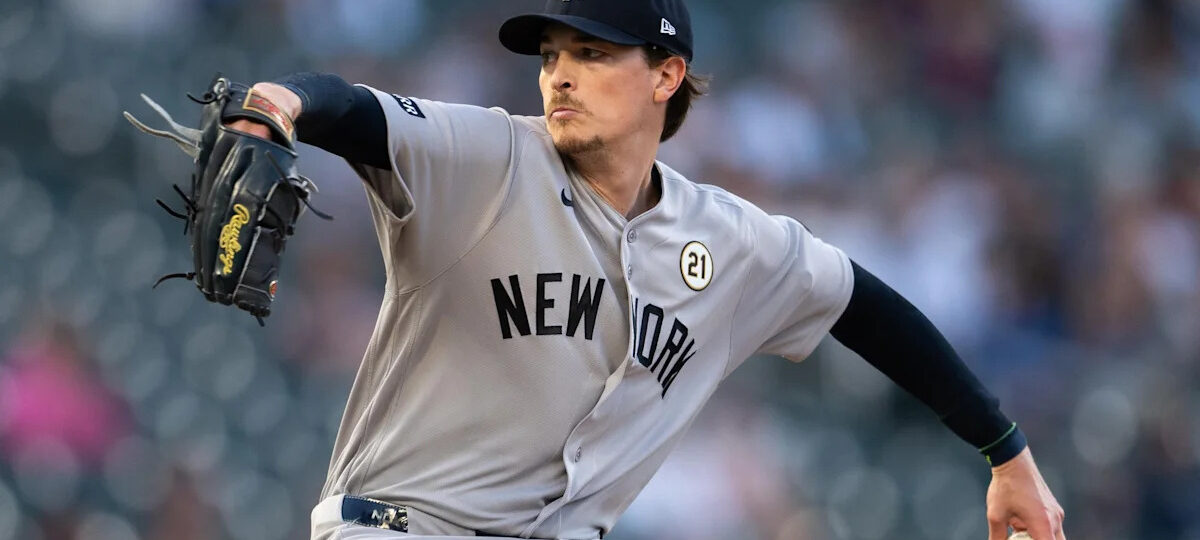

It wouldn’t have been a proper Yankees-Twins series in Minnesota without a game that devolved into extra-innings madness. The Yankees failed to cash in multiple bases loaded opportunities and so missed a chance to sweep, falling farther behind the Rays in the standings. Nonetheless, the Bombers took care of business in the first two games of the series, and it is from the middle game that we pull our candidate for Sequence of the Week.
We join Max Fried with two outs in the bottom of the fifth on Tuesday at Target Field. The Yankees have a 3-1 lead courtesy of a Cody Bellinger two-run homer and George Lombard Jr. RBI single. However, the Twins are threatening to cut the lead to one with Emmanuel Rodriguez on second with a two-out double. That brings the number nine hitter Austin Martin to the plate, a batter Fried absolutely wants to retire to avoid the lineup turning over with a runner in scoring position.
After going almost all fastballs the first time he faced Martin, Fried looks to steal a called first-pitch strike with a backdoor sweeper.
After seeing mostly hard stuff that moved away from him, you can understand why Martin would give up on this pitch early given how far from the strike zone it is initially aimed. Fried sweeps in a dandy on the outer half for called strike one.
Establishing that backdoor breaking ball for a called strike forces Martin to respect any pitches that start away, even those that look like balls out of the hand. This opens up a host of possibilities for Fried, including the changeup low and away for chase.
This is a pretty well-executed changeup out of the zone down and outside. It looks like it is aimed at that corner of the zone before fading away from the hitter. You can see Martin was initially tempted to chase the pitch — a product of that first pitch backdoor sweeper — before holding up for an impressively disciplined take.
With Martin taking against that last pitch away, Fried and Ali Sánchez feel that there is an opening for another backdoor sweeper.
Another decently executed pitch, just a little too low to nip the bottom of the zone for a second called strike. It is worth noting that Martin showed some willingness to offer before backing off, so that outside pitch is still open for chase opportunities.
Not wanting to fall any further behind in the count, Fried throws his first fastball of the encounter. However, unlike the four-seamers and sinkers he threw Martin in the first AB, this cutter breaks toward the hitter instead of away. Therefore, if the hitter succeeds in reading fastball spin out of the hand, a backdoor cutter that starts off the plate away should freeze Martin.
That is precisely what happens, Fried pinpointing this cutter with precision on the corner up and away. Martin leaves the bat on his shoulder, only to watch the pitch cut across the black of the plate for called strike two.
Now that he has established his fastball in the zone and has the count leverage in his favor, Fried has an opening to climb the ladder with the cutter hoping for a chase and whiff under a pitch elevated above the zone.
Even though this offering misses the top of the zone by about a foot, it’s not a complete waste pitch. Fried has reset the hitter’s eye level for the fastball up, which should open the door for a breaking ball down and in.
That is just what Fried’s thought process is with the count full. He doesn’t need to give in with a fastball with first base open, knowing that it will be very hard for Martin to lay off a breaking ball that looks like a strike out of the hand.
Now this is what you call a back-foot sweeper. The pitch looks like a strike for much of its journey toward home until the lateral sweep really seems to accelerate in the final 15 feet. It’s just where you want to land a pitch like this, close enough to the strike zone to extract the chase but close enough to the batter that he is not able to pull in his hands in time to make contact.
Here’s the full sequence:

Asked after the start what positives he would take away, Fried cited breaking ball command and an economical pitch count to go seven strong on just 88 pitches, the first point certainly highlighted by this sequence.
The Yankees desperately needed this start from Fried, not only to boost their chances of winning this particular game but also as a sign of continued build-up from the recurrence of his left elbow bone bruise. Fried labored in the start before this one, needing 80 pitches to complete 3.1 innings. Seeing him back to his best when it comes to pitch efficiency and damage limitation has to be encouraging as they formulate their postseason rotation plans.
Discover more from NAIRAVOICE.COM.NG
Subscribe to get the latest posts sent to your email.