
*Before we dive in, remember that all data cited in this section is provided exclusively by Fantasy Points Data Suite. Get 15% off a subscription with promo code DS2.
Here at Fantasy Points Data, we have a new matchup tool in Data Suite 2.0. This tool is the foundation of this breakdown between Lions @ Bills this week.
NOTE: Since this was written, the betting line for Lions vs. Bills has shifted from Bills -4.5 to Bills -5.5.
Spread BUF -4.5 · Total 54.5 · Implied BUF 29.5 / DET 25.0
- Buffalo 36-31 at Houston: Josh Allen 20-of-29, 334 yards, 2 pass TD, 2 rush TD
- Detroit 31-30 (OT) over New Orleans: Jahmyr Gibbs 29-156-2 rushing; Amon-Ra St. Brown 10-67-2; Jared Goff 26-of-39, 206 yards, 2 TD.
Buffalo 36-31 at Houston: Josh Allen 20-of-29, 334 yards, 2 pass TD, 2 rush TD
Detroit 31-30 (OT) over New Orleans: Jahmyr Gibbs 29-156-2 rushing; Amon-Ra St. Brown 10-67-2; Jared Goff 26-of-39, 206 yards, 2 TD.
FPTS game script: Buffalo is favored by 4.5 at home and should stay balanced. Detroit already throws more than expected; trailing would push that further.
That script is the whole game. If Buffalo gets ahead, Allen can pick spots in the two passing mismatches below. If Detroit stays within one score, Gibbs and the Lions’ anti-blitz / run edges become live.

Each row is unit vs unit. Rank 1 is best. The bar leans toward the team that owns the gap.
Two Buffalo passing edges, three Detroit counter-edges. That is a shootout profile with a home-favorite tilt, not a one-sided smash.
This is the largest bar on the graphic and the cleanest “why Buffalo is favored” number.
Allen’s Week 1 tape already pointed here. He averaged 11.5 yards per attempt and 11.5 air yards per attempt, with 38.5% of throws traveling 15+ yards and 26.9% traveling 20+. First-down dropbacks jumped to 48.1% after sitting at 39.2% last year. On first-down passes he went 8-of-12 for 186 yards. Brady‘s Bills are no longer a “run first, then throw” offense; they are throwing in-structure and down the field earlier.
Detroit is missing the two players who police those windows. Kerby Joseph and Brian Branch are both on PUP and ineligible until Week 5. New Orleans’ Tyler Shough just went 35-of-56 for 410 yards and 3 TDs. Detroit allowed 378 net passing yards in Week 1, last in the league. Intermediate in-breakers, play-action crossers, and TE seams are the exact throws a safety-less Lions defense will struggle to wall off.
How Buffalo should attack it: play-action from under center and 13-personnel (Buffalo used 13-personnel on 40.4% of snaps in Week 1, highest in the NFL), then hit Dalton Kincaid and DJ Moore on intermediate crossers and seams. Kincaid went 5-for-6 for 130 yards and 5.91 yards per route. Moore was 5-for-8 for 100 yards and a TD, plus a 46-yard PI. Those two are the primary beneficiaries of this +24 gap.
Same defense, longer throws. Allen went 11-of-14 on throws of 10+ yards against Houston and posted a 12.8-yard aDOT. Brady ran play-action on 40.5% of dropbacks. Detroit’s deep-pass rank (#24) plus missing safeties is an invitation to take shots, especially early, when Buffalo is still on schedule.
Watch DJ Moore and Keon Coleman on go/post concepts, and Allen himself if the pocket breaks. The Lions’ front can still generate pressure, Aidan Hutchinson had 2 sacks in Week 1, but once Allen escapes, Detroit’s current secondary is not built to cover the second play.
This is Detroit’s best passing answer.
Buffalo’s blitz EPA rank of 30th says the Bills have been getting cooked when they send extra rushers. Goff has lived on that look for years: quick game, choice routes, and St. Brown sitting in the hole the blitzer vacated. St. Brown saw a league-high 14 targets in Week 1 (10-67-2), including 54.5% of third-down targets and 57.1% of red-zone targets. If Jim Leonhard‘s new 3-4 front gets impatient on a short week, Goff’s anti-blitz profile is the punishment.
Caveat: Detroit’s offensive line is banged up. LG Christian Mahogany (hip) and RT Blake Miller (knee) are out; C Juice Scruggs is limited. If those spots don’t hold up, Buffalo can get home with four and never need the blitz this graphic flags as a weakness. That is the swing factor for whether this -21 gap actually shows up.
Buffalo loves heavy personnel. Week 1 was loaded with 13-personnel (three TEs), and Dan Campbell specifically called out Buffalo’s three-TE versatility, one blocker, one matchup piece, one hybrid. But FPTS is grading 12-personnel EPA, and Buffalo’s 12-personnel offense ranks only . Detroit’s defense against 12P ranks . So: Buffalo can line up heavy, but Detroit has been good at defending two-TE looks specifically.
The implication is not “don’t use tight ends.” It is “Buffalo’s efficiency edge is not coming from 12p smash-mouth.” The efficiency is coming from intermediate/deep passing out of those looks, and from 13p motion that stresses linebackers. Kincaid still plays; the graphic is saying Detroit can handle base 12p run/play-action better than it can handle Allen’s intermediate game.
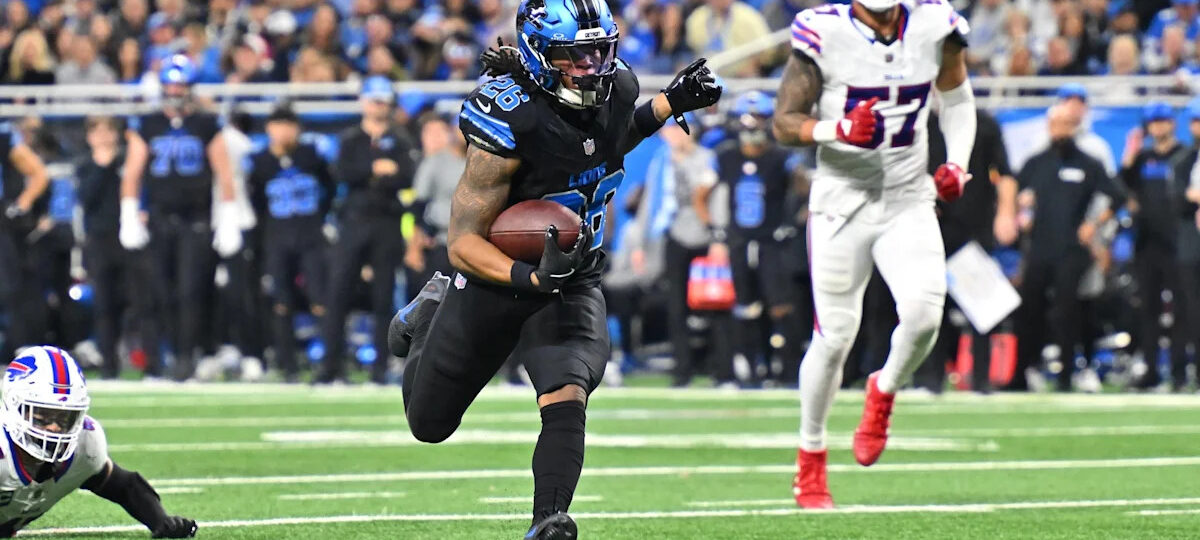
Gibbs is the reason Detroit can stay in this game.
Week 1: 29 carries, 156 yards, 2 TDs, plus 5 catches for 30 yards, 34 touches, 186 total yards. He took 91.9% of backfield touches. Isaiah Pacheco is on IR. This is no longer a Gibbs/Montgomery split. Detroit was under center on 75% of snaps (second in the league) and posted a 51.5% rush success rate, way up from 37.6% in 2025.
Buffalo just allowed 124 rushing yards to Houston, including 60 and 3 scores from David Montgomery. ILB Terrel Bernard (calf) and DL TJ Sanders (knee/illness) are on the injury report. If those two are limited, Gibbs’ rush EPA against a run defense is the most transferable Lions edge on the sheet.
James Cook is still Buffalo’s balancer (13-57 rushing in Week 1, 88.9% of backfield touches), but the mismatch FPTS is highlighting is Detroit on the ground, not Buffalo.
If Buffalo leads early (the base case):
Allen lives in the +24 intermediate and +19 deep gaps. Detroit is forced into the “already throws more than expected, trailing pushes that further” script. Goff volume rises, St. Brown and Sam LaPorta (8 targets, 82.9% route share in Week 1) become PPR engines, and Detroit needs the anti-blitz edge to hit. The total (54.5) is in play because both defenses leaked 30 in Week 1.
If Detroit stays on schedule:
Gibbs and under-center 12/13 looks keep Buffalo’s offense off the field. Buffalo only ran 52 plays in Week 1. Detroit ran 73. That pace gap is how an underdog with a worse passing defense still covers and potentially pulls off the win. The -17 run-game gap is the path to +4.5.
The hidden overlay: personnel and absences
- Lions safeties Branch and Joseph out through Week 4. That amplifies Buffalo’s two passing edges beyond what a generic L5 rank already shows.
Lions OL availability will decide whether Goff can actually beat the blitz/rush.
Bills LB/DL health will decide whether Gibbs’ run edge is real on Thursday or just a spreadsheet line.
DJ Reed (foot) is a question for Detroit’s perimeter; he would be the primary answer to Moore. Christian Izien is playing and would help against Allen’s designed and scramble runs as well as provide an extra matchup option vs Kincaid.
Lions safeties Branch and Joseph out through Week 4. That amplifies Buffalo’s two passing edges beyond what a generic L5 rank already shows.
Lions OL availability will decide whether Goff can actually beat the blitz/rush.
Bills LB/DL health will decide whether Gibbs’ run edge is real on Thursday or just a spreadsheet line.
DJ Reed (foot) is a question for Detroit’s perimeter; he would be the primary answer to Moore. Christian Izien is playing and would help against Allen’s designed and scramble runs as well as provide an extra matchup option vs Kincaid.
The data we have out at our disposal is internally consistent with the market. Buffalo’s two biggest edges are the ones that travel on a short week against a secondary missing both starting safeties. Detroit’s three edges are real, but they require game state (close score) and health (OL, Bernard/Sanders). That is why the number sits at Bills -4.5 and the total is the highest on the Week 2 board: Buffalo should win because of Allen in the intermediate/deep game, and both teams should score because neither defense has a schematic answer for the other side’s best unit.
A reasonable result band is Buffalo 30–34, Detroit 24–28. The cover and the over both live in whether Gibbs can force Buffalo out of the script the graphic assumes. If Detroit keeps it close, anything goes.
Discover more from NAIRAVOICE.COM.NG
Subscribe to get the latest posts sent to your email.