
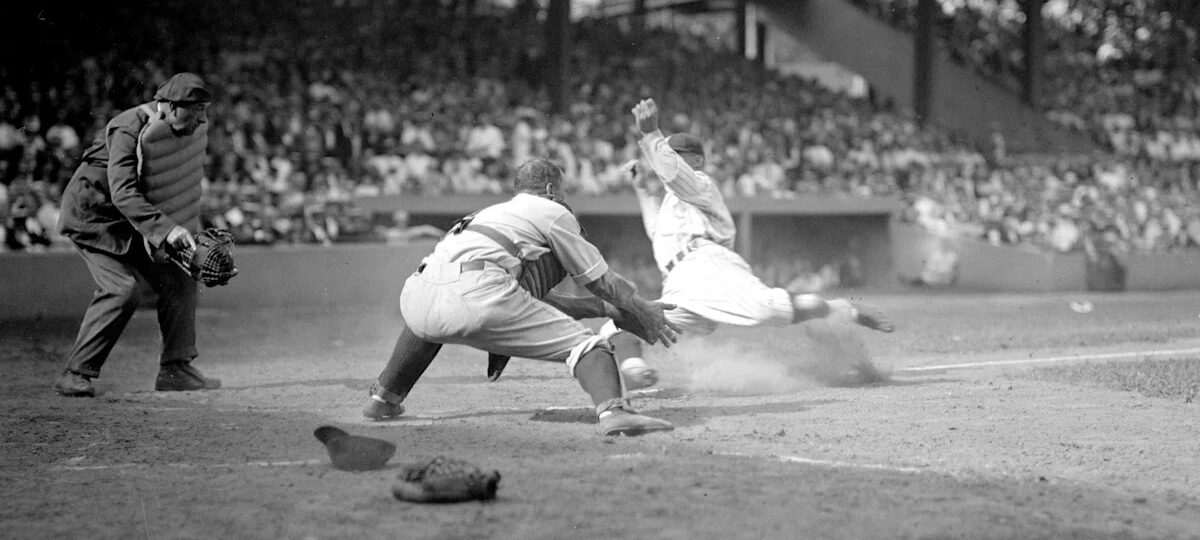

When a player in today’s Major League Baseball scene comes along and does something extraordinary, he’ll provide a flurry of answers as to what brought him into that position in the first place. When Aaron Judge hit 62 home runs in 2022, the number by itself was otherworldly, but passing Roger Maris’ mark of 61 made it even more special. The players who came before set a standard. And one of the leaders for early switch-hitters and catchers was Wally Schang, the first regular backstop for a Yankees World Series champion.
Walter “Wally” Henry Schang
Born: August 22, 1889 (South Wales, NY)
Died: March 6, 1965 (St. Louis, MO)
Yankees Tenure: 1921-25
Walter Henry Schang was born into a baseball family, gathering passion for the game from his father, who played in the local town league. “Wally” started playing semipro ball in Holland, New York, in high school. Over three seasons, Wally earned a reputation as one of the area’s best semipros. The Buffalo Bisons of the International League were impressed and picked up Schang’s contract near the end of the season. Appearing in 48 games for the Bisons in 1912, Schang batted .333 along with making an excellent defensive impression. In the 1913 season, 13 of the 16 MLB clubs attempted to draft him (per SABR). The Philadelphia Athletics were the fortunate team to land Schang, and from there, he began his professional career.
The one season with the Bisons was the only one that Schang would play in the minor leagues. A’s owner/manager Connie Mack decided he would be best served at the highest level. Schang finished with 207 at-bats and hit .266, ranked first among all major league catchers with three home runs, and his .392 OBP with a .416 put him at an .808 OPS to end the year. He also was one of the league’s best defensive catchers, and all of those facts helped him to finish eighth in MVP voting.
The Athletics played the New York Giants in the 1913 World Series, and Schang hit .357 in four games with a team-leading seven RBIs. With that, the rookie was a champion already at just 23 years old.
October 10, 1913: Philadelphia Athletics catcher Wally Schang takes aim at the right field wall during batting practice prior to Game 4 of the World Series.
It worked! Schang went 2-2, 2 BB, R, 4 RBI.
Athletics 6, Giants 5
Shibe Park, Philadelphia#Mackmen#MLBpic.twitter.com/iRjNY7yzvu— Alex Cheremeteff (@AlexCheremeteff) March 4, 2019
Philadelphia won the 1914 American League pennant with a 99-53 record and was again aided by Schang, who developed from an exciting up-and-comer to the best offensive catcher in the game. Wally led all catchers in the Junior Circuit in batting average (.287), extra-base hits (22), home runs (3), slugging percentage (.404), and RBI (45). However, he fell short on the defensive end due to a broken thumb and was tied for the AL lead for catchers in errors, but he still finished 10th in MVP voting that year thanks to his impressive offensive performance. Schang went 2-for-12 during Philly’s surprising World Series sweep at the hands of the “Miracle” Boston Braves.
Despite the Athletics’ rapid decline following the 1914 season, Schang remained an excellent player. In his final three years with the team, his lowest posted OPS+ was 122. In 1916, he posted the second-highest home run total of his career (7). But in 1917, Mack’s gradual firesale of his wonderful team led to Schang’s dismissal. The A’s traded him to the Boston Red Sox, along with right-handed pitcher Joe Bush and center fielder Amos Strunk.
In three seasons with the Red Sox, Schang did exactly what he had done previously with Philadelphia, including a World Series win in his second season, 1918. The backstop went 4-for-11 in five games against the Cubs to secure the title. Two years later, he posted an .862 OPS and four home runs compared to his zero in the two previous years. In 1919, the Red Sox had sent Babe Ruth to the Yankees, and after that 1920 campaign, Schang followed in a trade with three teammates for catcher Muddy Ruel and three other Yankees. Bombers GM Ed Barrow had been Schang’s manager in Boston, and he wanted his old catcher back on board — like many of his former Red Sox standouts.
In 1921, at 31, Schang joined Ruth and helped the Yankees reach the World Series for the first time as a franchise. He also played a career-high 134 games that season. He slashed .316/.428/.453 with a career-high 78 walks, 53 RBIs, and 134 hits (also a career best). In 1922, he played 124 games with a .319/.405/.412 slash line with 52 RBIs, 130 hits, 53 walks, and 36 strikeouts, helping him to finish 13th in MVP voting, the first finish in the top 15 since his top-10 finish eight years earlier in 1914. He hit a disappointing .188 in the Yankees’ 1922 World Series loss, but recovered the next year in the postseason.
Schang made three total World Series with the Yankees, winning the third of his career in 1923 against the crosstown Giants, and he wasn’t just along for the ride. He batted .318 in the postseason with a .711 OPS. And while he didn’t record an RBI, Schang came across to score three runs in that 1923 Fall Classic, a career-high. It was his final career playoff appearance, but the Bombers made it memorable — in their first season at newly-constructed Yankee Stadium to boot.

In 1924 with the Yankees, Schang hit just above the average for a catcher, with an OPS+ of 108. But in 1925, now 35 at this point, with rumors that Schang’s eyesight might be declining, he didn’t do much to quell them, finishing with a .645 OPS in 73 games, and he was traded to the St. Louis Browns in 1926.
In five seasons with St. Louis, he didn’t play over 100 games outside of his first year, but he still performed well in a limited role. He hit .294/.423/.439 through his career before being sent back to Philadelphia to join the World Series-bound (and winning) Athletics, who Mack had successfully rebuilt with the help of Jimmie Foxx, Lefty Grove, Mickey Cochrane, and more. However, Schang did not appear for the team in the 1930 Fall Classic and finished his MLB career with the Detroit Tigers at age 41. He slashed an abysmal .184/.311/.211 in 30 games, but he continued to be revered by his teammates.
In retirement, Schang was a coach and minor-league scout/manager, even mentoring teenage prodigy Bob Feller at the outset of his Hall of Fame career in Cleveland. Schang missed the Hall of Fame multiple times, but he is still a player who made an impression on the early days of 20th-century baseball, both as a switch-hitter and as a catcher.
Happy birthday, Wally!
See more of the “Yankees Birthday of the Day” series Yankees Birthday of the Day: Wally.
Discover more from NAIRAVOICE.COM.NG
Subscribe to get the latest posts sent to your email.