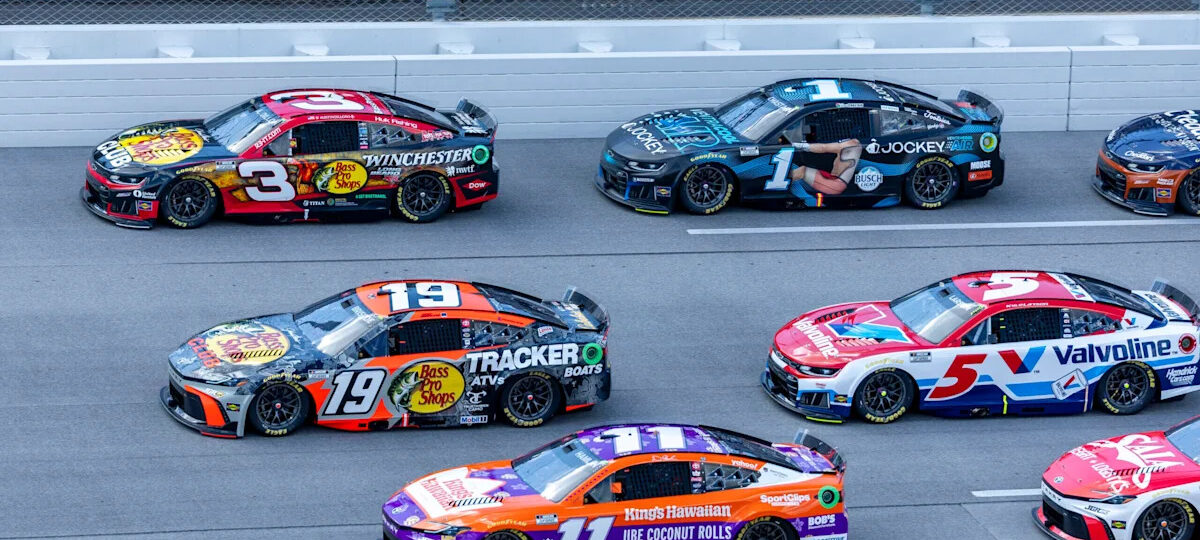
At Talladega Superspeedway, three cars can run side by side for lap after lap without anyone gaining much ground. Sometimes a fourth lane forms, turning an already crowded pack into a wall of race cars stretching across the track.
It’s one of the most familiar sights in NASCAR. It’s also one of the biggest reasons Talladega races can unravel so quickly.
But drivers aren’t running three-wide simply because there’s enough pavement. They’re doing it because of how drafting works, and because staying in the right line can make the difference between leading the race and falling outside the top 20.
Why Talladega Can Handle Three-Wide Racing
Talladega has something most NASCAR tracks don’t: an enormous amount of room.
The 2.66-mile superspeedway is 48 feet wide, with 33 degrees of banking in its turns. That gives drivers space to run multiple lanes while carrying tremendous speed through the corners.
But the track’s dimensions are only part of the explanation.
Drafting is what makes those lanes competitive.
When cars run closely together, they can take advantage of the airflow around one another to reduce aerodynamic drag and maintain momentum. A line of cars working together can gain ground on another line, especially when drivers time their pushes effectively.
That’s why a driver might abandon the inside lane for the middle or outside. If enough cars follow, the new line can develop enough momentum to move forward.
If nobody follows, that same driver could lose a dozen positions.
Why Drivers Don’t Simply Stay in Two Lanes
At Talladega, waiting for an opening isn’t always the best way to pass.
When two drafting lines become evenly matched, drivers may attempt to establish a third. It’s a gamble that depends on cooperation from the cars behind them, not just the speed of the driver making the move.
And three-wide racing doesn’t necessarily mean everyone is pushing as hard as possible.
Fuel conservation has become a major part of modern superspeedway strategy. Drivers can spend stretches of a race running in tightly packed lanes while managing throttle input and trying to extend their fuel mileage.
That changes when stage points or the checkered flag are within reach.
Suddenly, drivers become more aggressive with their pushes, lane changes and blocks. A move that seemed manageable earlier can become far more dangerous when several lines are fighting for the same piece of pavement.
That’s where Talladega’s reputation for massive crashes comes from.
The same drafting dynamics that allow drivers to race three-wide also keep the field tightly packed. When someone makes contact near the front, cars behind often have nowhere to escape.
Three-wide racing isn’t a Talladega gimmick. It’s a product of the track’s design, the aerodynamics of NASCAR’s cars and drivers trying to find every possible advantage.
And when all three come together, there’s very little room for error.
Discover more from NAIRAVOICE.COM.NG
Subscribe to get the latest posts sent to your email.