
When discussing the Pac-12, Commissioner Teresa Gould talked about innovation. Disruption. Questioning the way things are done and bucking trends.
It sounds good in theory. The old conference regime thought so too. When former commissioner Larry Scott signed a 12-year, $3 billion TV deal with ESPN and Fox in 2011, he received plenty of praise. It was the richest contract at the time, and the Pac-12 Networks, which also launched that year, brought something unique to the cable industry.
“I was part of the storytelling,” former Pac-12 vice president of public affairs Kirk Reynolds told the American-Statesman in August. “We were talking about how unique and exciting it was; a lot of people were writing about that.”
The group didn’t know it, but that TV contract was the first misstep leading to the conglomerate’s demise. A disconnect from the universities, arrogance and unnecessary risks all contributed to one of college sports’ most storied conferences being stripped for parts, according to about a half-dozen people connected to the conference who spoke with the Statesman. But Washington State and Oregon State persisted. Seven new members join them in 2026: Utah State, Colorado State, Boise State, Fresno State, San Diego State, Texas State and Gonzaga.
And as the pilot of the Pac-12’s revival, Gould has no intention of repeating her predecessors’ mistakes.
Initially, Scott’s trailblazer mindset and alternate line of thinking brought a lot of intrigue to the Pac-12, Reynolds said.
The idea of the network – six regional channels along with a national channel – hadn’t been done before. In theory, it catered to the area surrounding each conference member, bringing a unique flavor to the locals and capturing their attention. Add in the lucrative TV deal, and it’s easy to see the reasons for optimism.
In Scott’s case, he failed to account for a few key factors.

In this Oct. 8, 2019, file photo, commissioner Larry Scott speaks during the Pac-12 NCAA college basketball media day, in San Francisco. A Pac-12 team has made the College Football Playoff just twice in six seasons and none of the last three. If anyone should be leading the charge toward expanding the current four-team model, you would think it would be Pac-12 Commissioner Larry Scott. (D. Ross Cameron/Associated Press)
For one, the 12-year deal hampered the Pac-12’s flexibility.
“All of a sudden, you’re seeing these conferences re-up every few years and get back to the negotiating table to take another bite out of the apple,” said Mike Yam, a former Pac-12 Network studio host.
The Pac-12 Network had agreements with four of the major cable providers at the time: Comcast, Time Warner Cable, Cox Communications and Bright House Networks. Although each had a foothold in the conference’s regional markets, DirecTV never joined, which hurt nationwide distribution and branding, Reynolds said.
As the SEC and the Big Ten raked in dollars, recognition and championships thanks to their partnerships with ESPN and Fox, the Conference of Champions lagged. The six regional networks didn’t mesh with how audiences consumed the product.
“I think USC and UCLA looked around and said, ‘Hey, what are these payments going to look like? Can we compete at the highest level? Are we going to be consistently running at a deficit?” Yam said.
This soured Scott’s relationship, which already wasn’t stellar, with the schools (Scott declined to comment for this story through an acquaintance).
The former chairman and CEO of the Women’s Tennis Association, Scott didn’t have a background in college athletics. Also, the ex-commissioner would report to the presidents, not the athletic directors. Scott rubbed certain ADs the wrong way, and the lack of understanding and trust between the parties hurt the collective.
“In the long run, that was another issue that created problems for the conference,” Reynolds said.
The final nail in the conference’s coffin was Scott’s successor. After his departure in 2021, some assumed the replacement would be a more traditional hire with a history in high-level athletics. Instead, former MGM Resorts president George Kliavkoff seemed cut from the same cloth as Scott. Both had no history in college sports, were raised on the East Coast and graduated from private universities not exactly known for athletics – Kliavkoff from Boston University, Scott from Harvard.

Former Pac-12 Commissioner George Kliavkoff speaks during the Pac-12 Conference football Media day Tuesday, July 27, 2021, in Los Angeles. (Marcio Jose Sanchez/Associated Press)
When ESPN came to the table in the fall of 2022 offering $30 million per school, Kliavkoff reportedly overplayed his hand, countering with $50 million. The Worldwide Leader in Sports left the bargaining table and partnered with the Big 12.
Once Klivakoff’s final plan, the Apple TV contract, failed to materialize in 2023, Washington State and Oregon State were abandoned in the ruins of their leaders’ failure. Ten teams left or announced their departures from 2022-23.
“It’s just sad how it all played out,” Yam said.
As the former deputy commissioner at the time, Gould had a front-row seat to how everything transpired. The decisions she’s made to revive the conference speak to what she learned during the conference’s darkest days.
Unlike Scott and Kliavkoff, Gould spent 13 years working for Cal athletics and has been involved in the Pac-12 for more than 25 years. Through her experience, she said she learned to stay close to her board and focus on understanding what they’re thinking and feeling.
“Teresa has been on campuses, has those relationships and knows what kind of pain points schools go through,” Reynolds said. “That’s probably a benefit to the Pac-12.”
Gould told the Statesman she and her staff looked for ambitious universities during the rebuild. Boise State, San Diego State, Colorado State, Fresno State and Utah State are some of the most well-funded midmajor programs located on or near the West Coast. Texas State, the final addition, has one of the fastest-rising athletic departments and enrollment numbers in the nation, giving the conference a presence in the Lone Star State.
As the Pac-12 looks to return to national relevance, it’s opting for maximum reach. The upcoming football season will be available to 100% of televisions via over-the-air broadcast networks, or cable, satellite, or streaming on national cable networks.
“I think that is of great value to a Pac-12 conference that’s trying to reestablish itself as a major brand in college athletics,” Yam said.

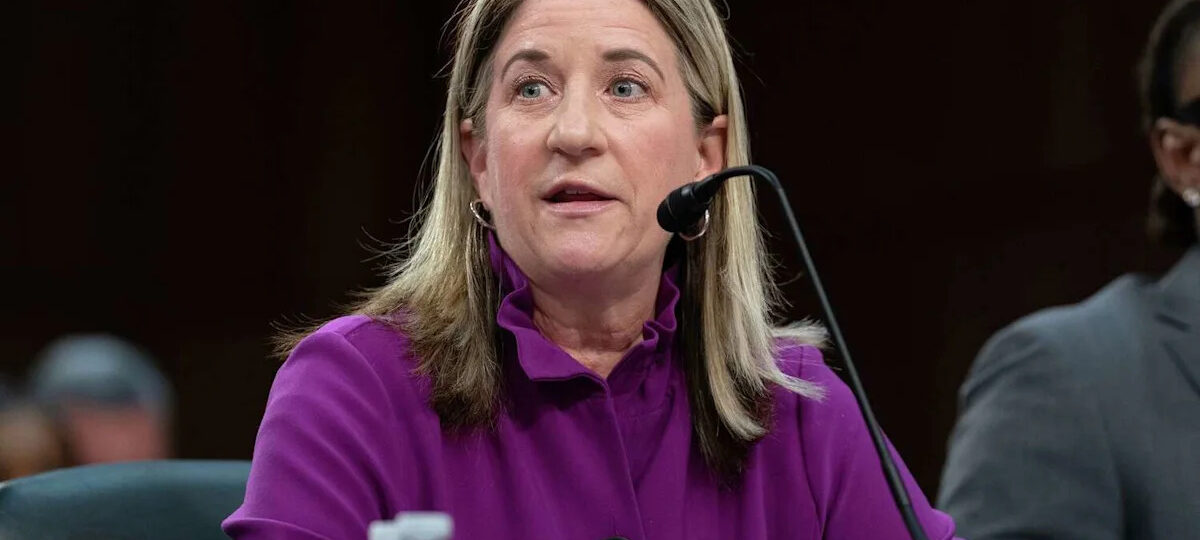
Pac-12 Commissioner Teresa Gould testifies before Senate Committee on Commerce, Science, and Transportation hearing to examine college sports, supporting student athletes, and fair competition on Capitol Hill, Wednesday, June 3, 2026, in Washington. (Jose Luis Magana/Associated Press)
Part of the reason the Pac-12 fell so far behind was that it reacted to its environment instead of anticipating change.
Gould presents as more vigilant, and her energy has spread throughout the universities. She still holds the West Coast ideals of innovation that defined the old Pac-12’s brightest moments, but also landed the conference in the mess it’s in. So while Gould won’t take unnecessary risks, she understands the Pac-12 can’t afford to be stagnant.
“Can’t be content, can’t be complacent,” Washington State President Jon Haarlow said. “We know there’s going to be another shoe to drop.”
One of the best ways for the Pac-12 to make a mark in its first season back is to get a school into the College Football Playoff. Doing so would put the conference on a pedestal above the Football Bowl Subdivision’s six other non-power conferences.
Easier said than done. Although the American and the Sun Belt champions sent representatives to the CFP last year, it’s unlikely two Group of Six schools earn bids again. Gould has praised the conference’s perceived parity, but that could be an issue for the Pac-12 if there’s no clear-cut No. 1 team.
So instead of hoping one of its programs is good enough to earn a spot, the Pac-12 made the final regular-season matchup a flex game. Depending on how the season goes, the conference can switch opponents around to improve its teams’ resumes and their chances of a playoff berth.
“That would kind of put a stamp on it – that the Pac-12 is back,” a Texas State athletic official said.
For all the talk of challenging status quos, the Pac-12 hasn’t rocked the boat in any drastic way just yet.
Oregon State President Jayathi Murthy told the Statesman that big disruptions don’t come easy. Anything that’s well-established has a certain inertia, which is especially true for college athletics.
“The biggest constraint, of course, is that this is a system,” Murthy said. “No university can decide to go off on its own.”
Gould is satisfied with the Pac-12’s current members, she said in June. The universities are aligned in their direction, and while she admitted being a smaller conference can lead to operational issues, she refuses to make a long-term decision to solve a short-term issue.
That doesn’t mean she’s not thinking about potential additions.
“We are always going to be open-minded and thinking about expansion,” Gould said. “But we’re not going to do that at the expense of the quality of the league.”

The PAC-12 logo is displayed, March 3, 2024, in Boulder, Colo. (David Zalubowski/Associated Press)
The 2030s could be a seismic time for the collegiate landscape. The exit fees for Atlantic Coast Conference teams drop from $165 million in 2026 to $75 million in 2030, and the Big 12’s media rights deal with ESPN and FOX expires in 2031, a year after the Big 10. The Pac-12’s media deals with CW, CBS Sports and USA Sports go through the 2030-31 season; it’s hard to see that as pure coincidence.
Would a few West Coast-based programs in other conferences be willing to move? Perhaps. But predicting what might happen four years down the road is a fool’s errand.
What’s important is that the Pac-12 hasn’t just been revived; it’s positioned itself to be ready for what could come. And that’s the difference.
Discover more from NAIRAVOICE.COM.NG
Subscribe to get the latest posts sent to your email.