


 BBC
BBCSitting on a park bench in the eastern Hungarian city of Debrecen, Barbara Elek is nervously refreshing her emails. She and her husband Levi are waiting to find out if Barbara is pregnant, after their third round of IVF 10 days ago.
“If it doesn’t succeed, then obviously I’ll be devastated, and then the last resort will be trying to make sure that, at least financially, we don’t lose everything,” she says.
Like many other young Hungarian couples Barbara, 33, a social worker and Levi, 34, a chef, were eligible for tens of thousands of pounds in interest-free loans and subsidies when they promised to have two children. But they’ve struggled to get pregnant naturally and if they can’t prove they have a child on the way by 1 November then it is possible they may have to pay back those loans with penalty interest.
The couple took out a 10 million‑forint (£25,000) loan on the promise of having two children. Under rules introduced by Hungary’s previous government, they could be asked to repay penalty interest of between 1.5 and 3.5 million forint (£3,700-£8,600), something they say they can’t afford. They also receive a mortgage subsidy with similar terms.
In 2010, then prime minister of Hungary Viktor Orbán embarked on some of the most ambitious pronatalist policies in the world – paying people to have, or promise to have, children. Hungary’s fertility is well below the replacement level of 2.1 babies per woman needed to keep the native-born population steady – a number that accounts for those children who don’t survive to adulthood. And on top of that, there have been high levels of emigration and low immigration.
 Reuters
It’s not just a Hungarian issue. Across Europe, fertility rates have been below the level needed to keep the population stable without immigration since the 1980s. Today, the same is true in more than half of all countries, home to around two‑thirds of the world’s population.
When Orbán was re‑elected in 2010, Hungary’s fertility rate was among the lowest in Europe. His party, Fidesz, promised to tackle population decline. “In the West, the answer to this is immigration. You bring in as many as you’re missing. Hungarians think differently. We don’t need numbers, we need Hungarian children.”
Orbán, who was voted out of office in April this year, rolled out extensive tax breaks, interest-free loans and mortgage subsidies to young couples who promised to have children. There are also subsidies to buy a bigger car or renovate your home. The incentives were only available to married, heterosexual couples and those in the formal job market.
At one point, it seemed all of this was pushing Hungarians to reproduce. The fertility rate rose from 1.25 in 2010 to 1.59 by 2020.
Hungary, for a time, was hailed as a great success story by some – especially US conservatives. But then the fertility rate began to drop and in 2025 it had fallen to 1.31, not much higher than when these incentives first launched.
“Judged by the aims of the policies, this is clearly a failure,” says Tomas Sobotka, from the Vienna Institute of Demography.
So why did Hungary’s pronatalist approach deliver an early rise in births only then to fall back? And what lessons does it offer to other countries desperate to lift fertility?
One view is that Hungary’s statistics point to a success. With fertility falling across Europe over the past decade, they argue the country’s policies may have staved off even greater decline.
Fruzsina Skrabski, of the pro-family NGO Three Princes, Three Princesses, believes without these policies “there would be hundreds of thousands of fewer children”. She is “certain it led to more children being born, just not enough to reverse the trend”.
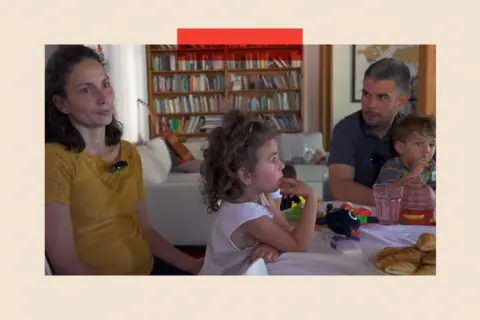
Maté, 43, and Agi Gorondy, 37, who live in the suburbs of Budapest, wholeheartedly agree. They have five children all under 10 years old – and say they may have more – and they credit Hungary’s family-friendly environment. The couple took advantage of generous maternity pay, interest-free baby loans and subsidies to help renovate their house and buy a bigger car. Maté, a freelance business developer, benefits from tax cuts. And as a mother of more than two children, Agi will pay no income tax at all if she returns to work.
“I think there’s been a change in the past 16 years. In this neighbourhood… four- or five-child families are no longer rare,” Maté says. Statistically there was an increase in families with three or more children in Hungary in the 2010s, peaking in 2020 at 146,000. By 2024 that was down to 125,000.
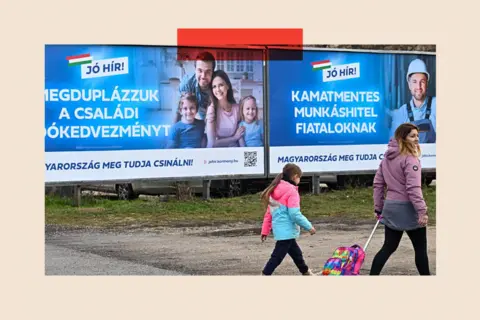
Timothy P Carney, a senior fellow at the American Enterprise Institute, who has written several books on fertility decline, believes one of Orbán’s successes was that he put family, and supporting families, at the centre of the political narrative. He points to the “Family-Friendly Hungary” messaging, emblazoned in the arrivals hall at Budapest airport.
Others say the benefits landed unevenly. Prof János Tóth, a philosopher studying demographic issues at Hungary’s University of Szeged, believes the incentives worked especially well for one particular group – the lower middle class in the countryside. But in the cities, where fertility is lowest, the money just doesn’t go as far. He believes the “baby-expecting loan” of 10 million forint (£25,000) did initially help many young couples to start a family, but soaring inflation has eroded its value.
“Every country has this problem of low fertility in cities,” he says. In his view, Hungary has to do more to help people to have their first child, rather than focusing on persuading those who already have children to have more – “the first child is the most important”.
Eva Fodor, co-director of the Democracy Institute at the Central European University, questions how much difference the policies made.
“It seems that these policies were effective for a little while, like most pronatalist policies are,” she says. She believes they prompted a cohort of people to have children they would have had anyway, just a little earlier than planned. “So the fertility rate went up for a while, for a year or two, and then it started falling again.”
But Hungary’s rise and fall in fertility may have had little to do with its policies at all, and simply mirrored wider trends across eastern Europe. The Czech Republic, for example, did not introduce such expansive pronatalist measures yet saw a similar boost and then a similar decline.
For many parents, the real barrier may not be finances but the basic services they depend on. Antonia Miskolczi, a 29-year-old mother in Budapest, says her concern over Hungary’s healthcare system mattered far more to her decision‑making than any financial incentive.
“I was actually terrified of childbirth,” Antonia says. She watched TikTok videos warning expectant mothers to bring their own toilet paper and disinfectant to the hospital and says several relatives had a terrible experience. She had her son at a private hospital.
Antonia and her husband Marton used several benefits to have their first child, but says it hasn’t changed their plan to have only one more. “I don’t think big promises are needed. Just fix the fundamentals and the willingness to have children will increase,” she says. “Improving education and healthcare should be the very first step if people are going to feel comfortable having children.”

In 2019, Eva Fodor interviewed 21 well-educated middle-class Hungarian women, who work in professional jobs in state administration, to determine if government support prompted them to have a child. She found most saw it “as a one-time payment, not as a long-term investment into raising children.”
“What they really need is institutions and health care systems and childcare, which they deemed insufficient,” she says. Though Hungary did expand access to childcare and invested in healthcare, Fodor says many women still felt it wasn’t enough.
Hungary was far from alone in trying to reverse falling birth rates. South Korea, for example, had a fertility rate of 1.19 in 2008 – one of the lowest in the world. Since then, it has spent more than £215bn trying to get its population to have more babies. Parents get an upfront “baby bonus” of £20,000-£30,000 when their child is born, as well as generous child benefit allowances each month. They also get vouchers to help with private childcare.
But South Korea’s total fertility rate continued to decline in that time, reaching 0.8 in 2025.
Fertility has fallen in most countries since the pandemic, a shift many experts believe is driven by more than economics. Demographer Tomas Sobotka argues that lockdowns, vaccination campaigns that may have prompted women to delay pregnancy and a general sense of instability all worked to put people off having children. “Fertility tends to decline because people don’t have confidence in the future,” he says.
The war in Ukraine and a global surge in inflation created new shocks, and Sobotka notes that the countries closest to the conflict have seen the sharpest fertility declines. Globally, Sobotka argues: “People still feel insecure, uncertain about the future because there are all these crises unfolding and the political environment is very toxic”.
In the 2000s, Sweden and some of its Nordic neighbours introduced a series of policies that boosted fertility – though that wasn’t their explicit intention. Shared parental leave, affordable childcare and universal pre-school helped to create conditions that made it easier to combine work and family life. Over the next decade fertility rates in Sweden increased – from 1.5 to 2.0.
Many scholars thought Sweden had solved the conflict between feminism and fertility by making it easier for both parents to work and raise a family. Then in the 2010s fertility dropped again, leaving researchers perplexed.
But Sobotka thinks these policies insulated Nordic countries from the depths of fertility decline seen in East Asia. “At some level, every country needs at least the Nordic policy package and maybe better,” he argues. He believes countries that make it easier for men and women to share work and care are far better protected against deep fertility decline.
Fodor says that for its part, Hungary has “strengthened this idea that women are the primary caretakers of the family”.
“Gender roles have become more rigid.”
 AFP via Getty Images
And it may be that culture matters more than cash. “Part of the problem is we overestimate how much finances work,” says Carney. Israel, the only country in the OECD with a fertility rate that is comfortably above replacement, doesn’t have particularly high levels of government spending on family benefits. But it does have a strong cultural and ideological focus on having children – informed partly by the desire to rebuild the Jewish population after the horror of the Holocaust.
“But the government’s ability to shift culture is very limited,” Carney warns, “And part of the peril of the government weighing in on the culture is it could politicise it.”
In some countries, that backlash is already visible. In South Korea, for example, survey research has found many young women resisting marriage and family as a protest against what they see as patriarchal ideas of a traditional family.
France, by contrast, has resisted some of Europe’s fertility decline. Its rate of 1.6 is among the highest in the EU. It has comparatively high public spending and a greater focus on work-life balance than many of its neighbours.
South Korea does not have that flexibility. “For men there is this kind of traditional notion of breadwinners, so they often come from home very late at night,” says Sobotka. “This is punishing for both women and men, but also for family life.” Child-rearing is left to women. Women also face “anticipatory discrimination”, he adds, “often women are either withdrawing from the labour market or getting into part-time or unstable jobs around the time when they have kids.”
Similarly, flexibility at work is not present in Hungary. “Even state-owned companies are not flexible, they do not take into account the fact that men and women both may have responsibilities outside of the labour market,” says Fodor.
The Orbán government spent around 5% of GDP on its family-friendly initiatives and they were seemingly popular enough that Hungary’s new leader Peter Magyar didn’t campaign on changing them.
“We are living in societies where parenthood is extremely expensive. So whatever different countries can do to support parents and support families is a good policy,” says Sobotka.
Fodor takes a different view: “If that money had been spent on social institutions and… gender equality and promoting men’s role in domestic work, I think a similar increase in the fertility rate could have been achieved.”
Barbara and Levi’s situation is not unique. The Hungarian National Bank reports that one in five couples who took the loans five years ago didn’t end up having children. The new Hungarian government said it was reviewing these policies and looking at what should happen when people take out loans but don’t have the children they said they intended to have.

Barbara’s email finally came through. The embryo they had implanted hadn’t survived.
“It’s horrible, just horrible,” her husband Levi said, holding his wife.
In family‑friendly Hungary, the couple are caught in a system that promised support, but now find themselves without the family they hoped for and facing the prospect of their financial stability falling apart.
On 16 June BBC World Service is launching a Hungarian-language offer, BBC News Magyarul to serve more audiences in Central Europe with trusted journalism. BBC News Magyarul will be available on the website, Facebook and Instagram.

BBC InDepth is the home on the website and app for the best analysis, with fresh perspectives that challenge assumptions and deep reporting on the biggest issues of the day. Emma Barnett and John Simpson bring their pick of the most thought-provoking deep reads and analysis, every Saturday. Sign up for the newsletter here
Discover more from NAIRAVOICE.COM.NG
Subscribe to get the latest posts sent to your email.