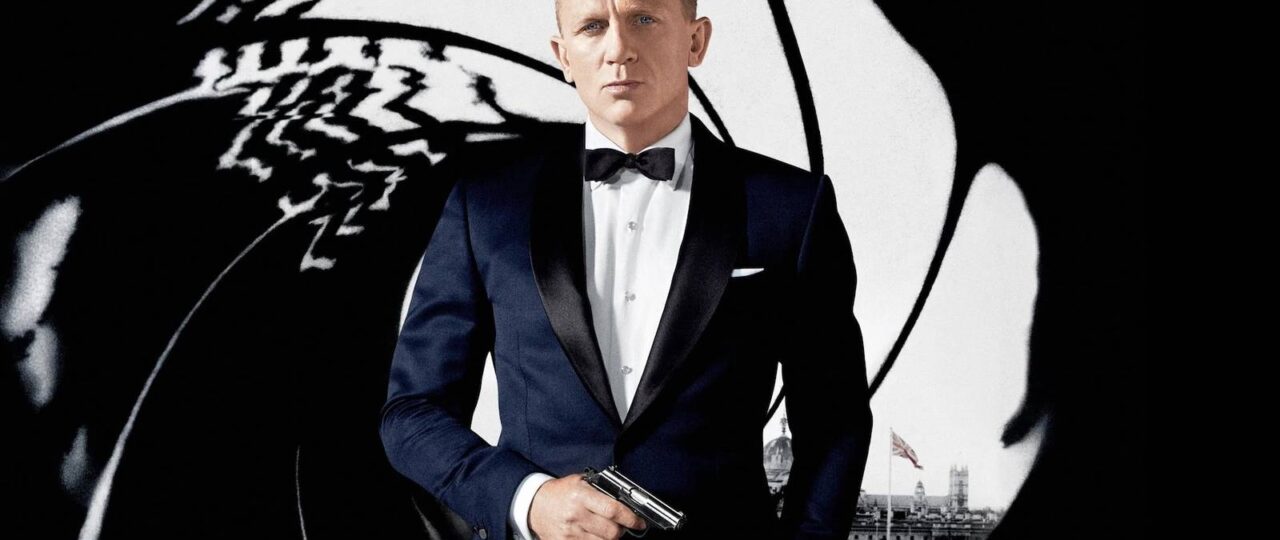
Bond is coming back. Amazon (ugh) and director Denis Villeneuve are in the final round of tests to find the newest actor to slip into a tuxedo and sip some martinis. Whoever that actor is, he’ll take over a legacy left behind by greats like Sean Connery, Pierce Brosnan, and most recently, Daniel Craig. The latter’s tenure as Bond certainly wasn’t without controversy. Aside from all the behind the scenes drama that included bankruptcies, writer’s strikes and good old-fashioned creative differences, Craig himself faced immediate backlash for his casting in the role, mostly due to the fact that he has blond hair. The horror. Craig would immediately toss those unfounded concerns into a dumpster like a body when he made his sterling debut as the character.
Five films and fifteen years later, the actor officially retired from the role. Even if every film of his wasn’t perfect and often chafed against the expectations of some Bond purists, the actor did the role proud and brought unexpected nuance to it. The end of Craig’s era also turned out to be the end of the Eon era. Eon Productions, the production company formed by Albert Broccoli and Harry Saltzman, had been behind every “official” James Bond movie since the beginning with Dr. No. While various rights and licenses had changed hands back and forth over the years, Eon always had creative control of the franchise. That ended with the new venture that ceded that control to Amazon MGM. What that means for the future of the franchise remains to be seen, but what it means for Craig is that he was its last face under that stewardship. That face played Bond in five movies, and we’ve officially ranked them.
5
‘Spectre’ (2015)
<<img src="https://static0.colliderimages.com/wordpress/wp-content/uploads/2023/08/daniel-craig-and-lea-seydoux.jpg?q=49&fit=crop&w=825&dpr=2" />
Image via Sony Pictures Releasing</figure>
After the resurrecting success of Skyfall, much of that film’s creative team, including director Sam Mendes, returned for Spectre. Despite becoming one of the highest grossing Bond film’s of all time, and winning an Academy Award for Sam Smith’s theme song, the film is almost universally regarded as Craig’s worst, and often ranks low in the franchise overall. The film has many issues which hold it back, from trying to tie together all the loose threads from Craig’s previous threads into one narrative to its failed attempt at misdirection regarding its villain, but the greatest cardinal sin of Spectre is that it’s boring, and that is something that no Bond movie should ever be. It isn’t completely without merit. The opening action sequence is spectacularly choreographed, and the technical craft of the film is uniformly excellent. It’s just unfortunate the same effort wasn’t put into refining the script or characters.
Thanks to the resolution of legal issues dating back decades, Eon Productions was able to reintroduce the titular villainous organization, which had previously featured prominently in the franchise. In the film, the organization is revealed to have been behind all the previous villains in the Craig continuity, with Christoph Waltz cast as their leader Blofeld. This version of the iconic villain is also shown to have a history with Bond dating back to his childhood. That is just one part of the film’s convoluted plot, which also sees Bond romancing Madeleine Swann, the daughter of the villainous Mr. White, played by Léa Seydoux, and trying to circumvent a government surveillance initiative. It’s too much plot without enough intrigue, especially since the film attempted to treat Blofeld’s identity as a plot twist when even the most casual Bond fan knew that Waltz had been cast as the character. Even Craig seems disinterested in the film, giving his most toneless performance of his entire Bond career.
4
‘Quantum of Solace’ (2008)
<<img src="https://static0.colliderimages.com/wordpress/wp-content/uploads/2023/03/quantum-of-solace.jpg?q=70&fit=crop&w=825&dpr=1" />
Image via Sony Pictures Releasing</figure>
Hot take: Quantum of Solace isn’t a bad movie. It may not be a great Bond movie in the traditional sense, but it is a defiantly different one that can be enjoyed as its own vibe. Any follow-up to Casino Royale was going to struggle to match the standard it set, and the sequel famously suffered from an accelerated production thanks to an impending writer’s strike which affected its script. Marc Forster was also a left-field choice for the film’s director, and the action sequences were criticized for their shaky-cam visuals borrowed from the Bourne franchise. Even with those issues, the film successfully operates as a leaner, meaner Bond thriller that finds the spy out for revenge with an aesthetic that’s stripped to the bone. Everything from the tech to the villain to the Bond girls are given a grounded, gritty makeover. It may not be the Bond movie that fans wanted in 2008, but it’s an interesting exercise showing how far the boundaries of the franchise can be pushed.
While some of the earlier Bond movies had plots that followed lines laid down in their predecessors, Quantum of Solace serves as a direct sequel to Casino Royale, picking up literal moments after that film’s ending. Bond then spends the rest of the film tracking down the organization responsible for the death of Vesper Lynd, here called Quantum, as a stand-in for Spectre and to justify the film’s admittedly awkward title, which was taken from an otherwise unrelated short story by Ian Fleming. Bond barely has time for any quips as he kills his way up the organization’s food chain to the weaselly villain Dominic Greene, played by Mathieu Almaric. Greene is a far cry from the more cinematic villains of the franchise, but he fits in with the film’s more grounded approach, even if his final confrontation with Bond strains credibility. Craig is suitably humorless this time around in the role, playing Bond as a cold, calculating killing machine with a single purpose, making Quantum of Solace an underrated run-and-gun Bond movie.
3
‘No Time to Die’ (2021)
<<img src="https://static0.colliderimages.com/wordpress/wp-content/uploads/2025/01/no-time-to-die.jpg?q=70&fit=crop&w=825&dpr=1" />
Image via United Artists Releasing</figure>
Craig’s final bow as Bond is a movie that tries to give the actor everything it can to help him go out on a high note. No Time to Die is epic-sized, stuffed with stunts and set pieces but also some of the most nakedly emotional content of the entire franchise. The film had a protracted development that shuffled through a number of directors before Danny Boyle came on board and then subsequently departed and was replaced by Cary Joji Fukunaga, following the same prestige over action expertise principle as Forster and Mendes. It careens wildly in tone and focus, before ending with a shocking moment that retroactively served as a fitting end for the character before he would become an Amazon product. It’s a lot of movie, and not all of it works, but what does works like gangbusters and Craig is more committed than ever to the role. Bond is given even more dimension in No Time to Die, and if any actor has earned the right to give the character an emotional send off, it’s Craig.
While Spectre ended with Bond driving off into the sunset with Madeleine Swann, their past, and the producers, couldn’t let them be happy forever. In this case, it’s the machinations of Blofeld who manipulates Bond into believing he’s been betrayed by Swann which leads to their break up. Five years later, Bond is still retired but is called back into action when a nanobot bioweapon falls into the hands of the villainous Safin, played by Rami Malek, who also has a past with Swann. The plot is just as complicated as Spectre, and Malek’s villain isn’t as compelling or creepy as the movie wants him to be, but it makes up for it with some spectacular action sequences. No Time to Die is a lot of fun when it wants to be, such as in the Cuba sequence featuring Ana de Armas or in Bond’s playful banter with his 007 successor, played by Lashana Lynch. If the movie was more focused, it might have been a fun final romp for Craig, but it wants to have its emotional cake and eat it too. Ending the film with Bond’s death was a bold choice, and one that pissed off plenty of oversensitive fans, but maybe the filmmakers realized that the character was bigger than any one actor or movie. James Bond will return, under the ownership of a Bond villain, but Craig got to go out in style.
- You don’t explain yourself, justify yourself, or soften yourself for anyone’s
comfort. The confidence is structural, not performed. - Connery’s Bond established everything, the tone, the danger, the cool, because Connery
himself had the innate presence to make something that had never existed feel inevitable. - You share that quality: the sense that you were always going to end up exactly here, doing
exactly this. - The name is Bond. In your case, it always was.
- Moore’s Bond is underrated precisely because the effortlessness looks easy, and
effortlessness is the hardest thing to manufacture. - You have the same quality: a lightness that disarms people before they realize how sharp you
really are. - The raised eyebrow, the perfectly timed quip, the refusal to be rattled. These are not
affectations. They are a philosophy about how to move through a world that would like to
take itself too seriously. - You have never let it.
- Dalton’s Bond has genuine moral weight: he feels the cost of what he does, he has lines
he won’t cross, and he is not interested in the version of himself that pretends
otherwise. - You share that intensity. You push harder than the situation technically requires, because
you have a standard and you hold yourself to it. - He was ahead of his time, the Bond the franchise wasn’t quite ready for yet, arriving
exactly when he was meant to. - You know what that feels like.
- Brosnan arrived at the role looking exactly like Bond was supposed to look, and he delivered
on that expectation with a professionalism that made it seem effortless. - You have the same quality: a smooth competence, a charm that operates like a precision
instrument, and the ability to make even difficult things look like they weren’t. - His four films revived the franchise after a six-year gap and made Bond a blockbuster
property again. There is a reason for that. - The reason is that some people simply fit their moment perfectly. You are one of those
people.
- Lazenby’s single outing is, by many measures, one of the finest Bond films ever made,
and he is not a small part of why. - You share his quality of raw authenticity: less polished than the alternatives, more honest
for it, capable of something real that technique alone can’t produce. - He was underestimated, and then he wasn’t, and then history caught up with him.
- You are the kind of person history catches up with. Give it time.
- Craig’s Bond is the franchise’s most psychologically complete: a man doing a
punishing job, carrying its costs imperfectly, capable of love and loss in ways that
can’t be dismissed. - You share that depth. You don’t hide behind the role or the charm or the suit. You let
the work show what it really costs. - He was controversial from the moment he was announced and definitive by the time he was
finished. The skeptics became the believers. - That arc, of being underestimated and then undeniable, is one you know intimately.
2
‘Skyfall’ (2012)
<<img src="https://static0.colliderimages.com/wordpress/wp-content/uploads/2024/01/skyfall.jpg?q=70&fit=crop&w=825&dpr=1" />
Image via Sony Pictures Releasing</figure>
That No Time to Die made such a radical narrative decision shouldn’t really have shaken fans, since the franchise as a whole had been stirred up ever since Craig came into it. Skyfall, one of the most critically acclaimed Bond films of all time, had already taken a bold step forward when it killed off Judi Dench’s M. In many ways, Craig’s third outing as 007 found the perfect balance that Quantum of Solace, Spectre and No Time to Die all struggled with to some degree. It manages to tell a more emotional story and delve deeper into Bond as a character while still delivering an exciting spy thriller with just the right amount of fan service. While Marc Forster may have been an awkward fit as a Bond director, Sam Mendes turned out to be the perfect filmmaker to elevate the franchise and character. Skyfall set a new standard for what a modern Bond movie could be, even if stodgy traditionalists might have taken exception to some of its diversions, and every subsequent entry has lived in its shadow.
Leaving the plot threads of Quantum dangling for a later day, Skyfall makes the correct decision to put Bond into a contained storyline, opening with him in the middle of a mission gone bad that ends with him taking a bullet and plunging to his apparent death. It’s a terrific opener that leads into an equally intriguing movie that digs into not only Bond’s traumatic past, but also the sins of M, as both have to contend with a former 00 agent gone rogue named Silva, played perfectly by Javier Bardem. The film also manages to successfully bring back classic franchise characters like Q, in the form of a millennial computer nerd played by Ben Whishaw, and Moneypenny, with Naomie Harris getting to kick some ass in the field before settling behind her desk. Skyfall belongs to Dench though, playing the first septuagenarian Bond girl and getting in on some action of her own before gracing fans with one of the most emotional death scenes in the franchise’s history. Skyfall was a grand resurrection for Craig’s Bond, effectively killing off the character’s past and forging a new future for him.
1
‘Casino Royale’ (2006)
<<img src="https://static0.colliderimages.com/wordpress/wp-content/uploads/2025/11/casino-royale-2006.jpg?q=70&fit=crop&w=825&dpr=1" />
Image via Sony Pictures Releasing</figure>
It’s difficult to choose whether to rank Skyfall or Casino Royale as the best Craig Bond movie, but it’s hard to beat the genuine excitement that fans old and new alike felt with his debut. While there was lots of unfounded criticism of Craig’s casting, Casino Royale put a bullet right down the barrel of every doubter. The Bond franchise has often followed popular trends, for better or worse. Moonraker followed Star Wars into space. License to Kill put Bond into a bombastic 80s action movie. Craig’s era was no different. Quantum of Solace was Bond by way of Bourne, Skyfall took its cues from The Dark Knight, and every film after it tried to serialize rather than stand alone in a bid to steal some of the success of the MCU. Casino Royale did it best when it decided to give Bond a gritty reboot after the success of Batman Begins. The character was in dire need of one after Die Another Day had devolved the franchise with dodgy CGI and a poor series of puns, and every element came together to make Casino Royale the best Bond movie of all time.
Martin Campbell, who had successfully helped introduce Pierce Brosnan as Bond and brought the character out of the Cold War in GoldenEye, was brought back to the franchise and his unpretentious style meshed perfectly with Craig’s more muscular introduction. The Eon producers had also gained back the rights to Ian Fleming’s first Bond novel, which had never been given a proper film adaptation and provided the perfect plot to reintroduce the character. Bond is younger and more impulsive in Casino Royale, a blunt instrument who hasn’t become the sharpened spy yet. That gave Craig ample room to make the role his own, especially in his scenes with Vesper Lynd, the first woman who would break Bond’s heart. Eva Green is spectacular in the role, and every scene between her and Craig bubbles with their chemistry. Likewise, Mads Mikkelsen provides a proper foil as the villainous Le Chiffre, who Bond takes on in a high stakes poker game, replacing the novel’s baccarat. Overall, the film stays fairly faithful to Fleming’s book, but still manages to update the character for the 21st century. Casino Royale proved the old-fashioned Bond still had a role to play in the new world, and in that role Craig proved that nobody does it better than him.
Discover more from NAIRAVOICE.COM.NG
Subscribe to get the latest posts sent to your email.