

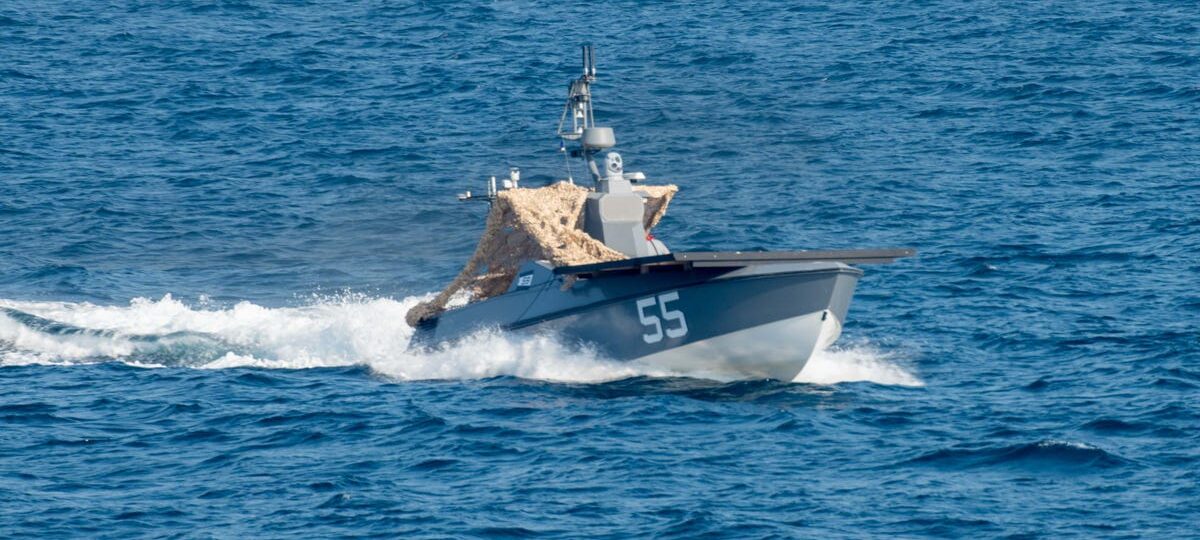
UKRAINE — NATO militaries are increasingly developing new naval drone fleets after observing their success in Ukraine, a commander in Kyiv’s military intelligence agency told Business Insider, but some of their designs have left him feeling “uneasy.” Ukraine has used naval drones to devastate Russia’s Black Sea Fleet, damaging and destroying its warships and forcing Moscow to relocate the bulk of operations from the occupied Crimean peninsula to the other side of the region.
NATO countries have been closely watching this asymmetrical campaign waged by Ukraine and have set out to equip their forces with naval drones that could deliver similar effects in combat alongside traditional warships. “There is, of course, a common NATO security doctrine,” said Ninth, a commander with Ukraine’s GUR intelligence agency who oversees a naval drone unit.
He asked to be identified by his call sign for security reasons. “What gives me satisfaction,” he said in a recent interview, “is seeing other countries adopting elements of Ukraine’s experience and practical lessons learned in combat.” “Many are now revising their doctrines to recognize the necessity of equipping their fleets” with naval drones, he said. “However, as someone who works directly with these systems in combat, I often find myself uneasy when I learn about the technical requirements some countries are issuing to their shipbuilders and defense companies.” Ukrainian naval drones have years of operational experience built into them, and their designs are constantly modified to reflect the changing security situation in the Black Sea.
At the start of Russia’s full-scale invasion, Ukrainian naval drones were built to speed into a target and explode on impact.
Now, they’re armed with machine guns, surface-to-air missiles, and other weapons, making them more dynamic platforms.
NATO naval drones aren’t built on the same kind of combat experiences.
European nations have used them for maritime security patrols.
The US Navy has often done the same, using them for surveillance purposes in the Middle East, though earlier this month, one carried out a first-of-its-kind rescue mission after Iran shot down an American helicopter near the Strait of Hormuz.
NATO has been incorporating naval drones into maritime exercises, but complex combat operations are very different.
Ninth declined to specify exactly where NATO’s naval drones were lacking, though he said the issues primarily concern the design, system behavior, and electronics, among other attributes. “Many European shipyards tasked with developing these systems simply lack this experience,” the GUR commander said. “They respond to the specifications provided by NATO countries, but they do not fully understand the realities of combat conditions because they have never encountered them firsthand.” NATO doesn’t face the same wartime pressures that Kyiv does; however, Ukrainian officials and conflict experts have routinely said that the Western military alliance needs to more urgently prepare for a modern battlefield.
They are not warships, but designing a naval drone is a challenge.
Ninth said that they must be able to operate in rough sea states, meaning they need the correct weight distributions and structural calculations.
And hull construction and materials aren’t the only considerations.
Ninth said a naval drone’s “true value” is in its electronics; vessels must be able to communicate.
If operators lose their signal, the boats need to feature some autonomous functions, such as the ability to cruise on autopilot, use artificial intelligence to avoid obstacles, and make decisions independently about target selection.
The GUR commander attributed Ukraine’s naval drone prowess to the combat experience it has accumulated over the years, striking Russian warships and ports across the Black Sea. “We should never forget that one working day for our engineers and programmers equals roughly 10 working days for specialists in countries that are not at war,” Ninth said. “When we make changes, we do not validate them hypothetically.
Within hours.” Armed conflict doesn’t adhere to typical office schedules; rather, it is a round-the-clock affair, Ninth said. “We understand the enemy’s tactics and constantly adapt our own methods accordingly,” he added. “Whenever we identify a weakness, we immediately mobilize to eliminate it.” “That,” he said, “is the pace at which wartime innovation takes place.”
Discover more from NAIRAVOICE.COM.NG
Subscribe to get the latest posts sent to your email.