

KYIV, Ukraine — The pilot was learning to hunt.
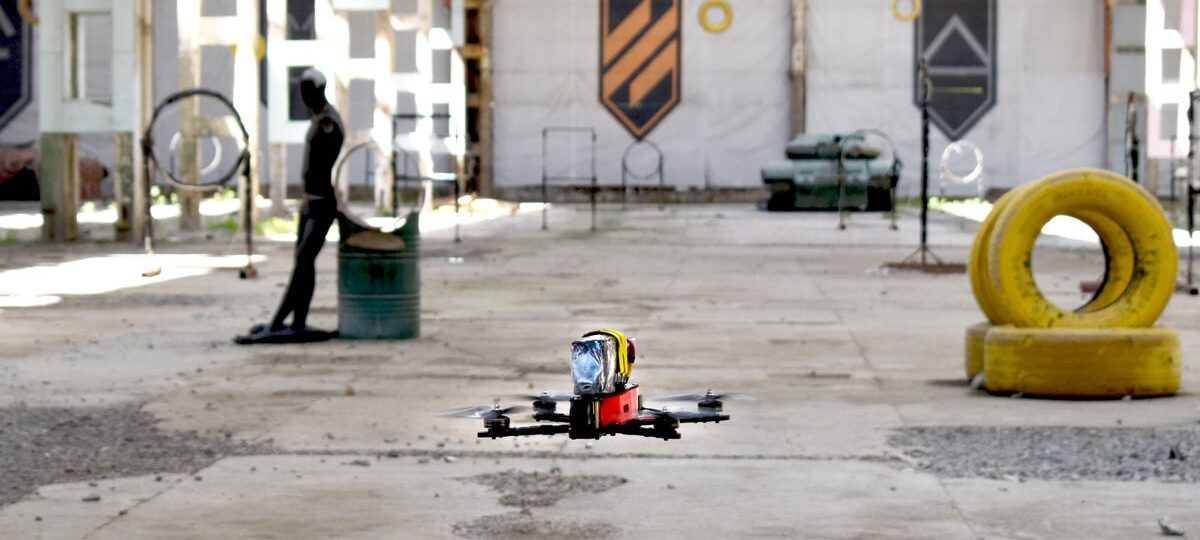
Inside a warehouse strewn with hanging tires and metal hoops, a small quadcopter lifted off the floor and crept slowly toward a fake Russian tank.
The drone cleared several hoops, then drifted toward a tire and clipped the rubber, sending it crashing into the dusty concrete floor.
On the battlefield, that same loss of control could mean losing a drone before it can cripple Russian armor, reach a trench, or deliver supplies to soldiers fighting for their lives in the kill zone. “With an FPV drone, you can’t afford to lose control,” said a Ukrainian soldier with the call sign Radio, referring to the first-person-view drones now prolific in combat.
Uncrewed systems in Ukraine, both in the air and on the ground, are moving supplies, guiding attacks, and killing troops and vehicles in unforgiving combat.
But these tools are only as useful as their operators’ skills.
Drone pilots are trained to fly through jamming, evade defenses, conserve battery, and adapt to shifting Russian tactics.
That is what Killhouse Academy, run by Ukraine’s elite 3rd Assault Brigade, is built to teach.
It trains new pilots and constantly updates its courses with fresh battlefield lessons.
It draws Ukrainian soldiers, as well as foreign volunteers eager to learn from the world’s most intense drone war.
The academy serves as an important reminder that in war, the side with the most expensive weaponry isn’t necessarily the one that wins.
Armed conflict tends to reward the side that learns the fastest as the battlefield evolves.
In this war, a cheap drone in the hands of a skilled pilot can be devastating, but that outcome takes intensive training. “It’s like driving a car,” said a foreign soldier who goes by the call sign Sante. “You need to learn properly, and you need to practice and practice and practice and practice.” Business Insider recently went inside the Killhouse training facility and spoke with brigade personnel, instructors, and students about how Ukraine is turning battlefield experience into a training pipeline for drone warfare — and what other militaries can learn from it.
Combat drone pilots in Ukraine’s 3rd Assault Brigade set up the Killhouse Academy two years ago as Ukraine looked for ways to offset Russia’s larger military.
Unable to match Moscow force-for-force, Ukrainian troops turned to cheap drones to achieve mass, strike expensive targets, and gain an asymmetric edge.
Ukraine has poured money and urgency into drones, ground robots, and other unmanned systems, turning battlefield necessity into hard-won expertise.
Once reliant on Western weapons to hold off Russia, Kyiv is now using its combat experience to teach foreign militaries how drones are changing the fight. “People come from all over the world to study here,” said Radio, a Killhouse spokesperson.
Moments later, the interview was cut short by the piercing sound of an air-raid siren, forcing students and staff to take shelter.
Drone schools and training sites, much like operators on the battlefield, are priority targets.
The warning is a reminder of the risks graduating students may take in the field.
Sante, a foreign fighter from the Mediterranean who arrived in Ukraine last year, had never flown a drone when he enrolled in the academy.
In combat, he had received supplies from some drones and hid from others.
Their growing importance on the battlefield convinced him he needed to learn more, he said.
The Killhouse began as a basic FPV training course but has since expanded to include an advanced training program, a fixed-wing drone engineering course, and a school for uncrewed ground vehicles.
These changes reflect broader evolutions in the war.
And as uncrewed warfare evolves, training must change with it.
The basic FPV course costs roughly $180 for Ukrainians and twice that for foreigners, who make up about 5% of students.
Ukrainian soldiers receive a discount, while disabled military personnel and members of the 3rd Army Corps can attend free of charge.
Some students are as young as 15 — they have to get their parents’ permission — while others are older than 60.
Most participants are soldiers, but courses also draw civilians and defense industry workers who want to learn more about drones, especially if they’re involved in military-technology work.
For Ukraine, the challenge has moved beyond building drones.
The country produces millions a year.
Now, it’s finding enough people who can fly them well enough to survive electronic warfare, dodge Russian defenses, and hit targets in the heat of battle.
Business Insider reporters traveled across Ukraine to document how new technologies, tactics, and industries are radically changing warfare.
Read more dispatches from Ukraine: “Statistically speaking, older people usually have a harder time, especially if they’ve never played video games before,” Radio said.
By contrast, teenagers with this experience can master the course in a matter of days, he said.
Every month, roughly 250 students participate in the basic FPV course.
Those in the daytime session train for six hours a day, six days a week.
There’s another held in the evening for people who have work or school — it’s only three hours a night but goes for 10 days.
When Business Insider visited the academy in May, students were in the middle of their final day of the basic course.
It’s a tough program, and not everyone makes it through; only 80% of students graduate, receiving a certificate showing they are qualified drone pilots.
Those who fail the final exam can try again later.
The instructional portion of the course is held in a temporary module-turned-classroom inside the large warehouse, where students learn the basics of FPVs — including how they are built and how they work — and practice flying on computer simulators before they hit the obstacle course with 7-inch quadcopters, a standard size for FPV drones.
There are two additional modules in the warehouse that serve as ground control stations, allowing multiple students to fly through the obstacle courses simultaneously.
While it’s possible to pilot using a virtual reality headset, they work with computer screens, allowing students to work in teams while instructors watch their moves from behind.
Students usually begin working on the obstacle course of tires and metal hoops on the second or third day, after completing simulator exercises.
To graduate, they must show they can handle the basics that matter most in combat: takeoff, hovering, flying through at least three obstacles, and landing.
To wage war effectively, they’ll want to continue honing their skills.
Piloting an FPV is not too difficult, Sante said, but “it takes time to get adapted to the drone controller and the drone itself,” both of which are highly sensitive. “It takes getting used to,” Radio said. “You have to understand how it works.
Your brain has to build those neural connections, and that’s probably the hardest part.
Ironically, the hardest thing in FPV piloting is flying very slowly or hovering in one place.” The FPVs lack a stabilization feature, he said.
They can’t hover in place at the push of a button, so pilots have to constantly make little movements to keep the drones from crashing.
The basic course focuses on teaching pilots that sense of control, said Tokyo, an instructor who goes by her call sign.
Students learn to hover, make tight turns, and handle practical issues such as signal loss.
Later in their training, they may learn how to hunt moving targets. “We are teaching them to fly slowly because that means you can fly much longer distances because your battery wouldn’t discharge fast,” Tokyo said.
Killhouse is part of Ukraine’s attempt to turn battlefield experience into something repeatable: train pilots, absorb new lessons from the front, update the course, and send those lessons back out.
Ukraine recently signed drone and security deals with NATO and Middle Eastern countries, and it has sent specialists abroad to train foreign militaries in drone and counter-drone warfare.
Radio said discussions are underway with several countries, including some NATO members, to launch Killhouse courses abroad.
Fresh battlefield data has led to improvements in the courses, and that constant updating is central to the academy’s purpose.
Drone warfare has changed significantly in the two years since Killhouse launched, and it continues to change, forcing instructors to adjust the course so pilots are not learning tactics already overtaken by evolutions in the war.
Radio said Killhouse is always watching what’s happening on the front lines, including through the eyes of its instructors with combat experience.
Sometimes this means making adjustments, such as creating harder obstacle courses to challenge students. “The situation changes constantly,” he said. “Fiber optics appeared, the role of ground robotic systems is becoming more visible and more important, and we, of course, adapt to the modern conditions of war.” One of the biggest shifts in the war this year has been Ukraine’s push to replace humans with drones for logistics missions.
That has made flying skills important beyond attack missions.
Drones are now part of how Ukrainian forces move ammunition, food, water, and other supplies through areas where sending people can be fatal. “Logistics today can’t be executed without drones — ground drones or flying ones,” Sante said. “Without drones, you’re dead.” He said the role of drones could change again as the war evolves, but for now, “they are vital.”
Discover more from NAIRAVOICE.COM.NG
Subscribe to get the latest posts sent to your email.