
 The U.S. men’s national team left the 2026 men’s World Cup with little more than bruised egos after Monday night’s 4-1 loss to Belgium in the round of 16.
However, the consolation prize is not insignificant: a $15 million FIFA payday, and its impact will expand to the entire federation.
A sizable share of that money is also headed to the U.S. women’s national team, not because stars including Trinity Rodman and Lindsey Heaps took part in the tournament as World Cup ball presenters, but because their World Cup-winning predecessors negotiated a landmark revenue-sharing agreement unmatched in global soccer.
Under the landmark collective bargaining agreement signed in 2022, the U.S. men’s and women’s national teams will equally share FIFA World Cup prize money from the 2026 men’s World Cup and the 2027 Women’s World Cup just as they did for the 2022 and 2023 World Cup cycle, except their take home is slightly lower as U.S. Soccer retains 20 percent of the prize money awarded by FIFA. The remaining 80 percent will be pooled and split evenly between the men’s and women’s national team player pools, provided the USWNT qualifies for their respective tournament in 2027.
Of the approximately $15 million FIFA awarded the U.S. for reaching the round of 16, U.S. Soccer will retain about $3 million, leaving roughly $12 million to be shared between the men’s and women’s player pools, approximately $6 million for each team before any player distribution within those pools. However, that money goes into an account until the end of the 2027 Women’s World Cup cycle.
The agreement was the product of years of public pressure, legal battles and collective action by the USWNT, whose on-field dominance had long outpaced its compensation. Between 1991 and 2019, the women won four World Cups and four Olympic gold medals. The men’s best modern World Cup finish — which started in 1998 when FIFA moved the tournament to 32 teams — remains a quarterfinal appearance in 2002.
For years, the pay gap was tied in part to separate collective bargaining agreements. The men operated under a bonus-heavy pay-for-play model, while the women had prioritized guaranteed salaries, health insurance and benefits, protections that reflected the instability of the women’s professional game at the time.
That structure gave the women more security, but also capped their upside.
After the USWNT won back-to-back World Cups in 2015 and 2019, players including Megan Rapinoe, Alex Morgan, Becky Sauerbrunn and Carli Lloyd helped push the fight into the courts and the public square.
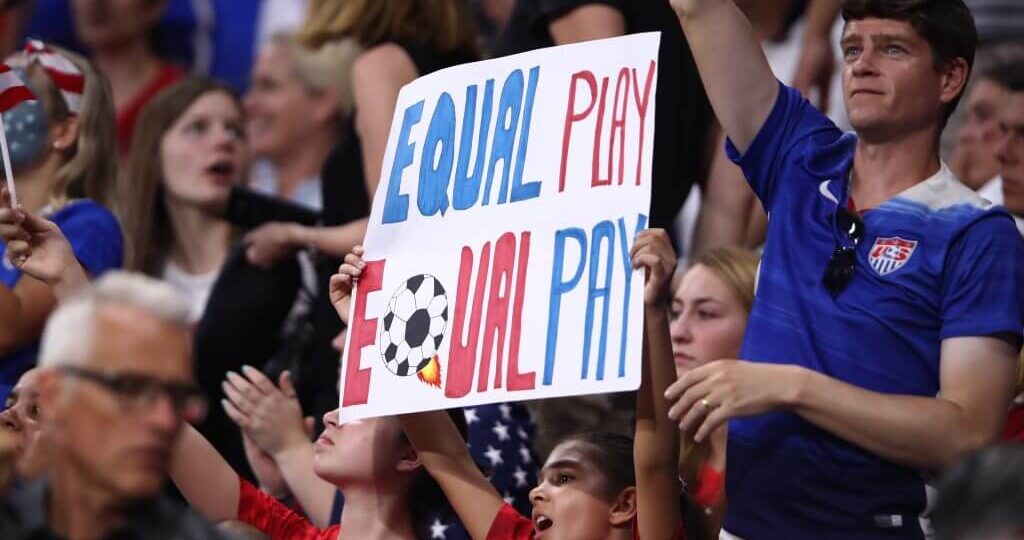
In March 2019, 28 USWNT players filed a gender discrimination lawsuit against the U.S. Soccer under the Equal Pay Act and Title VII of the Civil Rights Act, arguing they performed substantially equal work while receiving inferior pay and working conditions.
The case hit a major setback in 2020, when a federal judge dismissed the players’ equal pay claims, ruling that the disparity was largely the result of different CBAs rather than unlawful discrimination. But the lawsuit had already reshaped the conversation. Sponsors backed the players, public support surged, and pressure mounted on U.S. Soccer.
A breakthrough came in 2022, when U.S. Soccer agreed to a $24 million settlement with the players, including back pay and funding for post-career goals and women’s soccer initiatives. Months later, the federation and the men’s and women’s players associations ratified new CBAs running through 2028.
The most innovative piece of those agreements was designed to address the elephant FIFA left sitting in the room: unequal World Cup prize money.
FIFA has historically awarded far more money for the men’s World Cup than the women’s tournament. For example, the USMNT earned $13 million for reaching the round of 16 at the 2022 Qatar World Cup, more than three times the $4 million the USWNT received for winning the 2019 Women’s World Cup, and more than six times the $2 million awarded for its 2015 title.
The revenue-sharing model changed that math.
The 2023 Women’s World Cup featured a record $110 million total prize pool. For the first time, FIFA mandated that a significant portion of the money go directly to players rather than just national federations. Every player was guaranteed at least $30,000, with performance-based bonuses increasing up to $270,000 per player for the champions.
The revenue-sharing model also softened the financial blow of the USWNT’s disappointing 2023 Women’s World Cup, when the team failed to advance beyond the group stage. Without the 2022 collective bargaining agreement, the USWNT would have taken home only $1.87 million in FIFA prize money. Instead, under the agreement’s pooled prize-money structure, the women’s team received nearly $6 million after the USMNT’s roughly $13 million payout from the 2022 Men’s World Cup was combined with the USWNT’s prize money and U.S. Soccer retained its 10 percent share.
The arrangement works for all parties. While the USMNT’s World Cup run boosted the USWNT’s payout this cycle, the women could return the favor in 2027. A deep run in Brazil would increase the shared prize-money pool, creating a larger payday for players. FIFA president Gianni Infantino has vocalized his desire for equal prize money by the 2027 Women’s World Cup.
If that holds, and USWNT achieves what their predecessors achieved, USMNT could be looking at a $25 million payout for their female counterparts’ success.
This article originally appeared in The Athletic.
US Men’s national team, US Women’s national team, Women’s Soccer, FIFA Men’s World Cup, FIFA Women’s World Cup
2026 The Athletic Media Company
Discover more from NAIRAVOICE.COM.NG
Subscribe to get the latest posts sent to your email.