

7 hours agoShareSaveAdd as preferred on GoogleMatías ZibellBBC Mundo, reporting from Ushuaia
As Argentina’s southernmost city, Ushuaia has long enjoyed its reputation as ‘The End of the World’ and as a gateway for trips both to Antarctica and for tourists to explore the dramatic, natural beauty of Patagonia.
But in recent days it has been grappling with a different kind of fame, one that has cast a shadow over local businesses and officials: the suggestion it could be ground zero for the hantavirus outbreak on the Dutch vessel MV Hondius.
The cruise ship is now anchored in Tenerife in Spain’s Canary Islands where passengers are being evacuated and flown home. It began its journey on 1 April, more than 6,000 miles away in Ushuaia in the province of Tierra del Fuego.
On board were 114 passengers and 61 crew members from 22 countries. While the virus is believed to have come aboard there, its precise origin – and the identity of those carrying it – remains unclear. That uncertainty has fuelled intense speculation in parts of the media.
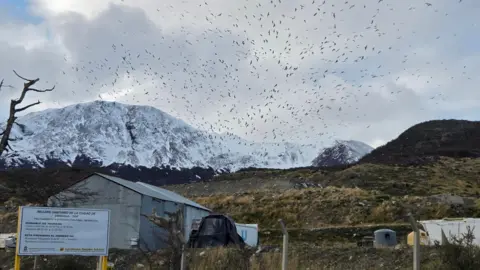
One theory suggests a passenger may have been infected at a landfill site on the outskirts of Ushuaia, where tourists often visit to watch birds and where waste attracts rats and mice. Argentinian officials who spoke anonymously to some news outlets have said that is their leading hypothesis.
That suggestion, however, has not been well received locally.

 Matías Zibell / BBC News Mundo
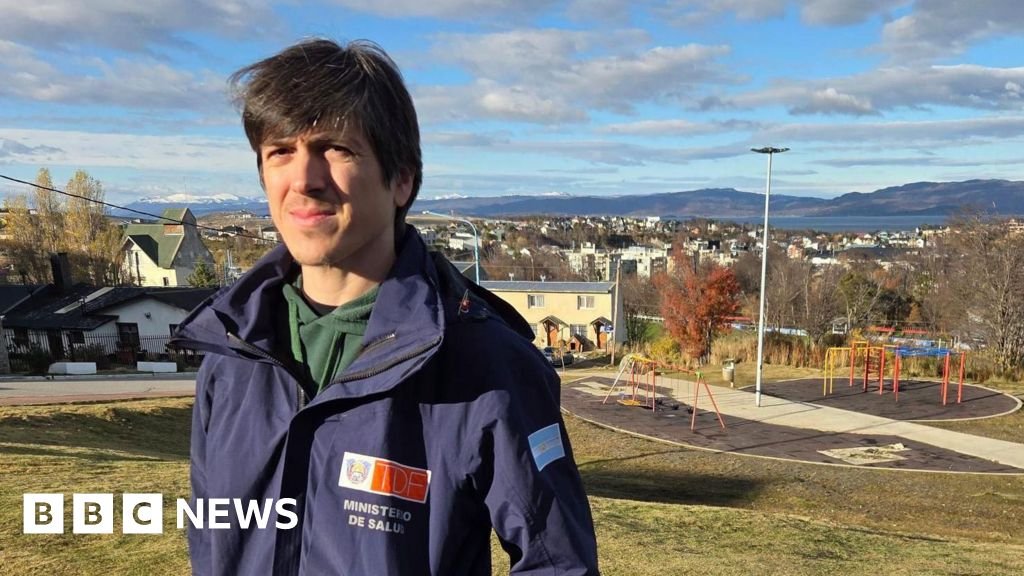
“In Tierra del Fuego we have no record of hantavirus cases in our history,” Juan Facundo Petrina, the province’s Director General of Epidemiology and Environmental Health, said.
“And specifically, since 1996 – when the National Surveillance System included it among mandatory reporting diseases – we haven’t had a single case in Tierra del Fuego.”
Petrina, who took on his position in 2021 during the coronavirus pandemic, has repeated this point in every press conference and interview he has given in recent days.
He has stressed that his province is an unlikely source of the infection and that the endemic zone for hantavirus lies more than 1,500km (930 miles) to the north.
“To begin with, we do not have the subspecies of the long-tailed mouse [which transmits the disease], nor do we share the same climatic conditions as northern Patagonia – neither in humidity nor temperature – for its development,” he said.
“And if rodents were to start moving, since they don’t respect geographical boundaries, it’s important to remember that we are an island.
“They would face the limitation of crossing the Strait of Magellan in order to infect local species, so that is an additional difficulty, beyond the climate.”
 Matías Zibell / BBC News Mundo
While many experts agree with Petrina that the infection is unlikely to have occurred in Tierra del Fuego, Argentina’s national government has announced it is dispatching a team of experts there to determine whether there are traces of hantavirus or whether the long-tailed mouse has reached the region.
The team will work with local biologists to trap rats at the landfill site and test them for the virus. But two days after the announcement, the experts are yet to arrive. When the BBC visited the site there were dozens of birds circling the piles of waste and no sign of an active investigation.
Epidemiologist Eduardo López, head of the Department of Medicine and Infectious Diseases at the Ricardo Gutiérrez Children’s Hospital in Buenos Aires, said further investigation in the province is necessary.
“The case requires more study because ecosystems are changing,” he said.
“For example, the long-tailed pygmy rice rat, whose original habitat was the Patagonian Andes and north-western Argentina, can now be found in the province of Buenos Aires alongside other rodents that transmit the disease.”
 Matías Zibell / BBC News Mundo
The urgency is not only scientific but economic. Tierra del Fuego is Argentina’s youngest and least populated province, with industries like hydrocarbon exploration and fishing closely followed by tourism as local sources of income.
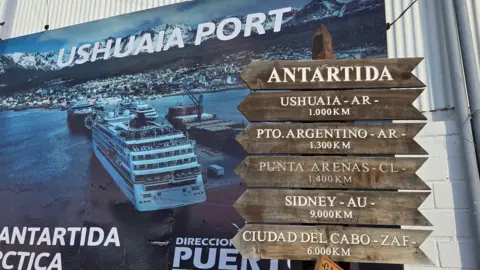
Juan Manuel Pavlov, of the Fuegian Tourism Institute, said more than 95% of boats to Antarctica leave from the port. “With more than 500 port calls a year, the cruise industry is fundamental to the provincial economy.”
So far, despite a surge in inquiries from international operators, there have been no official cruise cancellations. But with the cruise season having ended in mid-April, any longer-term impact may take months to emerge.
“We have a winter season ahead that we expect to be very successful,” Pavlov said. “We’ve been working hard in our main markets and we don’t want something like this to overshadow everything that’s been done to prioritise people’s health.”
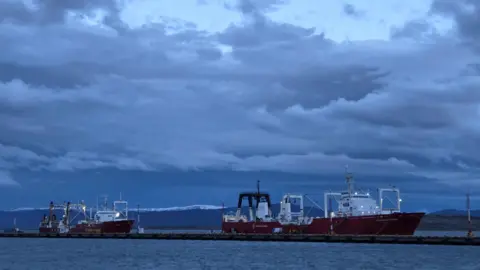
At Ushuaia’s port, life appears to be continuing as normal. Tourists stroll along the waterfront and gather for shorter excursions – to Isla de los Estados, home to the famous “end of the world” lighthouse, or along the Beagle Channel.
“The absence of cases here is very reassuring,” said Adonis Carvajal, who works for a tour operator.
“People ask whether there are infections in the province, and the fact there are no reports of sick people here brings calm.
“The strain may be from the south – that’s not denied – but it didn’t originate here.”
 Matías Zibell / BBC News Mundo
Among the visitors was David Bomparp, a Venezuelan living in Medellín, Colombia, who arrived with his partner, Daniela Sandoval, just days ago.
“We planned this trip back in October, and only the day before boarding the plane did we find out what had happened,” he said.
“As far as we understood, nothing had been confirmed here, so we came without worrying, following safety measures.”
Daniela, however, said her mother was less relaxed.
“She was sending me Instagram reels and links all night because she was worried,” she said. “I told her not to worry because there were no confirmed cases here.”
Nearby, Costa Rican tourist Jordan Bermúdez said his group went ahead with their plans. He said they had researched the virus before arriving from Punta Arenas in Chile on 5 May, but it did not deter them.
“We arrived, found the city quite calm, did all the tours we had planned, and we think everything is normal,” he said.
 Matías Zibell / BBC News Mundo
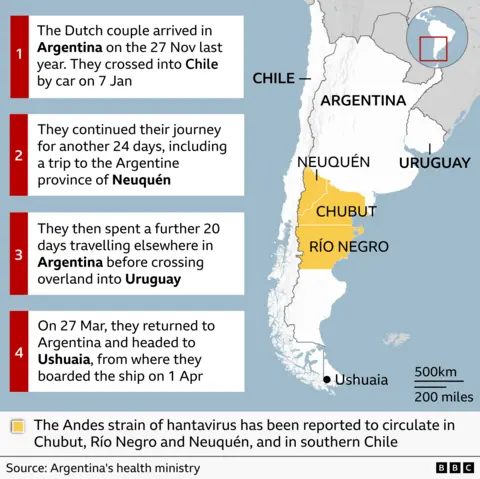
Health authorities are still trying to determine where the infection originated. They believe one of the Dutch couple who contracted the virus and died are likely to be “patient zero”.
Officials have attempted to reconstruct their journey through Argentina, Chile and Uruguay, before they boarded the ship in Ushuaia, largely using border entry and exit records.
Chilean and Uruguayan authorities say the couple did not contract the virus in those countries, based on the World Health Organization’s estimated incubation period of between one and eight weeks.
Petrina agreed that they most likely contracted the illness in Argentina, but said he believed it was probably two to four weeks before the cruise. It could have been in a mountainous region in Patagonia, he said, perhaps in the provinces of Chubut, Neuquén or Río Negro.
The National Ministry of Health, meanwhile, has not put forward a definitive theory. “We cannot rule out, in principle, that the infections occurred in Tierra del Fuego, but there is an important fact to consider: since Hantavirus became a notifiable disease, no cases have ever been reported in the province,” it said.
It is hoped that the evacuation of the passengers and the crew from the MV Hondius in Tenerife might yet yield some clues.
But for now, without the Dutch couple to fill in the gaps and officials unable to fully reconstruct their travels, many questions about how this outbreak started remain unanswered.
Countries airlift nationals evacuated from virus-hit cruise ship
How worried should we be about hantavirus?
SpainArgentinaCruise shipsCanary Islands
Discover more from NAIRAVOICE.COM.NG
Subscribe to get the latest posts sent to your email.