November 3, 1976 marked the arrival of the very first Stephen King movie, so to celebrate, let’s look back on the legendary author’s most underrated adaptations from each decade. Nobody involved with Brian De Palma’s Carrie adaptation could have foreseen what a force the author of the original book would become. After all, when the movie was released in November 1976, there were only two Stephen King books in existence: Carrie and ‘Salem’s Lot.
Jump ahead to 2026, the author has penned over 60 novels and written dozens of short stories, screenplays, essays and much more. There is a similar number of Stephen King movies too, and a half-century on from his breakthrough, it’s hard to picture a time when the writer wasn’t a towering figure in pop culture.
His work has inspired countless other writers and filmmakers, and fittingly, 2026 saw the arrival of a fresh take on Carrie too. The list of King adaptations is filled with masterpieces (Stand by Me, The Shining) and turkeys (Maximum Overdrive, Dreamcatcher), but inbetween, there are plenty of gems that could use more attention.
1970s: Salem’s Lot (Theatrical Cut)
<<img src="https://static0.srcdn.com/wordpress/wp-content/uploads/2026/10/a-vampire-has-blue-skin-sharp-teeth-and-glowing-yellow-eyes-in-salem-s-lot.jpg?q=49&fit=crop&w=825&dpr=2" />
</figure>
It’s tricky to pick an underrated 1970s entry, considering Carrie and the theatrical edit of Tobe Hooper’s ‘Salem’s Lot are the only two entries. Even so, the ‘Salem’s Lot movie is an intriguing little curio in itself. This adaptation was originally filmed as a three-hour miniseries, and follows an author returning to his hometown and discovering it is slowly being consumed by vampires.
‘Salem’s Lot is a classic miniseries that haunted younger horror fans after it aired in 1979; in particular, the eerie shot of a floating vampire boy knocking on a window is pure nightmare feul. While the series was being shot, a foreign distributor put extra money into the budget for Hooper to shoot gorier, alternate takes of certain sequences for a planned European theatrical release.
After ‘Salem’s Lot was a ratings success for CBS, this movie version went around the world later in 1979. While the longer version is a more complete meal, it must be said the theatrical version moves much faster. The runtime is a tight 110 minutes, and while it drops some great scenes (including the original ending) it cuts a lot of fat out too.
There are also bloodier shots too, such as Straker (James Mason) impaling a victim on deer antlers. Most importantly, ‘Salem’s Lot still works gangbusters in its shorter version. It lets viewers fall in love with the characters in this doomed town, and David Soul’s protagonist Ben still makes for a very, well, soulful hero.
1980s: Christine
<<img src="https://static0.srcdn.com/wordpress/wp-content/uploads/2026/11/christine-the-car-chasing-moochie-in-christine-1983.jpg?q=49&fit=crop&w=825&dpr=2" />
</figure>
This John Carpenter outing came in the aftermath of The Thing, which, despite being proclaimed a masterwork now, was critically reviled in 1982. Carpenter was thus fired from another Stephen King adaptation (Firestarter), and took on Christine before he needed a gig.
It speaks to what a pro Carpenter is that even if Christine was a work-for-hire job, he still did a great job. This adaptation stripped away a lot of elements from King’s behemoth of a novel, such as the ghost of the car’s original owner. Instead, “Christine” herself is the evil one, and the film becomes a potent metaphor for puberty and teen angst.
Its the character stuff that Carpenter leans into, which is why the film still works. In truth, it’s never particularly frightening, with the car itself being too cute-looking to instill fear. That said, Carpenter is a master of atmosphere, and it gets by on pure vibes. It also features one of Carpenter’s most menacing, underrated musical scores.
Christine has great setpieces too, especially the sequence where the titular automobile is on fire and still chasing her victims down. The film came and went without much fanfare in 1983, but it eventually found a small but loyal fanbase.
1990s: The Night Flier
<<img src="https://static0.srcdn.com/wordpress/wp-content/uploads/2025/10/the-night-flier-dees.jpg?q=49&fit=crop&w=825&dpr=2" />
</figure>
It feels like enthusiasm for Stephen King horror adaptations slowed down during the late 1990s, whilst his dramas (The Shawshank Redemption, The Green Mile) became more in vogue. Hence, The Night Flier landed at the worst possible time, with this vampire thriller following a slimy tabloid reporter (played by the late, great Miguel Ferrer) on the trail of a supposed bloodsucker who travels America via a small airplane.
The Night Flier is a character study about a journalist who is, by his own admission, a bloodsucker himself. His stories are predicated on human misery and suffering, and he has no life or friends outside his grimy little job. Director and co-writer Mark Pavia makes sure to hit this note while crafting an eerie horror noir around his anti-hero’s quest to meet his own dark mirror.
If The Night Flier was playing close to the vest for the first two acts, the finale really lets the gore fly. The ending alone is worth seeking out the movie for, but it’s easy to see why it didn’t connect in 1997. It has no major actors and follows a “hero” who absolutely sucks, so by design, its destiny was to become a cult horror flick.
2000s: 1408
<<img src="https://static0.srcdn.com/wordpress/wp-content/uploads/2026/07/1408-john-cusack-mike-enslin.jpg?q=49&fit=crop&w=825&dpr=2" />
Image via MGM</figure>
One of King’s most inspiring works is the non-fiction On Writing: A Memoir of the Craft, where he reflects on his career and gives readers the tools they need to pen their own stories. It was in this book that King first penned 1408 – a horror story about a haunted hotel room – as a writing exercise, designed to show readers how to trim down a story between drafts.
King later fleshed 1408 into a short story, which in turn was adapted into a movie starring John Cusack and Samuel L. Jackson. In truth, the latter is a guest star, with the film largely being a one-man show for Cusack as a writer trapped inside the titular hellish room. For a King adaptation that was a genuine success back in 2007, it’s strange how forgotten this little gem feels now.
It largely works due to Cusack’s committed turn, as a rigidly logical writer who is gradually undone as he realizes that, yes, 1408 itself is a sentient beast that’s slowly eating him alive. The adaptation undercuts its initial, chilly atmosphere by going too big and noisy towards the end, but for a story set largely in one locale, it does a superb job of giving Cusack’s Mike fresh obstacles to overcome.
2010s: Gerald’s Game
<<img src="https://static0.srcdn.com/wordpress/wp-content/uploads/2026/11/carla-gugino-as-jessie-tied-to-a-bed-in-gerald-s-game-2017.jpg?q=49&fit=crop&w=825&dpr=2" />
</figure>
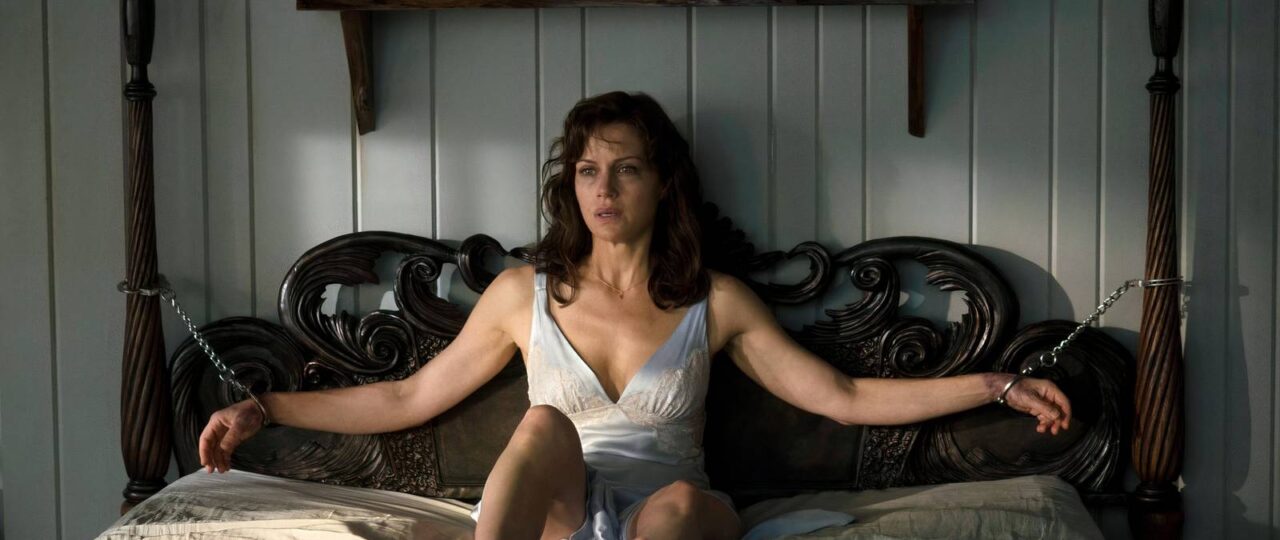
Mike Flanagan has become a prolific adapter of King’s work, including Doctor Sleep and 2026’s Carrie. Flanagan understands that what makes King’s books work are the characters, and that the horror flows naturally from there. In adapting Gerald’s Game, Flanagan really had to flex his directing muscles, as the source novel had long been labeled unfilmable.
A story about a woman left handcuffed to a bed after her husband dies of a heart attack might make for a thrilling, internal novel, but it’s hard to make cinematic. Gerald’s Game manages just that, depicting the plight of Jessie (Carla Gugino) in the present day and then flashing back to her troubled past and relationships with the various men in her life.
Anchored by a stunning central performance from Gugino, Gerald’s Game is a harrowing survival thriller that nonetheless is oddly inspiring. It works as both a moving drama about a woman coming to terms with the mess her life has become, while also featuring genuinely disturbing sequences, including Jessie’s most unconventional attempt to “slip” out of her handcuffs.
2020s: The Monkey
<<img src="https://static0.srcdn.com/wordpress/wp-content/uploads/2025/12/the-monkey-in-stephen-king-s-the-monkey.jpg?q=49&fit=crop&w=825&dpr=2" />
</figure>
Director Osgood Perkins had a nice run of horror hits in the 2020s, including Longlegs and The Monkey. Despite the latter being a genuine hit – grossing nearly seven times its budget with a $70 million haul and receiving good reviews – it feels like Longlegs overshadowed it totally.
It feels like, in the years ahead, The Monkey will instead become the film everyone talks about regarding Perkins’ career. It’s a pitch-black horror comedy that delights in conceiving and executing gory deaths for its luckless cast of characters. It’s a more sinister riff on Final Destination, and feels like Perkins was venting the intensity of Longlegs and set out to to make something fun and cathartic.
It’s telling that The Monkey has little in common with Stephen King’s 1980 short story in that regard, which was a more sober affair. Perkins decided to make a more existential and caustic comedy, looking at how random life and death can be – while also ending on a surprisingly hopeful note about just enjoying the whole, messy ride while it lasts.
Discover more from NAIRAVOICE.COM.NG
Subscribe to get the latest posts sent to your email.