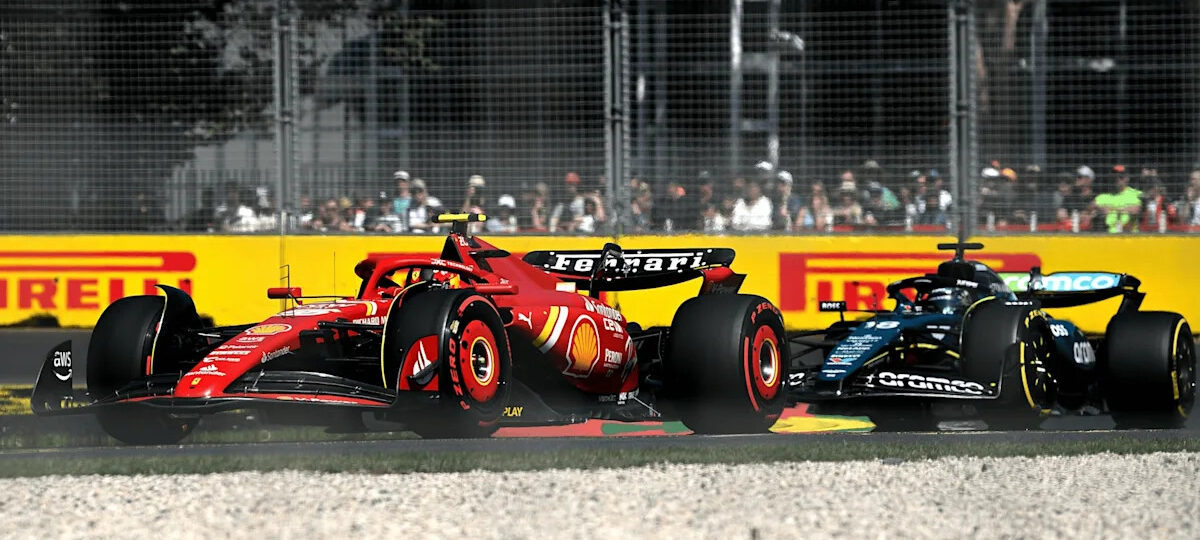
Kimi Räikkönen started the last race of 2007 third in the standings, seven points behind a rookie and three behind a two-time champion. By the end of the afternoon he was the Formula 1 world champion. Räikkönen won the 2007 Brazilian Grand Prix at Interlagos on October 21, 2007, 19 years ago today. Lewis Hamilton’s McLaren suffered a gearbox glitch early, and Ferrari ran a one-two that put Räikkönen’s 110 points one clear of both McLaren drivers on 109.
It was the first time since 1986 that three drivers had arrived at a season finale with a chance at the title. It is also the last time a Ferrari driver has won it.
The 2007 season belonged to McLaren for most of its length, and so did the trouble. Hamilton, in his debut season, and Fernando Alonso, who had just won back-to-back titles with Renault, spent the year taking points off each other in identical cars. Meanwhile, the espionage case involving Ferrari technical data ended with McLaren excluded from the constructors’ championship.
Räikkönen, in his first year at Ferrari after replacing Michael Schumacher, looked out of it with two races left. He was 17 points behind Hamilton. However, Hamilton scored nothing in China while Räikkönen won there, his fifth victory of the season. As a result, Hamilton went to Brazil on 107 points, Alonso on 103 and Räikkönen on 100.
Under the 10-8-6-5-4-3-2-1 points system, Hamilton controlled the title. A fifth-place finish would have been enough whatever his rivals did. Alonso had to recover a four-point gap to his teammate while also keeping Räikkönen behind him.
Räikkönen’s path was the narrowest. He needed to win, with Alonso no higher than third and Hamilton no higher than sixth. A sixth place for Hamilton would have tied them on 110, but Räikkönen would have taken the title on wins. In other words, the Finn needed his own perfect day and a bad one for both McLarens.
- Hamilton (107): fifth or better and the title was his.
- Alonso (103): needed a strong finish, ideally a win or second place, and help from Hamilton’s result.
Räikkönen (100): win, Alonso third or lower, Hamilton sixth or lower.
Hamilton (107): fifth or better and the title was his.
Alonso (103): needed a strong finish, ideally a win or second place, and help from Hamilton’s result.
Räikkönen (100): win, Alonso third or lower, Hamilton sixth or lower.
Felipe Massa took pole at his home race, and Hamilton started alongside him. Räikkönen started third and Alonso fourth. At the start, Massa squeezed Hamilton, Räikkönen went around the outside into second, and Alonso passed Hamilton for third. Then Hamilton tried to retake the place down the hill into Turn 4, locked up, ran wide and rejoined eighth.
Eighth was still recoverable. What came next was not. A few laps later Hamilton’s McLaren slowed sharply with an electronic gearbox problem, and by the time the car came back to life he had dropped to 18th. He spent the rest of the afternoon climbing back through the field on a three-stop strategy, but he could not get higher than seventh.

Fans on the terraces at Interlagos, where three drivers arrived with a shot at the 2007 title. File image from the 2022 race weekend. Photo: Eduardo Taulois / Unsplash
With Hamilton out of the picture, the title came down to the order of the two Ferraris. Massa led, Räikkönen sat behind him, and Alonso ran a distant third. If the race finished that way, Hamilton would keep the crown.
Ferrari settled it with fuel and timing rather than team orders on track. Both cars made their first stops on lap 21. For the second round, Massa pitted from the lead on lap 50. Räikkönen stayed out until lap 53 and used the light-fuel laps to build enough time to rejoin ahead. When the stops shook out, Räikkönen led Massa, and the championship order flipped.
Räikkönen won by 1.493 seconds. Massa finished second, and Alonso was third, 57 seconds back. Hamilton crossed the line seventh.

Pit-stop timing decided the lead at Interlagos in 2007, when Räikkönen stayed out three laps longer than Massa. File image from 2022. Photo: Eduardo Taulois / Unsplash
The final table read Räikkönen 110, Hamilton 109, Alonso 109. Hamilton took second on countback. Räikkönen, who had finished second at Interlagos in each of the previous three years, became Finland’s third world champion after Keke Rosberg and Mika Häkkinen. Afterward he credited a team that, in his words, “always believed we could recover.” Ferrari also took the constructors’ title.
There was one more twist. After the race, the FIA technical delegate reported that fuel in the BMW Sauber and Williams cars was more than 10°C below ambient temperature, which the rules did not allow. The stewards declined to penalize them, citing doubt over the true fuel and ambient temperatures. McLaren appealed. Had those cars been excluded, Hamilton would have moved up to fourth and won the title.
In November 2007, the FIA International Court of Appeal ruled McLaren’s appeal inadmissible, and the result stood.
It is still Ferrari’s last drivers’ title. Massa came within one point at the same circuit a year later. Since then, Ferrari has won races and the 2008 constructors’ championship, but no Ferrari driver has been crowned. Every season that passes makes October 21, 2007, a bigger date in Maranello’s history. Ferrari’s modern title era began with Schumacher ending a 21-year wait at Suzuka in 2000, and Räikkönen’s title remains its last entry.
It shaped Hamilton’s career. The rookie lost the title by one point at Interlagos. Twelve months later, he won it there by one point over Massa, passing Timo Glock on the final lap to take the fifth place he needed. That pairing of results is one reason the circuit carries so much weight in his story.
It closed an era of driver aids. Brazil 2007 was the last Grand Prix before the FIA’s standard ECU, supplied by McLaren Electronic Systems, arrived for 2008. The change banned traction control and electronic engine-braking aids, and that put car control back in drivers’ hands.
It belongs to a long line of one-point finishes. The 2007 decider sits alongside Mike Hawthorn’s one-point title in 1958 as proof that a championship can turn on a single position. Fittingly, Räikkönen’s 21st and final Grand Prix win came on October 21, 2018, in Austin, 11 years to the day after Interlagos. He retired after the 2021 season with that single world title.
Nineteen years on, the lesson from Interlagos still applies to the current fight. As Kimi Antonelli heads to Austin with a chance to seal the 2026 title, the records he could break are a reminder that a lead is never final until the math says so.
Discover more from NAIRAVOICE.COM.NG
Subscribe to get the latest posts sent to your email.