

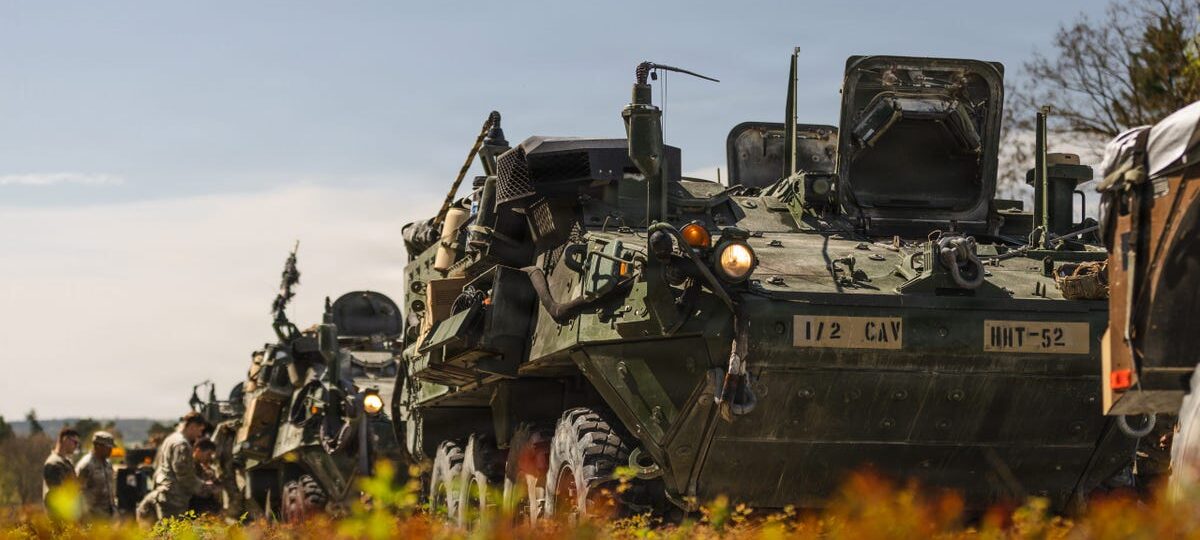
In future wars, US forces could find themselves fighting against enemy electronic warfare and jamming.
The lack of GPS and network connectivity could impact everything from navigation to communications.
The challenge is forcing leaders to assess potential vulnerabilities and determine how they need to adapt.
A newly announced US Army contract for an artificial intelligence-based alternative offers a potential solution.
On Thursday, defense tech company TERN announced an $11.26 million deal with the US Army to deploy its AI-based technologies on Army vehicles, offering soldiers an alternative to GPS should they lose GPS due to signal disruptions or jamming.
The contract includes TERN’s Independently Derived Positioning System and Vehicle Health & Maintenance System, both of which operate without GPS or external connections. “It can’t be expected that GPS is going to be available on the battlefield moving forward,” Brett Harrison, the president and cofounder of TERN, told Business Insider. “That’s kind of a given at this point,” he said.
TERN’s technology makes use of the sensors a vehicle already has, “making them smarter” with AI, Harrison said, and pre-loads a geographic area that soldiers can view like a digital map.
Soldiers can use it completely offline to see their vehicle’s position and surroundings.
According to the company, the continuous positioning and waypoint-based routing also map out off-road environments that traditional navigation systems often struggle with.
If they regain connection, the map will then update and operate similarly to civilian navigation apps.
Shaun Moore, CEO and cofounder of TERN, said the interface is designed to be user-friendly for soldiers.
The vehicle health system uses similar methods to constantly monitor maintenance needs and fuel levels.
It’s able to flag issues as they arise so commanders can have a better sense of overall equipment and operational requirements.
Harrison said the decision to develop these systems and make them low-cost and scalable was inspired by his and TERN cofounder and Chief Product Officer Phil Reason’s time serving in a special operations task force in Afghanistan, “experiencing the loss of GPS during actual missions.” During the war there, the terrain sometimes had a negative effect on navigation systems.
Their observations of the military’s over-reliance on signals and connectivity prompted them to develop the systems, partnering with Moore, whose background was in facial recognition technology.
TERN didn’t specify the number of vehicles it will field its technology on, but Harrison said it represents “the Army’s most significant investment in this type of technology to date.” It will be plugged into a variety of Army vehicles.
The company also worked through cybersecurity concerns in conjunction with the Army. “For the base system,” Moore said, “it can operate completely offline, so there wouldn’t be an attack vector,” or a way for the system to be hacked. “You’d have to go corrupt every individual vehicle,” he added.
Going forward, TERN is also working on how it can deploy its systems on drones, specifically uncrewed ground vehicles.
While there is some work in adapting the technology, Moore said the modular design allows for easier customization.
The Army’s contract with TERN is the latest step in addressing GPS vulnerabilities to jamming, signal loss, spoofing, and disruption.
Russia’s ongoing war in Ukraine and the US war against Iran have shown the consequences of losing connectivity, as well as how jamming in the invisible battles of the electromagnetic spectrum can give militaries advantages in both offense and defense.
The war in Ukraine has also demonstrated the value of AI-enabled navigation systems.
Department of Defense and Army leaders have repeatedly highlighted the risks of overreliance on GPS and have pushed for alternatives that would be vital in contested environments.
Discover more from NAIRAVOICE.COM.NG
Subscribe to get the latest posts sent to your email.