
Modern vehicles generate all kinds of data while driving, and Tern’s whole tech stack is oriented around using some of that information to navigate without GPS.
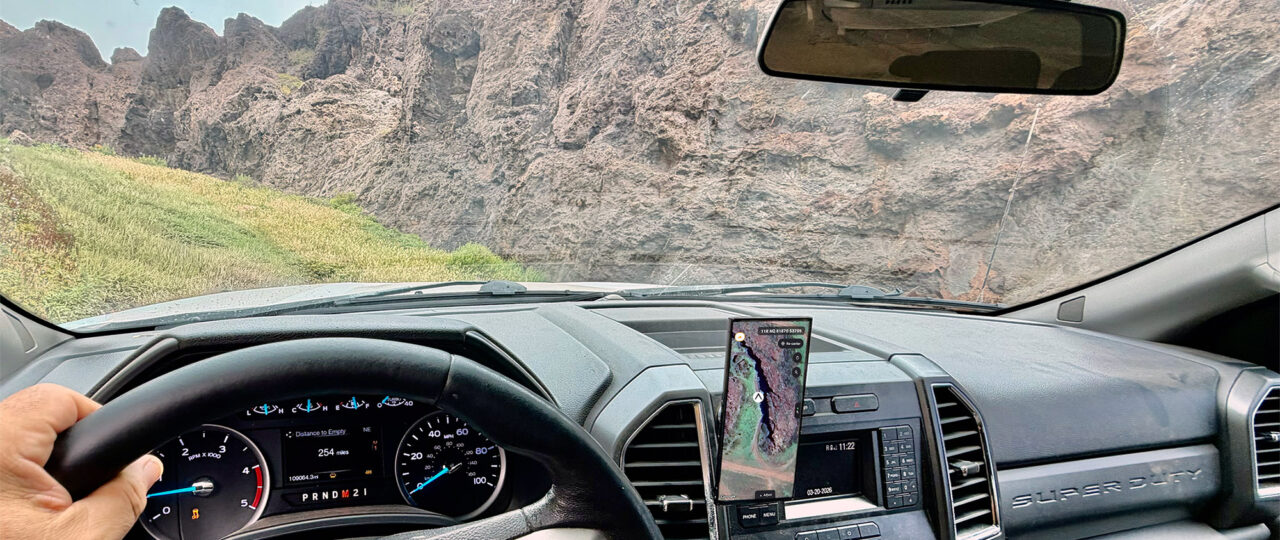
“We’ve got a device that plugs into the diagnostics board of the vehicle, wired to a tablet, and then that tablet is the interface for the soldier to use, and we provide both the position and navigation and routing there for the soldier,” Tern co-founder and CEO Shaun Moore said in an interview.
Moore said Tern is “passively listening to” this information and not disrupting its flow in any way. Tern then uses “proprietary methods” to make the information usable for navigation. (He declined to go into specifics.)
“There is quite a bit of work that was done to get it to the point where we can just receive that information and then output latitude / longitude, so big effort by our team,” he said.
All this allows a vehicle to essentially determine its own position independently, using edge processing, which is helpful both on- and off-road, in tunnels or in deserts. Moore’s co-founder Brett Harrison even recently used it to navigate a 1,300-mile drive between Austin and Laguna Beach, California. He said Tern’s tech never lost his vehicle’s place during the whole trip, while traditional GPS cut out dozens of times.
Another aspect of Tern’s tech that may be just as important as accurate positioning is that it’s a closed system. This means it is not just a backup, it’s actually harder for adversaries to disrupt it.
“I don’t know that there is broad awareness on the fragility of the system from a consumer standpoint,” Moore said. “I think people just see the blue dot on their phone and say it will always be there because it’s there now, right? Why wouldn’t it be there?”
As a military vet himself, Harrison said the Army contract is validating after Tern spent years proving that its tech works. He said his time in Afghanistan as part of a special operations task force is a big part of where the desire to solve this problem came from.
“From the very foundation of when we decided to embark upon this effort, we recognized it has to be actually deployable, actually scalable, and not a science project,” he said. “We weren’t interested in just seeing what we could prove. We wanted to make sure it actually was something that could get into the wild and serve a purpose”
Discover more from NAIRAVOICE.COM.NG
Subscribe to get the latest posts sent to your email.