
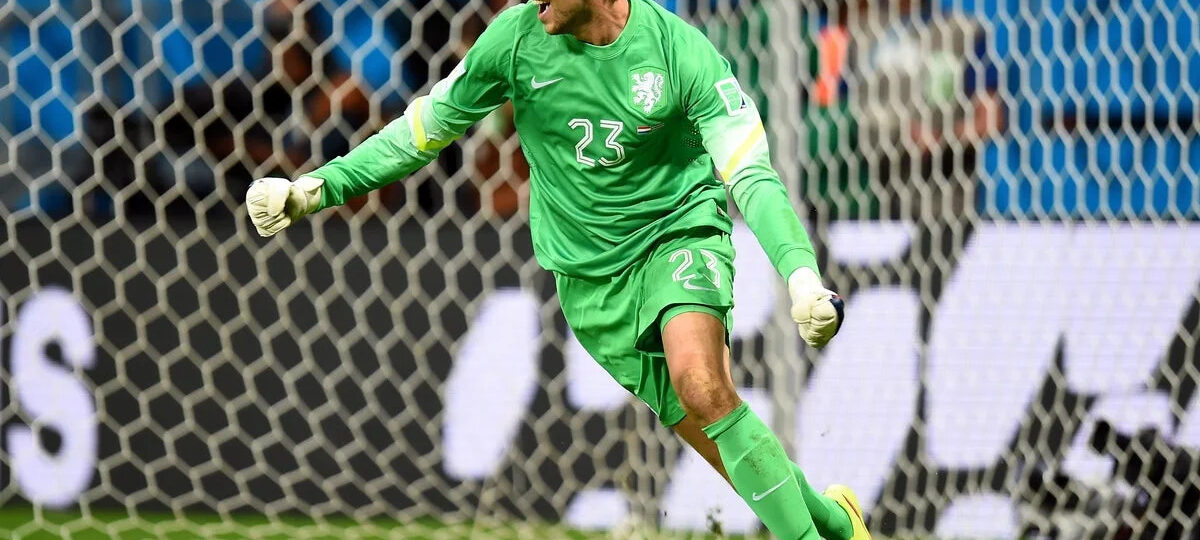
In the midst of one of the most famous World Cup shootouts interventions of all, with so much focus on him, Tim Krul was only looking to one place. That was into the eyes of the Costa Rica players.
“You can see which ones are more nervous,” Krul smiles. “They’re not able to put the ball where they want.”
So it proved with Bryan Ruiz and Michael Umana, as Krul saved from both to send the Netherlands through to the semi-finals in 2014.

That moment of history came just minutes after Louis van Gaal had specifically brought on the goalkeeper as a penalty specialist, the first time that had happened in the competition’s history.
If it has consequently entered World Cup lore, but arguably had a much wider influence on how the competition is now played, that we are going to see over the next few days. It marked a moment where the focus for shootouts – at least as regards what the most important element is – shifted from kickers to keepers.
For years, after all, most of the thinking had been dominated by whether players could step up, whether they had the “bottle”, whether they could handle the psychology of it all.
The evolution of sports science and superior technical coaching has long moved us past the point where penalties are “a lottery”, but a lot of evidence has since evolved to show that goalkeepers have now introduced much greater variation.
They have become the true differential, as Emiliano Martinez has shown for Argentina and Jordan Pickford for England.
It got to the point with Martinez, and the extent of his proactivity, that Fifa had to change the rules on keeper movement.
Hugo Loris arguably showed it from the other side with France, since he wasn’t even getting close to any of those penalties in the 2022 final. The contrast in the keepers was the difference between winning the shootouts – and winning the World Cup – and not.
If players are confident they can beat a keeper, it’s on. If there’s doubt, the impact can be much greater.
So, while the loneliness of the kicker is still very much what most emotionally resonates with shootouts, the fact they can only take one kick is part of the point. The goalkeeper is involved in all of them.

“I loved the shootout,” Krul says. “Loved it, because I had five chances, minimum. And that’s why I felt the percentages were so much more in favour of me, because I knew one or two of them would be so nervous.”
In other words, they might feel the loneliness of the kicker; goalkeepers can play on that.
“I had a moment in Salvador for that shootout where I was walking to get ready, then looked up and saw the Dutch flag, saw the World Cup flag. And then the spider-cam came down and I saw myself on the screen,” Krul explains. “And just the realisation, ‘this s*** is real’.
“That’s what you dream of as a young boy, to play in a World Cup and have an impact for your country.”
And that’s also what kickers are fearing, to feel that impact in the wrong way.
One illustrative approach that coaches use to think about shootouts is that, if elite players wanted to, they could easily stick a ball in a top corner – where goalkeepers physically can’t reach – at will. All of Diego Maradona, Leo Messi, Roberto Baggio and Michel Platini especially could. And yet all of them have missed big shootout penalties.

“I spoke to all the strikers and all the midfielders in our squad and even the best were impacted by psychology,” Krul reveals. “I was even thinking, ‘my goodness, you’re a guy who’s killed the biggest Champions League matches and you’re impacted by this.’ So there’s so much going on.”
That’s precisely why Krul and goalkeepers like Martinez definitively moved away from the old approach of pre-emptively deciding where to dive, so as to give yourself the best chance of saving if you went the right way. That is certainly too much of a lottery. Hence, Krul looked into their eyes.
“Players now change their mind in the last split second. And you can see the ones that are more nervous. They are not able to put the ball into the top corner or the bottom corner. That’s the one you go for, where they are hitting it with 85% conviction rather than 100%.
“You have to be able to read and react, of course. You need the explosiveness and the experience, but it’s more and more psychology.
“It is a unique situation, basically.”

Hence, Pickford is now treating his approach as if they are trade secrets. When asked whether he’d come up with anything new on Saturday, he asserted he wasn’t getting into that as if this was an attempt at industrial espionage.
“It’s my job to make the saves and in tournaments, time and time before, I’ve always come up with a save in a shootout for England and I’ll hopefully continue that,” he said. “We believe in each other – they have confidence I can save a penalty and I have confidence they can score them.”
But that’s where Krul and other goalkeepers are now fully conscious of the twist.
“The pressure is all on the taker. And that’s why emotional control is key with these kinds of moments.”
The goalkeeper, to a far greater degree than ever before, has consequently become the real difference.
Discover more from NAIRAVOICE.COM.NG
Subscribe to get the latest posts sent to your email.