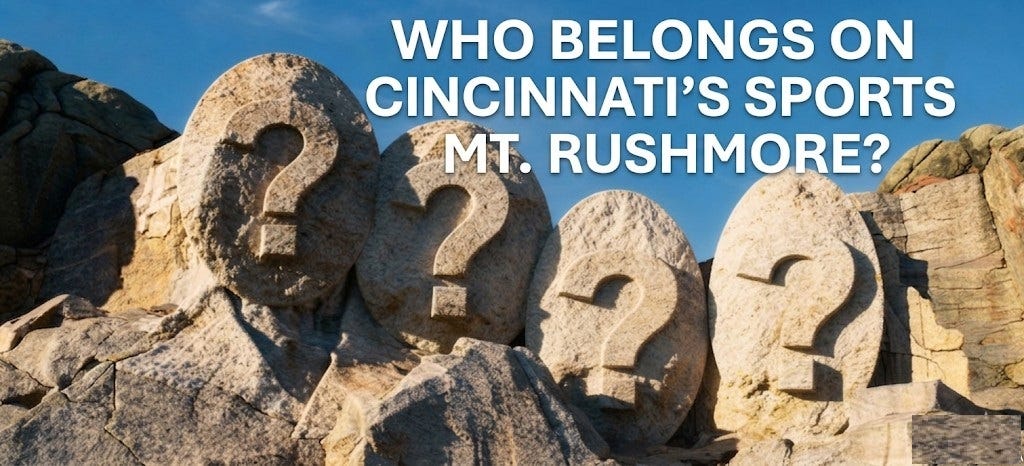
In a recent column, Enquirer sports columnist Jason Williams laid out his personal Mount Rushmore of Cincinnati sports figures. As a deeply subjective list of boyhood favorites and personal heroes, you can’t argue with his heart. Eric Davis was the quintessential five-tool marvel. Steve Logan was an absolute warrior for the Bearcats. Marty Brennaman is the unquestioned voice of summer. And Pete Rose is, well, Pete Rose.
But if we are going to fire up the dynamite and carve a true Mount Rushmore of Cincinnati sports − a permanent monument dedicated not just to nostalgia, but to objective, transcendent athletic greatness − Williams missed the mark.
To earn your face on the mountain, a sentimental soft spot isn’t enough. You must have reached the absolute pinnacle of your sport. That means delivering a world championship home to the Queen City, conquering the globe on an international stage, or completely redefining your sport locally before capturing the ultimate title elsewhere.
When you strip away the warm fuzzies and apply that ultimate, unyielding standard of championship success, a definitive blueprint emerges.

- Pete Rose: Williams got this one exactly right. You cannot tell the story of Cincinnati without “Charlie Hustle.” The all-time Major League Baseball hit king and the engine of the Big Red Machine, Rose delivered two World Series titles to his hometown.
- Johnny Bench: Yes, he is from Oklahoma, but his entire 17-year professional identity belongs exclusively to the wishbone “C.” Bench is the greatest catcher in the history of the sport, anchoring the Big Red Machine with two MVPs, 10 Gold Gloves, and a World Series MVP.
Oscar Robertson: “The Big O” put Cincinnati basketball on the global map. He won three national scoring titles and led the Bearcats to two Final Fours, captured a Gold Medal at the 1960 Olympics, and became the first NBA player to average a triple-double for the Cincinnati Royals before ultimately winning his NBA Championship in Milwaukee.
Barry Larkin: The ultimate hometown hero. He spent all 19 of his Hall of Fame seasons in a Reds uniform, won the 1995 NL MVP, and most importantly, served as the captain and starting shortstop for the historic 1990 wire-to-wire World Series Champions.
Pete Rose: Williams got this one exactly right. You cannot tell the story of Cincinnati without “Charlie Hustle.” The all-time Major League Baseball hit king and the engine of the Big Red Machine, Rose delivered two World Series titles to his hometown.
Johnny Bench: Yes, he is from Oklahoma, but his entire 17-year professional identity belongs exclusively to the wishbone “C.” Bench is the greatest catcher in the history of the sport, anchoring the Big Red Machine with two MVPs, 10 Gold Gloves, and a World Series MVP.
Oscar Robertson: “The Big O” put Cincinnati basketball on the global map. He won three national scoring titles and led the Bearcats to two Final Fours, captured a Gold Medal at the 1960 Olympics, and became the first NBA player to average a triple-double for the Cincinnati Royals before ultimately winning his NBA Championship in Milwaukee.
Barry Larkin: The ultimate hometown hero. He spent all 19 of his Hall of Fame seasons in a Reds uniform, won the 1995 NL MVP, and most importantly, served as the captain and starting shortstop for the historic 1990 wire-to-wire World Series Champions.
When you look beyond the immediate hometown hardware, Cincinnati has produced rare, elite athletes whose sheer historical dominance demands a place in the conversation:
- Joe Morgan: It is nearly impossible to leave him off the main mountain. Morgan arrived via trade and became the final, lethal piece of the greatest baseball team of the 1970s, winning back-to-back NL MVPs during the Reds’ back-to-back championship runs.
Tony Trabert: A rare dual-sport Bearcats basketball and tennis star who went on to conquer the globe. Trabert won an astonishing 10 Grand Slam titles (including Wimbledon and the US Open) and held the No. 1 world ranking in the mid-1950s.
Ezzard Charles: “The Cincinnati Cobra” reached the absolute peak of combat sports. He is universally recognized as one of the greatest heavyweights ever to live, bringing the Undisputed World Heavyweight Championship home to Cincinnati in 1950 after defeating Joe Louis.
Gary Hall Jr.: With 10 Olympic medals (including 5 Golds) across three Olympic games, Hall is statistically one of the most decorated, dominant sprint freestylers in the history of swimming.
DeHart Hubbard: A Walnut Hills High School legend whose success came with immense historical weight. At the 1924 Paris Olympics, he won Gold in the long jump, forever changing history as the first African American athlete to win an individual Olympic Gold Medal.
Aaron Pryor: “The Hawk” was an absolute buzzsaw in the ring, holding the World Light Welterweight Championship for over five years in the 1980s. He retired with a legendary 39-1 record and was named by the Associated Press as the greatest light welterweight of the 20th century.
Joe Morgan: It is nearly impossible to leave him off the main mountain. Morgan arrived via trade and became the final, lethal piece of the greatest baseball team of the 1970s, winning back-to-back NL MVPs during the Reds’ back-to-back championship runs.
Tony Trabert: A rare dual-sport Bearcats basketball and tennis star who went on to conquer the globe. Trabert won an astonishing 10 Grand Slam titles (including Wimbledon and the US Open) and held the No. 1 world ranking in the mid-1950s.
Ezzard Charles: “The Cincinnati Cobra” reached the absolute peak of combat sports. He is universally recognized as one of the greatest heavyweights ever to live, bringing the Undisputed World Heavyweight Championship home to Cincinnati in 1950 after defeating Joe Louis.
Gary Hall Jr.: With 10 Olympic medals (including 5 Golds) across three Olympic games, Hall is statistically one of the most decorated, dominant sprint freestylers in the history of swimming.
DeHart Hubbard: A Walnut Hills High School legend whose success came with immense historical weight. At the 1924 Paris Olympics, he won Gold in the long jump, forever changing history as the first African American athlete to win an individual Olympic Gold Medal.
Aaron Pryor: “The Hawk” was an absolute buzzsaw in the ring, holding the World Light Welterweight Championship for over five years in the 1980s. He retired with a legendary 39-1 record and was named by the Associated Press as the greatest light welterweight of the 20th century.
- Anthony Muñoz: The ultimate exception to the championship rule. The greatest offensive lineman in NFL history, an 11-time Pro Bowler, and the first career Bengal enshrined in Canton.
Ken Anderson: He spent his entire 16-year career in Cincinnati and stands as one of the most efficient quarterbacks of his era. Winning the 1981 NFL MVP and leading the Bengals to their first Super Bowl, he is one of only five players in NFL history to win at least four passing titles.
Boomer Esiason: Following right in Anderson’s footsteps, Boomer won the 1988 NFL MVP and steered the Bengals to Super Bowl XXIII. He was a four-time Pro Bowler who orchestrated the most prolific offense in the league and later won the prestigious Walter Payton NFL Man of the Year Award.
Frank Robinson: The 1961 NL MVP in Cincinnati who proved the Reds’ front office tragically wrong by going to Baltimore and winning two World Series titles and a Triple Crown.
Tony Perez: The clutch RBI engine and emotional soul of the Big Red Machine. Two World Series rings and a plaque in Cooperstown.
Paul O’Neill: A homegrown kid who was integral to the 1990 wire-to-wire championship. While platooned against righties in Cincinnati − arguably a glaring coaching error − he proved his worth by winning four more rings and a batting title in New York.
Jack Twyman: A Naismith Hall of Famer who was the first player (alongside Wilt Chamberlain) to average 30 points per game in a season. His legacy as Maurice Stokes’ guardian makes him one of the greatest humanitarians in sports history.
George Wilson: A star of the Bearcats’ 1962 NCAA Championship team who went on to capture an Olympic Gold Medal in 1964.
Tom Thacker: A legendary Bearcat who achieved an absolute unicorn feat: the only player in basketball history to win an NCAA Championship, an NBA Championship, and an ABA Championship.
Kenyon Martin: Even without an NBA ring, his 1999-2000 season at UC − sweeping every National Player of the Year award − remains one of the highest athletic peaks in city history.
Bill Talbert: Nine Grand Slam titles and the historic distinction of being the first diabetic athlete to conquer international sports.
Joe Hudepohl: A St. Xavier High School graduate and immensely popular local favorite who brought home three Olympic medals (including two Golds) across the 1992 and 1996 games, cementing Cincinnati’s aquatic legacy.
Rich Franklin: A Cincinnati native and former high school math teacher who became the undisputed UFC Middleweight Champion of the World during the sport’s mainstream explosion.
Amanda Borden: Born in Cincinnati, she captained the legendary “Magnificent Seven” U.S. Women’s Gymnastics team to a historic Team Gold Medal at the 1996 Atlanta Olympics.
Andrew Whitworth: The beloved 11-year Bengals bedrock who extended his career in Los Angeles to capture a Super Bowl ring and the Walter Payton Man of the Year award.
Anthony Muñoz: The ultimate exception to the championship rule. The greatest offensive lineman in NFL history, an 11-time Pro Bowler, and the first career Bengal enshrined in Canton.
Ken Anderson: He spent his entire 16-year career in Cincinnati and stands as one of the most efficient quarterbacks of his era. Winning the 1981 NFL MVP and leading the Bengals to their first Super Bowl, he is one of only five players in NFL history to win at least four passing titles.
Boomer Esiason: Following right in Anderson’s footsteps, Boomer won the 1988 NFL MVP and steered the Bengals to Super Bowl XXIII. He was a four-time Pro Bowler who orchestrated the most prolific offense in the league and later won the prestigious Walter Payton NFL Man of the Year Award.
Frank Robinson: The 1961 NL MVP in Cincinnati who proved the Reds’ front office tragically wrong by going to Baltimore and winning two World Series titles and a Triple Crown.
Tony Perez: The clutch RBI engine and emotional soul of the Big Red Machine. Two World Series rings and a plaque in Cooperstown.
Paul O’Neill: A homegrown kid who was integral to the 1990 wire-to-wire championship. While platooned against righties in Cincinnati − arguably a glaring coaching error − he proved his worth by winning four more rings and a batting title in New York.
Jack Twyman: A Naismith Hall of Famer who was the first player (alongside Wilt Chamberlain) to average 30 points per game in a season. His legacy as Maurice Stokes’ guardian makes him one of the greatest humanitarians in sports history.
George Wilson: A star of the Bearcats’ 1962 NCAA Championship team who went on to capture an Olympic Gold Medal in 1964.
Tom Thacker: A legendary Bearcat who achieved an absolute unicorn feat: the only player in basketball history to win an NCAA Championship, an NBA Championship, and an ABA Championship.
Kenyon Martin: Even without an NBA ring, his 1999-2000 season at UC − sweeping every National Player of the Year award − remains one of the highest athletic peaks in city history.
Bill Talbert: Nine Grand Slam titles and the historic distinction of being the first diabetic athlete to conquer international sports.
Joe Hudepohl: A St. Xavier High School graduate and immensely popular local favorite who brought home three Olympic medals (including two Golds) across the 1992 and 1996 games, cementing Cincinnati’s aquatic legacy.
Rich Franklin: A Cincinnati native and former high school math teacher who became the undisputed UFC Middleweight Champion of the World during the sport’s mainstream explosion.
Amanda Borden: Born in Cincinnati, she captained the legendary “Magnificent Seven” U.S. Women’s Gymnastics team to a historic Team Gold Medal at the 1996 Atlanta Olympics.
Andrew Whitworth: The beloved 11-year Bengals bedrock who extended his career in Los Angeles to capture a Super Bowl ring and the Walter Payton Man of the Year award.

A final nod must go to the foundational figures who didn’t play between the lines, but built the infrastructure of Cincinnati’s sports identity:
- Sparky Anderson: The mastermind manager who steered the complex egos and legendary talent of the 1970s Reds to back-to-back World Series titles.
Bob Huggins: He resurrected UC basketball from the ashes, giving the Bearcats a fierce, relentless national identity and a 1992 Final Four appearance.
Paul Brown: He founded the Bengals and innovated the modern game of football, leaving an administrative and structural legacy that still defines the city’s NFL franchise.
Mary Lee Tracy: The head coach of the Cincinnati Gymnastics Academy, who turned Fairfield into an epicenter of U.S. Gymnastics, producing Olympians and putting the city on the global map.
Marty Brennaman and Joe Nuxhall: Jason Williams was right to praise Marty, but you cannot mention him without his legendary foil, “The Old Lefthander.” For 31 years, “Marty and Joe” were the inseparable soundtrack to Cincinnati summers. Marty earned his rightful place in the Baseball Hall of Fame as the brilliant play-by-play voice, while Joe − who famously debuted as a Reds pitcher at age 15 − provided the heart, soul, and folksy charm that endeared them both to generations of fans.
Sparky Anderson: The mastermind manager who steered the complex egos and legendary talent of the 1970s Reds to back-to-back World Series titles.
Bob Huggins: He resurrected UC basketball from the ashes, giving the Bearcats a fierce, relentless national identity and a 1992 Final Four appearance.
Paul Brown: He founded the Bengals and innovated the modern game of football, leaving an administrative and structural legacy that still defines the city’s NFL franchise.
Mary Lee Tracy: The head coach of the Cincinnati Gymnastics Academy, who turned Fairfield into an epicenter of U.S. Gymnastics, producing Olympians and putting the city on the global map.
Marty Brennaman and Joe Nuxhall: Jason Williams was right to praise Marty, but you cannot mention him without his legendary foil, “The Old Lefthander.” For 31 years, “Marty and Joe” were the inseparable soundtrack to Cincinnati summers. Marty earned his rightful place in the Baseball Hall of Fame as the brilliant play-by-play voice, while Joe − who famously debuted as a Reds pitcher at age 15 − provided the heart, soul, and folksy charm that endeared them both to generations of fans.
Jason Williams built a great list of personal favorites. But if we are firing up the dynamite and carving a mountain of undisputed champions, this is the true blueprint.

John Mirlisena lives in Loveland, Ohio.
This article originally appeared on Cincinnati Enquirer: Who are the greatest athletes in Cincinnati sports history? | Opinion
Discover more from NAIRAVOICE.COM.NG
Subscribe to get the latest posts sent to your email.