

 PA Media
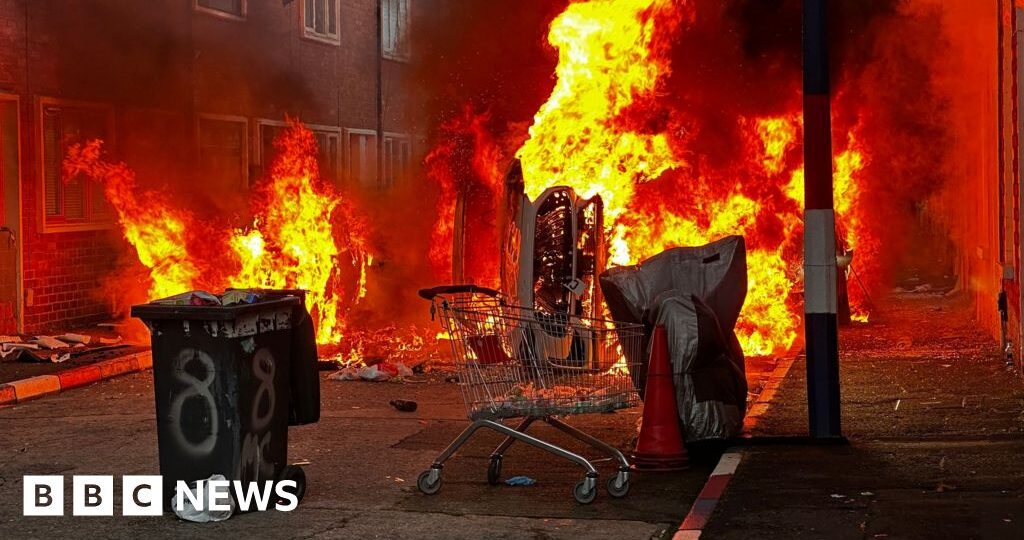
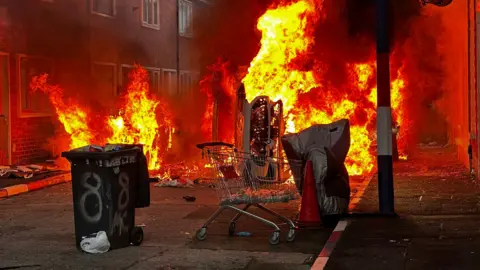
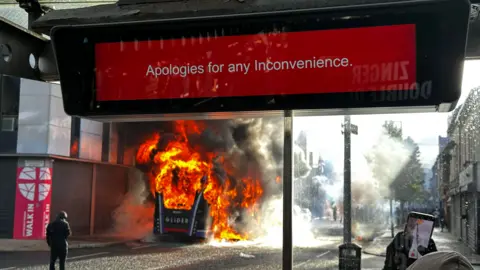
Dozens of young people, masked and dressed in black, are burning bins in the street and thick black smoke fills the air.
The sound of sirens grows louder as fire crews and ambulances arrive.
A woman is shouting through a letterbox to friends inside a house: “The pastor is here, I promise you it is safe.”
This is north Belfast on a rainy Tuesday night, and it is chaos.
The same scenes are playing out in other parts of Northern Ireland, where anti-immigration protests are being held.
Many of them are peaceful but others have been hijacked by people intent on violence and destruction.
I was part of the crew sent to the Crumlin Road, a predominately loyalist and working class part of Belfast, to report on the situation there.
When we arrive, the police are keeping a bit of distance, watching but also trying to avoid becoming a target.
We had been holding back from approaching the trouble until it felt safer, having been told at the other end of this long stretch of road to “leave, or you’ll be next”.
Being a journalist, particularly a BBC journalist, this is nothing new during times of heightened tension.
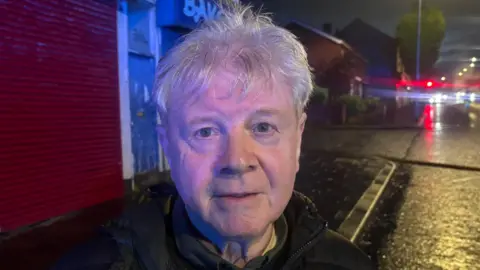
We move up towards the two streets of terraced houses which have become the focal point of the disorder.
Two cars have been set alight, and homes are also burning. There’s real concern about potential injuries, and the risk of a gas explosion.
The torrential rain forces many of those who had gathered to disperse.
Our team is trying not to get in the way, as we step over the fire hoses while also avoiding debris and broken glass.
Fire officers want us to keep a distance, but we need to document what is happening on the streets of Belfast.
I speak to the woman who is shouting through the letterbox of a house with smashed windows. She tells me her friends are inside, and they are trapped, terrified. The house behind theirs is on fire.
A group of African women are led to safety – one of them collapses into the arms of firefighters. The ordeal of the last few hours has taken its toll. She is placed into the back of a waiting car; the others are able to walk to the vehicle.
Pastor Jack McKee, from the nearby New Life City Church, is part of the rescue mission. As he is tending to those members of his congregation he has helped to safety, I take the opportunity to speak to him. He is furious.
“These members have been with us for 20 years. They’ve been put out of their home,” he tells me.
“They are good Christian people and they are getting put out just because they are black.
“You are hurting innocent people here. There are men, women, and children living in fear.
“I am angry. I am disappointed that this is the response of people in our community.”
McKee doesn’t expect them to return to the place they’ve called home for many years.
I have covered disorder in Northern Ireland for more than a decade now, including last summer when rioting erupted in Ballymena.
I have watched the police come under attack, a leisure centre being set on fire, and I have heard racist language used by people of all ages.
This week was the first time I witnessed people fleeing from their homes after being targeted because of their ethnicity.
The disorder was sparked after footage of a knife attack in north Belfast on Monday night was shared widely on social media.
Hadi Alodid, a 30-year-old originally from Sudan, appeared in court on Wednesday charged with attempted murder over the attack which left the victim, Stephen Ogilvie, with serious injuries.
I was also sent to Antrim and Ballymena this week to cover the protests there and it is important to say that they passed off peacefully.
The disorder was restricted to pockets of Belfast and other towns, but the whole of Northern Ireland suffered with schools and shops closing early, and public transport shutting down.
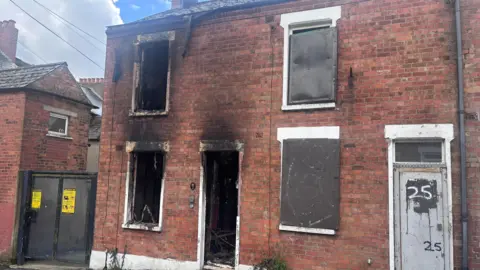
I return to the Crumlin Road on Wednesday – it is quieter but the air is still toxic from all the burning.
An end-of-terrace home has been completely gutted, the ceiling has collapsed and even from a distance, you can hear the water running through this shell of a house.
It became clear to me that only certain houses on these north Belfast streets had been the target of arson and criminal damage.
I knew from colleagues reporting from other parts of the city that masked men had gone door to door, intent on targeting those they believed to be from other countries.
 PA Media
I am invited into the house of an Indian man who has lived in the UK for 25 years; the last four in Northern Ireland.
He apologises for the mess inside, as he packs up his life to leave this place. He was too afraid to let us identify him.
The car outside his home was targeted and he tells me he didn’t sleep on Tuesday night.
“It was horrible, it was like a war zone. Everything was burning,” he said.
“I work full-time. I pay my taxes. I do everything for this country. I am British.”
In the short term, he is not sure what to do. If he and his family stay in the house, he is afraid the rioters will come back, but he is also scared in case they are stopped as they make a run for it.
“We are trying to leave Northern Ireland, to take the ferry to the mainland and hopefully we are safe there as we have friends and family there,” he adds.
“I have never, ever experienced this.”
 Twasul Mohammed
Over the past week, schools have reported fewer pupils attending, as families from ethnic minority communities keep their children at home.
Healthcare staff have been threatened. One nurse was confronted by masked men and chased while she was walking into work.
Her union said she had done nothing wrong apart from having a “different colour of skin” to the majority of people who live in Northern Ireland.
Despite this, the union said, she “bravely” continued with her shift at the hospital.
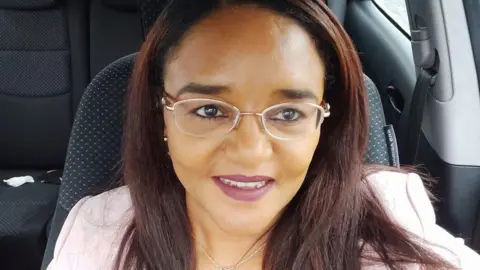
A Sudanese woman who came to Northern Ireland as a refugee in 2016 says her community is “terrified”.
Twasul Mohammed and others have been helping some of the families who were forced out of their homes.
“When the attack happened on Monday night, we knew this would be coming,” she said.
“Everyone is terrified, we are keeping our kids at home. I haven’t sent my kids to school since it happened and everyone is worried and tearful.”
Those responsible for causing this fear, and forcing people out of their homes, may be in their own homes now.
Those victims who do not have a place to call home this weekend are wondering where to go next.
Discover more from NAIRAVOICE.COM.NG
Subscribe to get the latest posts sent to your email.