
This excerpt has been adapted from Finding Renée Richards: The Groundbreaking Story of Tennis’s Trans Pioneer, by Julie Kliegman, and reprinted with permission from HarperOne, an imprint of HarperCollins Publishers. Copyright 2026.
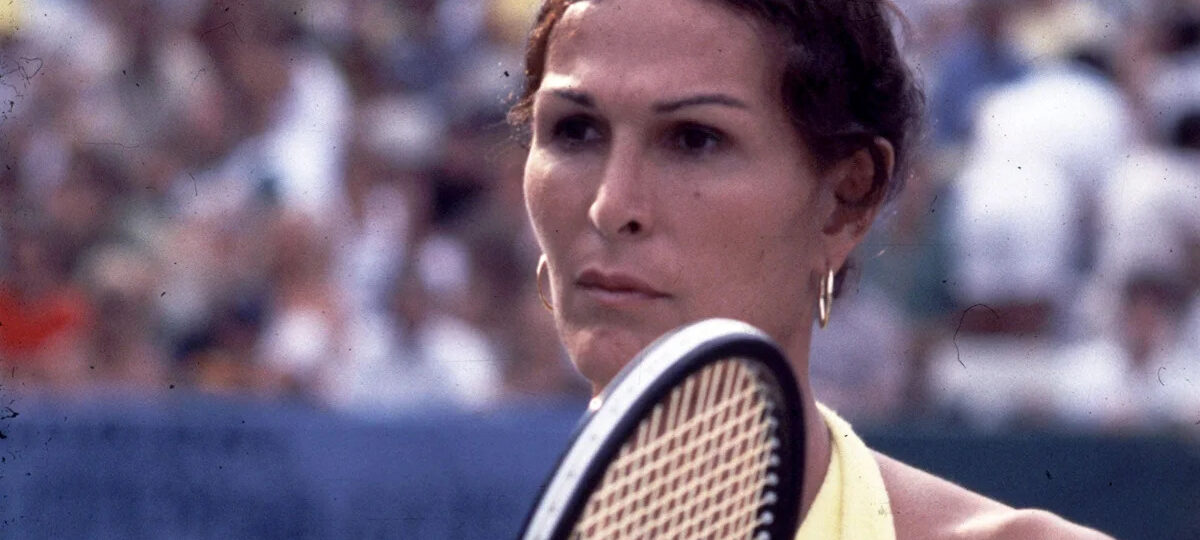
Renée Richards never set out to become a household name. She just wanted to play tennis. This is how she found herself entering the women’s draw of the La Jolla Tennis Tournament Championships in July 1976 under a half-fake identity. Don Rubell, her gynecologist and friend, had warned her that her killer left-handed serve would be recognizable anywhere, even while simply playing for fun at the John Wayne Tennis Club near her new home in Newport Beach, California. “Look, Renée, you look just like a woman who’s had a hysterectomy and no one would know any different,” Richards remembered him saying, “but you go into that big windup on your forehand, there isn’t a tennis player in the country that isn’t gonna know whose it is.” Serves, he continued, are as distinctive as fingerprints.
Richards, then 41, laughed at Rubell’s warning. She had moved across the country six months before the San Diego–area tournament to start a quiet new life for herself, with her new name, Renée, and to continue practicing ophthalmology. But her serve was a dangerous link to her old, pre-sex-change identity, when she lived on the East Coast and ranked as high as sixth nationally in men’s 35-and-over amateur tennis. Despite the risk, Richards simply couldn’t resist the urge to return to competitive sports: “I was like Eve in the Garden of Eden, but with a tennis ball instead of an apple.”
So Richards, posing as 31-year-old “Renée Clark,” arrived in the beachfront town of La Jolla with one mission: to win the mostly unremarkable amateur-circuit tournament on behalf of Wayne’s club, which maintained a fiercely competitive rivalry with the host club. (Today, the event, which began in 1917, is the longest-running tennis tournament to be held uninterrupted at the same venue.) The surname “Clark” may have suggested that Richards was married at the time, but she was single. Though living in stealth, as transsexual people at the time often did, Richards had confided in her local friends, Jack and Sue Geller. “Please, not a word to anyone out there,” she had pleaded to the couple in a coming-out letter just before she moved west. She also assured them: “Don’t be too apprehensive about seeing me—I don’t look all that different—and my personality is just as eccentric as ever.” She stayed with the Gellers during the La Jolla tournament.

“I wasn’t a dummy,” Richards later told the journalist and activist Eleanor Foa Dienstag, who in the late ’70s was working with her on an autobiography. (It would never be published.) “I knew I was playing brinksmanship,” Richards said, even with the name Clark. As she picked off opponent after opponent en route to the championship match, rumors swirled locally about this powerful new force in women’s tennis. Richards was aware of murmurings that she may be a man in disguise. She remembered that Virginia Glass, the chair umpire for the La Jolla semifinal she won over Tammy Redondo, quickly clocked her as a fellow New Yorker but proceeded to call the match as usual. Later, Glass called the Gellers’ house. When Richards answered, Glass persuaded her not to come clean to the public or offer to furnish evidence from her gynecologist. Meanwhile, others advised her to go home and forfeit the final. Richards stood firm: “I was prepared for people to cheer,” she told Dienstag. “I was prepared for people to throw rotten eggs at me.”
La Jolla native, top seed, and reigning champion Robin Harris met Richards in the July 11 final. They happened to arrive for the match wearing the same Sergio Tacchini sweater (Harris’ was periwinkle blue, and Richards’ peach). Harris, then 20, remembered scouting out her opponent’s semifinal from a nearby court. “I was a little intimidated,” Harris told me. “I’m only five-foot-three.” Richards is six-foot-two. Harris felt distracted in the final and that she didn’t play her best. “I didn’t know if she was still a man, or if she—what had gone on,” she said. Richards beat the crowd favorite with ease by a score of 6–1, 6–1.
Harris recalled that club officials pressed her and her parents to file a complaint against Richards, but they chose not to. “We’re not sue-happy,” she said. “That’s not who we are or were.”
Meanwhile, as the rumors and whispers continued to swirl, Richard Carlson, a scoop-hungry, award-winning San Diego broadcast journalist (and the father of eventual conservative pundit and conspiracy theorist Tucker Carlson), was intent on uncovering what he had heard could be the mysterious tennis player’s “true identity.” He began checking into her background and records during the tournament. Then, after Richards returned to her ophthalmology practice the following week, Carlson started calling her with pointed questions about the names she used on her personal documents and professional licenses. Richards remembered evading his queries and telling him several times not to contact her again.
In his fourth call, Carlson—who later said on his broadcast that he had spoken with Richards only twice—opened bluntly. “Isn’t it true, Dr. Richards, that your identity was once that of Dr. Richard Raskind, a prominent ophthalmologist and an amateur tennis player from New York City?”
Richards felt resigned. Carlson must have had her all figured out, including her transition and history of living as a man in New York. “Mr. Carlson,” she responded, “it would be an insult to your intelligence to deny this any further. You certainly have done quite a piece of detective work. Everything you’ve suggested is true, but certainly you can see that this is an extremely personal matter. Please don’t reveal it to the public.”
After more back-and-forth, in which Carlson asserted his right to do his job, Richards made one final, desperate plea: “Mr. Carlson, if you break this story, I will hold you responsible for the result.”
Carlson asked whether this constituted a threat.
“No,” Richards responded. “I just want you to know that you will bear the responsibility for ruining my life.”
“Duly noted,” Carlson said, and he hung up the phone.
On the July 21 local evening news on KFMB-TV, Carlson proceeded to lay out—incorrectly— that “Renée Clark” was really a successful men’s amateur tennis player named Richard Raskind simply masquerading as a woman by the name of Renée Richards.
“The women’s singles final match may go down in tennis history as one of the strangest ever played,” Carlson teased viewers while reporting on site from the La Jolla courts. “Thirty-one-year-old Renée Richards is actually 41-year-old Dr. Richard H. Raskind. He’s a man. Until recently, a New York ophthalmologist.”
Carlson went on to quickly describe how Richards proceeded to pull off what he clearly thought was a caper for accolades and prize money, saying, “He”—in reference to Richards—”donned women’s clothes. He’s been practicing medicine and playing tennis as a woman.”
Carlson then interviewed a couple of tournament attendees who had no idea how to gender Richards or contextualize her victory. “I’ll say this about him or her, the person played well,” one spectator said. “He was a gentleman or a lady, whichever the case may be.” The reporter then picked back up: “It was not until after [Richards] speculated that she might be good enough to beat Chrissie Evert that I told her that I knew she was a man, Richard Raskind.”
The facts of the matter, which Richards would try to bring to light in the days following that initial report from Carlson, were that she was a transsexual woman with the birth name Richard Henry Raskind, and that all she aimed to do was play her beloved sport at a competitive level while maintaining some semblance of privacy. But before Richards could correct the record, Carlson’s report set off a worldwide media circus. Reporters and photographers swarmed Richards outside her apartment back in Newport Beach in the coming days. She was frightened, even as she had public and private support to lean on. Richards found particular backing from her tennis club—many of whose members, she later came to realize, must have known about her trans identity well before it made headlines. They had chosen to swiftly look the other way.
Richards, now in her 90s, is a woman who lives with many regrets. She regrets never having pitched for the New York Yankees. She regrets living so publicly for a time in pursuit of high-level tennis opportunities and accolades. She regrets the “animosity and negativity” she thinks she caused throughout her sport. She does not, however, regret her transition to womanhood itself. Richards wrote in her 2007 book, No Way Renée, “Though I am glad that I stood up for my rights and became an inspiration to many disenfranchised people, I regret many of the effects of that decision.”
For his part, Carlson, who died in 2025 at age 84, never expressed regret, at least publicly, over this particular piece of muckraking. In fact, in a 2021 HBO documentary series about Liz Carmichael, another trans woman he outed in the 1970s, he told the filmmakers, “If you didn’t think [being trans] was kind of sick, you would think Jeffrey Dahmer was a normal person.”
And in 2011, in an interview for Renée, ESPN’s 30 for 30 documentary about Richards, he said, “I have thought that—and I thought then, yeah—you can call yourself a car and you can wear some bumpers and put taillights on your back. It doesn’t make you a car. Chromosomes make you a man or a woman.” (Through a representative, Carlson did not return multiple requests for comment from me in 2024.)
Carlson’s bad-faith, misleading attempt at hard-hitting reportage may not have been the coming-out story Richards had wanted or anticipated, but out she was indeed. She was now inarguably the most prominent transsexual person of the day, taking the mantle from Christine Jorgensen, the U.S. Army veteran turned actor and singer who had famously undergone a series of sex-reassignment surgeries abroad beginning in 1951. While Richards was far too strong-willed to let one man ruin her, she understood that her life as she knew it had already changed forever.
Discover more from NAIRAVOICE.COM.NG
Subscribe to get the latest posts sent to your email.